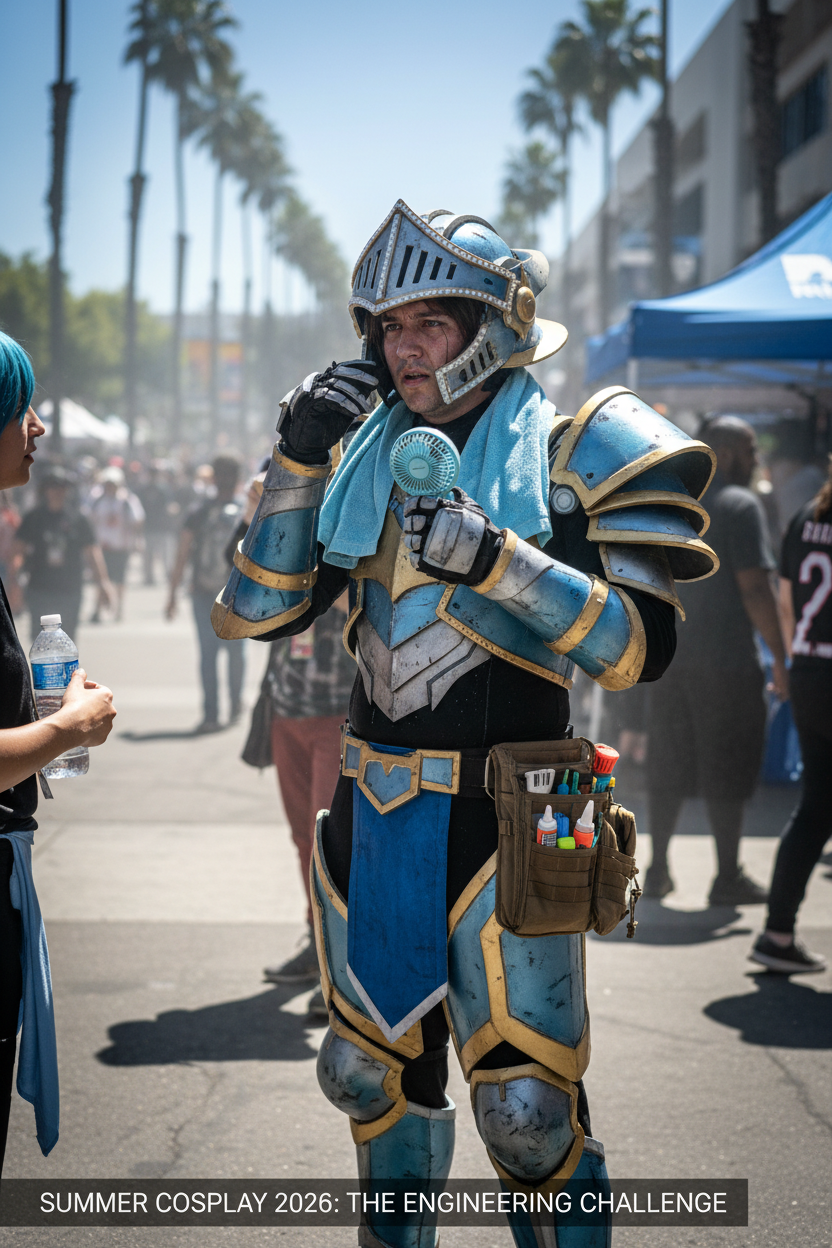
Summer convention season has always created a difficult contradiction for cosplayers.
You want the costume to look impressive.
But you also have to survive wearing it.
That problem became particularly visible at San Diego Comic-Con 2026, where Reuters reported on cosplayers dealing with summer heat, elaborate costumes, and unexpected costume failures. The report noted that heat could soften glue and cause costume pieces to fall apart, while fabric could rip or tear after months of preparation.
The problem goes beyond comfort.
Heat can affect:
- Adhesives
- Foam
- Fabric
- Wig styling
- Makeup
- Electronics
- Armor
- Straps
- Fasteners
- Body temperature
- Overall costume durability
At the same convention, a volunteer dressed as Fix-it Felix carried a roughly 15-pound repair backpack containing items ranging from superglue and duct tape to safety pins, soldering equipment, and a hot glue gun to help repair damaged costumes.
That makes one thing clear:
Summer cosplay is becoming a costume-engineering problem.
So how should cosplayers approach heat-proof cosplay in 2026?
1. Why Is Summer Convention Cosplay So Difficult in Hot Weather?
Direct Answer
Summer cosplay is difficult because elaborate costumes can trap heat, restrict airflow, add weight, and place additional stress on adhesives, fabrics, wigs, and electronics. The safest approach is to design ventilation and lightweight construction into the costume from the beginning.
A costume that works perfectly inside a cool room may behave very differently after several hours at a crowded summer convention.
The challenge comes from multiple factors working together.
Heat from the environment
Outdoor convention lines can expose cosplayers to direct sunlight and high temperatures.
Even when the main convention floor is air-conditioned, you may still spend time:
- Walking outside
- Waiting in lines
- Crossing between buildings
- Taking outdoor photos
- Waiting for transportation
- Standing in crowded areas
This makes hot weather cosplay fundamentally different from indoor cosplay.
Heat generated by your own body
Your body continuously produces heat.
A costume can make it harder for that heat to escape.
This is especially noticeable with:
- Full-body suits
- Heavy armor
- Wigs
- Masks
- Cloaks
- Thick synthetic fabrics
- Foam bodysuits
- Multiple layers
The costume does not have to be extremely heavy to become uncomfortable.
Even a relatively lightweight costume can feel exhausting if airflow is poor.
Heat plus movement
Cosplay is rarely static.
At a convention you may walk several miles without realizing it.
You may also:
- Pose for photos
- Climb stairs
- Stand in lines
- Dance
- Attend panels
- Carry props
- Move between buildings
A costume that feels comfortable for 20 minutes may become uncomfortable after four hours.
That is why comfortable cosplay costumes should be evaluated based on the entire convention day, not simply the first fitting.
2. Which Fabrics Are Best for Hot-Weather Cosplay?
Direct Answer
The best breathable cosplay fabrics are generally lightweight materials that allow moisture and heat to escape. Depending on the character, options such as lightweight cotton, linen blends, mesh, performance fabrics, and breathable lining can reduce heat buildup compared with thick, non-breathable synthetics.
Fabric choice is one of the easiest places to improve a summer costume.
But the “best” fabric depends on what you are trying to recreate.
Lightweight Cotton
Cotton can be useful for casual or everyday-style cosplay.
Advantages include:
- Familiar feel
- Relatively breathable
- Easy to sew
- Widely available
- Comfortable against the skin
However, cotton can absorb sweat and remain wet for longer.
For extremely hot conditions, a moisture-managing performance fabric may sometimes be more practical.
Linen and Linen Blends
Linen is naturally associated with warm-weather clothing because of its lightweight structure and airflow.
It can work particularly well for:
- Historical-inspired cosplay
- Fantasy costumes
- Casual character designs
- Loose shirts
- Dresses
- Capes
- Trousers
Its slightly textured appearance can also work beautifully for costumes that do not require perfectly smooth surfaces.
Mesh
Mesh can be extremely useful when incorporated strategically.
You do not necessarily need visible mesh everywhere.
Instead, hide breathable mesh in areas such as:
- Underarms
- Side panels
- Back panels
- Inside armor
- Helmet vents
- Costume lining
This creates airflow without dramatically changing the exterior appearance.
Performance Fabrics
Modern athletic fabrics can be useful for costumes requiring extensive movement.
They can help manage:
- Sweat
- Moisture
- Stretch
- Body movement
This is especially useful for:
- Bodysuits
- Superhero cosplay
- Dance-heavy costumes
- Character performance
- Full-day convention wear
The important principle is simple:
Do not automatically choose the fabric that looks most accurate if it makes the costume impossible to wear.
A slightly different fabric that keeps you comfortable may produce a better overall result because you can actually wear the costume for the entire event.
3. How Can Cosplayers Make Armor Lighter and More Breathable?
Direct Answer
Use lightweight materials such as EVA foam, thin thermoplastics, lightweight plastics, and hollow or simplified structures instead of unnecessarily dense construction. Add ventilation openings and avoid covering areas that do not need rigid protection.
Armor is one of the biggest challenges in summer cosplay.
A visually impressive armor set can become a portable heat trap.
That does not mean you need to eliminate armor.
It means you should rethink where the weight and material are actually necessary.
Use Lightweight Armor Materials
Lightweight cosplay armor can often be constructed from materials such as EVA foam.
Foam allows you to create:
- Shoulder armor
- Chest pieces
- Bracers
- Belts
- Helmets
- Decorative panels
- Large silhouettes
without making the costume unnecessarily heavy.
For larger armor pieces, consider whether the internal structure actually needs to be solid.
A hollow structure can sometimes provide the visual volume you need without adding unnecessary weight.
Remove Hidden Material
Ask yourself:
“Does this material contribute to the appearance?”
If the answer is no, consider removing it.
This is particularly useful inside:
- Shoulder pieces
- Helmets
- Large props
- Chest armor
- Back armor
You can often reduce weight dramatically by simplifying the interior while preserving the exterior silhouette.
Add Ventilation
Ventilation should be planned during construction.
Possible locations include:
- Under the arms
- Along the sides
- Behind armor panels
- Inside helmets
- Along the back
- Beneath capes
- Around waist areas
The best ventilation is often invisible.
From the outside, the costume remains visually accurate.
Inside, air can circulate.
4. Can Heat Affect Cosplay Adhesives?
Direct Answer
Yes. Heat can affect some adhesives, especially when a costume relies heavily on hot glue or adhesive-backed fasteners. Reuters specifically reported that high temperatures at SDCC 2026 could soften glue and cause costume pieces to separate.
This is one of the most important lessons from the 2026 convention season.
A costume can be structurally sound in your home and fail at the convention.
Why?
Because temperature changes the conditions under which your adhesive is operating.
Why Hot Glue Can Become a Problem
Hot glue is popular because it is:
- Cheap
- Fast
- Easy to apply
- Beginner-friendly
But it should not automatically be treated as the strongest solution for every costume component.
If a structural part experiences:
- Heat
- Movement
- Pulling
- Sweat
- Repeated impact
the bond may eventually fail.
That does not mean hot glue has no place in cosplay.
It simply means you should understand what the adhesive is being asked to do.
Use Mechanical Reinforcement
For important structural areas, consider combining adhesive with:
- Sewing
- Rivets
- Elastic
- Velcro
- Snaps
- Straps
- Reinforcing fabric
- Mechanical fasteners
Think of adhesive as one part of the construction system, rather than the entire system.
This becomes particularly important for:
- Armor straps
- Shoulder pieces
- Large props
- Heavy accessories
- Costume closures
Test Before the Convention
One of the best ways to prevent a costume failure is simple:
Test it under realistic conditions.
Wear the costume for several hours.
Walk around.
Sit down.
Climb stairs.
Move your arms.
Take photos.
Then inspect the costume.
If something starts loosening during your test, it is much better to discover the problem at home than at a convention.
5. Do Cooling Systems for Cosplay Actually Help?
Direct Answer
Cooling systems can help reduce discomfort in demanding costumes, particularly full-body suits, helmets, armor, and costumes with limited airflow. Their effectiveness depends on the design, power source, ventilation, and duration of use.
This is where cosplay begins to resemble wearable technology.
Simple cooling solutions can include:
- Portable fans
- USB fans
- Ventilation fans inside helmets
- Cooling towels
- Ice packs
- Hydration packs
- Battery-powered ventilation
More advanced builds can incorporate active cooling into helmets or armor.
Helmet Ventilation
Helmets are especially challenging.
They can trap:
- Heat
- Moisture
- Breath
- Sweat
A small fan positioned to move air through the helmet can make a significant difference.
The key is airflow.
A fan that simply moves hot air around inside a sealed helmet is less useful than a system designed with:
air intake → airflow → exhaust
in mind.
Battery Management
If you use powered cooling systems, remember that batteries introduce another design requirement.
Before the convention, test:
- Battery life
- Fan speed
- Cable placement
- Switch accessibility
- Heat generated by electronics
- Recharge requirements
Do not discover that your cooling system lasts only two hours after arriving at an all-day convention.
6. How Can You Prevent Costume Malfunctions at a Summer Convention?
Direct Answer
The best way to prevent summer costume malfunctions is to combine realistic pre-convention testing, stronger structural reinforcement, lightweight materials, breathable construction, and an emergency repair kit. You should assume that something may eventually need adjustment.
SDCC 2026 demonstrated why this matters.
Reuters reported both heat-related material failures and the presence of a dedicated volunteer carrying a large cosplay repair kit.
The San Diego Public Library also operated a Cosplay Repair Station during Comic-Con 2026, offering tools and supplies including sewing equipment, 3D printers, laser cutters, soldering irons, safety pins, adhesives, tape, and wig supplies.
That tells us something important:
Emergency cosplay repair is becoming part of the convention ecosystem.
But you should still prepare your own kit.
Build a Summer Convention Repair Kit
A compact emergency kit could include:
- Safety pins
- Double-sided tape
- Fabric tape
- Strong adhesive
- Small scissors
- Needle and thread
- Extra elastic
- Hair ties
- Bobby pins
- Velcro
- Spare buttons
- Spare straps
- Small zip ties
- Mini sewing kit
For electronic costumes, consider carrying:
- Spare batteries
- Charging cable
- Power bank
- Electrical tape
The exact contents depend on your costume.
Bring Spare Parts
This is one of the easiest improvements.
If your costume uses a specific:
- Button
- Strap
- Buckle
- Wig accessory
- Elastic component
- Decorative piece
bring a spare.
A five-dollar replacement part can save a costume that took months to create.
7. Is Heat-Proof Cosplay Really About Materials?
Not entirely.
This may be the most important lesson.
Heat-proof cosplay is fundamentally about design decisions.
You can buy the most advanced cooling equipment in the world and still have an uncomfortable costume if the underlying design traps heat.
Think about the costume as a system.
Layer 1: Skin
What touches your body?
Choose comfortable, breathable materials.
Layer 2: Clothing
Can air circulate?
Can sweat escape?
Layer 3: Armor
Does the armor need to cover the entire area?
Can it be lighter?
Can it be ventilated?
Layer 4: Accessories
Are they adding unnecessary weight?
Layer 5: Electronics
Can batteries and wiring be safely positioned?
Layer 6: Environment
Will you be outside?
Will you stand in line?
Will you walk several miles?
The best summer convention cosplay takes all six layers into account.
What 2026 Is Teaching Cosplayers About Costume Design
The SDCC 2026 experience is revealing a broader shift in cosplay.
For years, costume discussions often focused on:
- Accuracy
- Craftsmanship
- Materials
- Visual impact
- Photography
Now another question is becoming increasingly important:
Can you actually wear the costume comfortably?
That changes the definition of a successful cosplay.
A costume that looks incredible for five minutes but becomes unbearable after an hour may not be as successful as a slightly simplified costume that you can wear throughout the entire convention.
Reuters' SDCC report captures this tension particularly well: cosplayers invested months and hundreds of dollars into elaborate costumes, yet still had to contend with heat and unexpected failures once those costumes entered the real convention environment.
This creates a new design priority:
Performance under real-world conditions.
A Practical Heat-Proof Cosplay Checklist
Before taking your costume to a summer convention, ask:
Materials
- Is the main fabric breathable?
- Is the armor unnecessarily heavy?
- Are the adhesives appropriate for the application?
- Are important structural areas reinforced?
Ventilation
- Can air move through the costume?
- Is the helmet ventilated?
- Are there hidden mesh panels?
- Can trapped heat escape?
Comfort
- Can you sit down?
- Can you walk comfortably?
- Can you use the bathroom?
- Can you drink water easily?
- Can you wear the costume for several hours?
Durability
- Have you tested the costume?
- Have you stressed the straps?
- Have you tested adhesives?
- Have you checked seams?
Emergency Preparation
- Do you have a repair kit?
- Do you have spare batteries?
- Do you have replacement straps?
- Do you have a backup plan?
The goal is not to make your costume indestructible.
The goal is to make failure manageable.
Conclusion: The Future of Cosplay May Be Designed for the Person Wearing It
Heat-proof cosplay may sound like a niche problem.
But it represents a much larger change in costume design.
As conventions continue to take place during warm-weather months, cosplayers are being forced to think beyond appearance.
The next generation of cosplay design increasingly has to balance:
Accuracy + Comfort + Durability + Mobility + Safety
SDCC 2026 provided a very visible example of why that balance matters. Reuters documented heat-related costume failures, while repair volunteers and the San Diego Public Library's repair station helped cosplayers deal with everything from loose pieces and damaged straps to electronics and wig problems.
That suggests a useful new philosophy for comfortable cosplay costumes:
Design for the convention, not just the photograph.
A costume needs to survive the walk to the venue.
It needs to survive the crowd.
It needs to survive hours of movement.
It needs to survive heat.
And, ideally, it needs to survive long enough for you to actually enjoy wearing it.
That is why heat-proof cosplay is becoming more than a summer convenience.
It is becoming a genuine costume-design challenge—and potentially one of the most important areas of innovation in modern cosplay.


Hinterlasse einen Kommentar
Diese Website ist durch hCaptcha geschützt und es gelten die allgemeinen Geschäftsbedingungen und Datenschutzbestimmungen von hCaptcha.