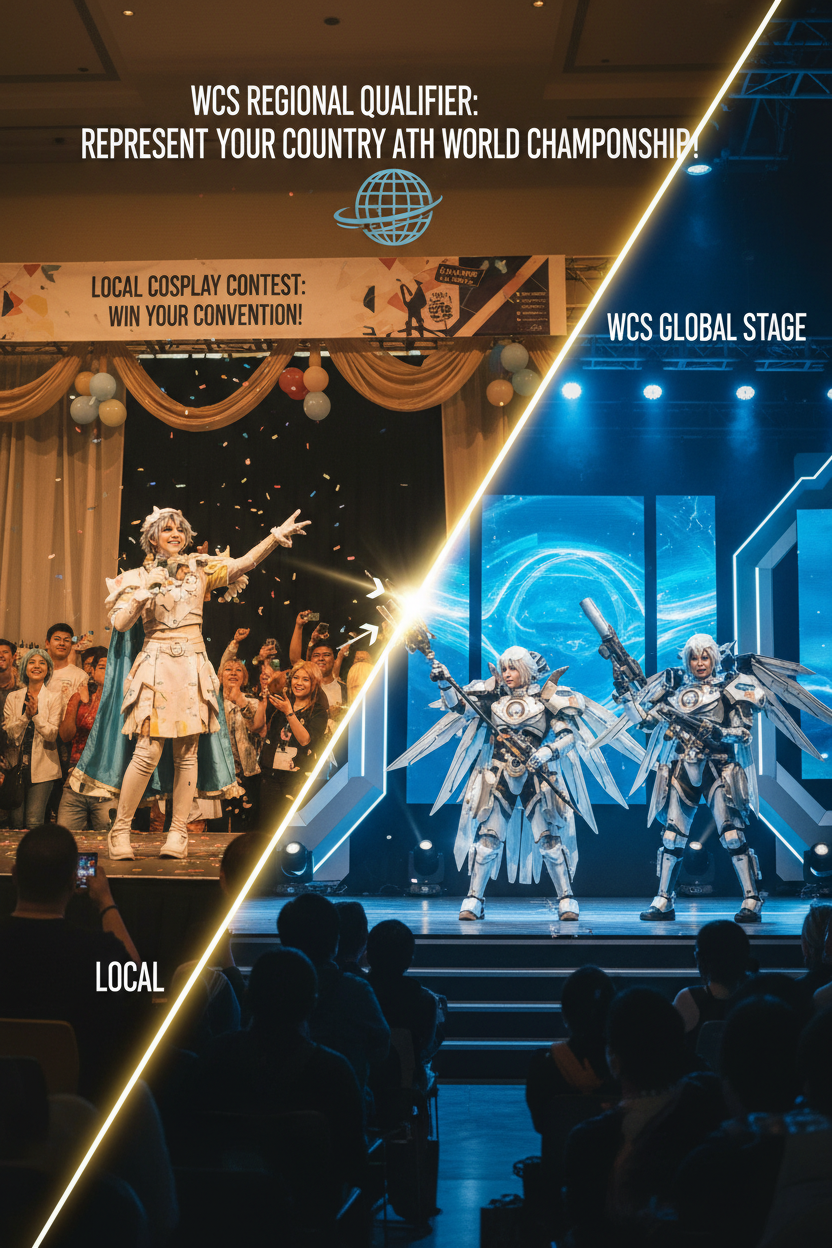
Local Cosplay Contest vs. WCS Regional Qualifier: The Quick Verdict
If you simply want to experience competitive cosplay, meet other cosplayers, and test your costume on stage, a regular cosplay contest is usually the easier place to start.
If your goal is to represent your country or region on an international stage, a World Cosplay Summit regional qualifier is a completely different level of commitment.
| Regular Cosplay Contest | WCS Regional Qualifier | |
|---|---|---|
| Main purpose | Local competition | Selection for WCS |
| Competition level | Local / event-based | International pathway |
| Typical goal | Win a prize/title | Earn representative status |
| Costume expectations | Vary by event | High craftsmanship emphasis |
| Performance | Often important | Highly important |
| Craftsmanship | Depends on category | Major consideration |
| Team format | Varies | Often country/region-specific |
| International pathway | Usually none | Yes |
| Preparation | Moderate to high | High |
| Travel implications | Usually local | Potential international travel |
| Best for | New & experienced competitors | Advanced competitors |
The distinction is becoming increasingly important because WCS is expanding its network of regional and national selection events.
For WCS 2026, the official schedule includes qualifiers connected to events such as AnimeCon in the Netherlands, Comic Con Cape Town, SMASH in Australia, Ani-Com & Games Hong Kong, Otakuthon in Canada, MCM London Comic Con, and many others.
Chapter 1: What Is a World Cosplay Summit Regional Qualifier?
The World Cosplay Summit, or WCS, is an international cosplay event centered around the World Cosplay Championship.
The basic structure is relatively straightforward:
Regional/National Qualifier
↓
Selected Representative Team
↓
World Cosplay Championship
↓
International Competition
WCS describes its championship as a stage where representatives who have passed competitions in their respective countries and regions gather in Nagoya to compete for the world championship.
For 2026, the championship brought together representatives from 41 countries and regions, demonstrating how much broader the competition has become.
This changes the meaning of a local contest.
Instead of:
“I am competing at my local convention.”
the competitor may effectively be competing for:
“I could represent my region at an international championship.”
That creates a much stronger incentive for experienced cosplayers.
Chapter 2: The Biggest Difference — Local Competition vs. International Pipeline
A regular cosplay competition usually ends when the event ends.
You compete.
You receive a ranking or award.
You go home.
A WCS qualifier has another layer.
Regular Contest
Contest → Award → End
Regional Qualifier
Qualifier → Representative → International Championship
That second structure is what makes WCS particularly interesting from a cosplay-culture perspective.
The local event becomes part of a larger international system.
Hong Kong Is a Good Example
Hong Kong provides one of the clearest recent examples.
WCS officially announced in April 2025 that Hong Kong would join the World Cosplay Summit starting with a new preliminary event in 2026.
The 2025 Ani-Com & Games Hong Kong event subsequently served as the selection competition for the 2026 championship. WCS lists the event as the Hong Kong preliminary round and identifies the selected contestants.
ACGHK's own 2026 activities page now lists its two-person cosplay competition as the World Cosplay Summit 2026 Hong Kong preliminary.
That is exactly what a “global pipeline” looks like:
Local Convention
↓
Regional Competition
↓
Hong Kong Representative
↓
Japan
↓
World Cosplay Championship
And the incentive is not merely symbolic.
The 2025 ACGHK competition materials stated that the winning pair would receive flights and hotel support to travel to Nagoya as Hong Kong's representatives.
Chapter 3: Competition Judging — What Changes?
One of the biggest differences between a standard contest and a WCS cosplay competition is the level of scrutiny.
A regular contest may have several judging categories.
For example:
- Costume accuracy
- Creativity
- Performance
- Craftsmanship
- Audience appeal
But international-level competitions have to evaluate something more comprehensive.
WCS 2026 itself demonstrates this through its special awards, which included categories for:
- Sewing costume
- Costume construction
- Wig
- Action
- Drama
- Sound
- Enjoyment
among others.
That tells you something important.
WCS isn't simply looking for:
“Who looks most like the character?”
It can reward multiple dimensions of cosplay.
Chapter 4: Dimension One — Craftsmanship
For a regular cosplay contest, craftsmanship requirements vary dramatically.
One convention may prioritize performance.
Another may prioritize costume construction.
Another may have beginner and advanced categories.
A WCS-level qualifier is different because the costume may eventually be evaluated against competitors from around the world.
That raises the importance of:
- Construction quality
- Fabric selection
- Armor work
- Prop construction
- Wig styling
- Finishing
- Structural accuracy
- Original techniques
The difference isn't necessarily that every WCS costume must be handmade from raw materials.
The difference is that craftsmanship becomes much harder to ignore when you're competing for international representation.
Chapter 5: Dimension Two — Performance
A common mistake is assuming that an amazing costume automatically makes an amazing competition entry.
It doesn't.
Cosplay is not only visual.
It is also performance.
Imagine two competitors.
Competitor A
Beautiful costume.
Perfect wig.
Excellent armor.
But they walk onto stage, stand still, pose once, and leave.
Competitor B
Slightly less technically perfect costume.
But their:
- Character acting
- Movement
- Timing
- Music
- Storytelling
- Stage presence
are exceptional.
Who is more memorable?
That question becomes extremely important at higher-level competitions.
The 2026 WCS results reinforce this broader evaluation approach: special awards included Action, Dramatic, and Best Sound, alongside costume-related awards.
So cosplay competition preparation needs to include much more than sewing.
Chapter 6: Dimension Three — Teamwork
This is another major difference.
Many local cosplay contests allow:
- Solo
- Duo
- Groups
depending on the event.
But WCS operates through representative teams, and its championship is built around country and regional representatives.
That means duo competitors need to think about:
- Costume consistency
- Character chemistry
- Stage blocking
- Shared storytelling
- Timing
- Music
- Props
- Transitions
A strong individual cosplayer does not automatically make a strong competitive pair.
The team needs to function as one performance.
Chapter 7: Dimension Four — International Readiness
This is something a regular cosplay contest usually doesn't require.
Winning a local contest might mean:
“You won this weekend.”
Winning a WCS qualifier can mean:
“You are now representing your country or region.”
That changes the psychological pressure.
You may have to think about:
- International travel
- Costume transportation
- Repairs
- Props
- Documentation
- Stage rehearsals
- Time zones
- Communication
- International audiences
The costume has to survive not only the competition.
It may need to survive an international journey.
Chapter 8: Cosplay Competition Preparation — What Should You Build First?
If you are considering a regional cosplay qualifier, don't begin by asking:
“What character should I cosplay?”
Start with:
“What kind of competitor am I?”
Are you strongest at:
- Sewing?
- Armor?
- Props?
- Wig styling?
- Makeup?
- Performance?
- Storytelling?
- Character acting?
Then choose a character that allows those strengths to become visible.
Build Around Your Strengths
If you're strongest at sewing
Choose a character with:
- Complex garments
- Layered fabrics
- Tailoring
- Embroidery
- Decorative details
If you're strongest at armor
Choose:
- Mechanical characters
- Warriors
- Fantasy armor
- Large props
If you're strongest at performance
Choose a character with:
- Strong personality
- Emotional scenes
- Action sequences
- Recognizable mannerisms
The best competition costume isn't necessarily the most complicated costume.
It is the costume that gives your strongest skills somewhere to shine.
Chapter 9: What Does It Take to Qualify for World Cosplay Summit?
The exact requirements vary by country and region.
That is extremely important.
There is no single universal “WCS application” process where every competitor submits directly to Japan.
Instead, WCS uses regional and national selection events.
The official 2026 schedule shows just how varied these pathways are. Different regions use different conventions and events as their selection competitions.
So if you're searching how to qualify for World Cosplay Summit, the first step is:
Step 1
Find the official WCS selection event for your country or region.
Step 2
Read that event's specific rules.
Step 3
Check:
- Eligibility
- Team requirements
- Costume rules
- Performance rules
- Registration deadline
- Required documentation
- Prize/support structure
Step 4
Build your competition entry around those rules.
Step 5
Prepare for both judging and stage performance.
Chapter 10: Should You Enter a Regular Cosplay Contest First?
For most competitors, yes.
A local cosplay contest can be an extremely useful training ground.
It lets you learn:
- How judging works
- How to prepare a costume
- How to manage stage anxiety
- How to perform
- How to explain your construction process
- How to handle last-minute repairs
- How to work with stage staff
You don't have to win.
The experience itself is valuable.
Think of smaller contests as:
Practice Matches
and regional qualifiers as:
Championship Qualifiers
You don't necessarily need to jump directly to the highest level.
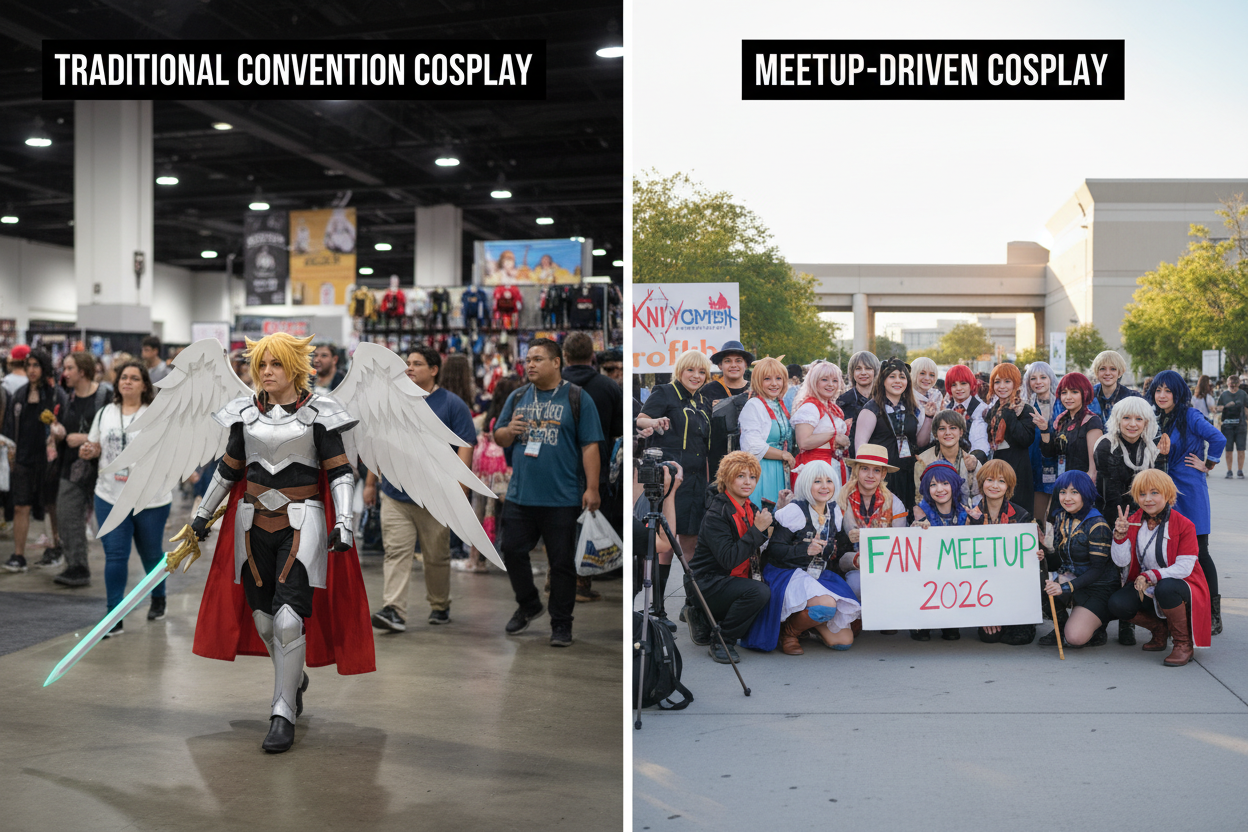
Chapter 11: Competition-Ready Cosplay Costumes vs. Regular Convention Cosplay
This distinction matters for product selection as well.
A normal convention cosplay might prioritize:
- Comfort
- Appearance
- Price
- Ease of wearing
A competition-ready cosplay costume needs to consider:
- Construction quality
- Structural durability
- Movement
- Stage visibility
- Character accuracy
- Performance requirements
- Repairability
That doesn't mean a commercially purchased costume cannot be used in competitive cosplay.
But competitors should always check the rules first.
Some competitions have specific requirements concerning construction and originality.
Chapter 12: WCS Qualifier vs. Regular Cosplay Contest — Which One Should You Choose?
Choose a Regular Cosplay Contest If:
You are:
- New to competitive cosplay
- Still learning stage performance
- Testing your first serious costume
- Interested in local community events
- Not ready for international travel
A regular contest gives you room to experiment.
Choose a WCS Regional Qualifier If:
You are:
- Already experienced with cosplay
- Comfortable performing on stage
- Confident in costume construction
- Interested in international competition
- Prepared to compete as a team
- Willing to invest substantial preparation time
This isn't necessarily “better.”
It's simply a different objective.
Chapter 13: Which Is Better for Your Goals?
| Your Goal | Better Choice |
|---|---|
| First competition | Regular cosplay contest |
| Learn stage performance | Regular contest |
| Test a new costume | Regular contest |
| Build competition experience | Both |
| Compete internationally | WCS regional qualifier |
| Represent your country/region | WCS regional qualifier |
| Focus on craftsmanship | WCS qualifier |
| Build a competitive portfolio | WCS qualifier |
| Meet local cosplayers | Regular contest |
| International exposure | WCS qualifier |
The best path for many cosplayers is actually:
Local Contest → More Experience → Regional Qualifier → International Competition
rather than attempting the final stage immediately.
FAQ
What is a World Cosplay Summit regional qualifier?
A World Cosplay Summit regional qualifier is a designated competition used to select a country's or region's representative team for the World Cosplay Championship. WCS's official 2026 schedule lists numerous selection events around the world.
How do you qualify for World Cosplay Summit?
You generally need to enter the official WCS selection competition associated with your country or region and win or otherwise qualify according to that event's rules. The exact eligibility and competition format varies by region.
Is WCS harder than a regular cosplay contest?
Generally, yes, because the qualifier is connected to an international championship and the selected competitors may represent their region or country. However, difficulty varies by local contest and qualifier.
What do judges look for in a cosplay competition?
Criteria vary, but craftsmanship, character interpretation, performance, creativity, costume construction, and stage presence can all matter. WCS 2026's special awards illustrate the breadth of categories that can be recognized.
Can beginners enter a WCS qualifier?
Potentially, depending on the regional rules. However, because the competition leads toward an international championship, beginners may benefit from gaining experience through local cosplay regional competitions first.
Does WCS only judge costume accuracy?
No. The 2026 championship included special recognition for action, dramatic performance, sewing, construction, wigs, sound, enjoyment, and other areas.
Why are regional cosplay competitions becoming more important?
Because some are no longer isolated local events. They can function as selection points in an international competition network. WCS's 2026 schedule demonstrates this expanding structure across multiple countries and regions.
Conclusion: Your Local Cosplay Contest Could Be the First Step
The most interesting thing about the growth of World Cosplay Summit regional qualifier events is not simply that there are more competitions.
It is that the relationship between local cosplay culture and international competition is changing.
A convention contest used to be mostly about:
Winning your convention.
Now, for some competitors, it can become:
Winning your region → representing your country → competing internationally.
Hong Kong provides a particularly clear example. ACGHK's partnership with WCS transformed its two-person cosplay competition into a direct selection event for the international championship, and the WCS 2026 championship ultimately included 41 national and regional teams.
That means serious competitors should start looking at local competitions differently.
Your next cosplay contest might not simply be another weekend activity.
It could be:
Practice → Qualification → Representation → International Competition
If your goal is to take that route, start preparing earlier.
Study the rules.
Watch previous competitions.
Practice stage performance.
Build costumes that can survive movement and travel.
Document your craftsmanship.
And most importantly, treat cosplay competition preparation as a complete project rather than something that begins one week before the convention.
For competitors ready to move beyond casual convention cosplay, investing in competition-ready cosplay costumes and craftsmanship-grade cosplay materials can also make sense—but always check the specific qualifier's rules before purchasing or constructing your entry.
The global cosplay stage may be much closer than you think.
Sometimes, the road to Nagoya begins at the convention center in your own city.

Hinterlasse einen Kommentar
Diese Website ist durch hCaptcha geschützt und es gelten die allgemeinen Geschäftsbedingungen und Datenschutzbestimmungen von hCaptcha.