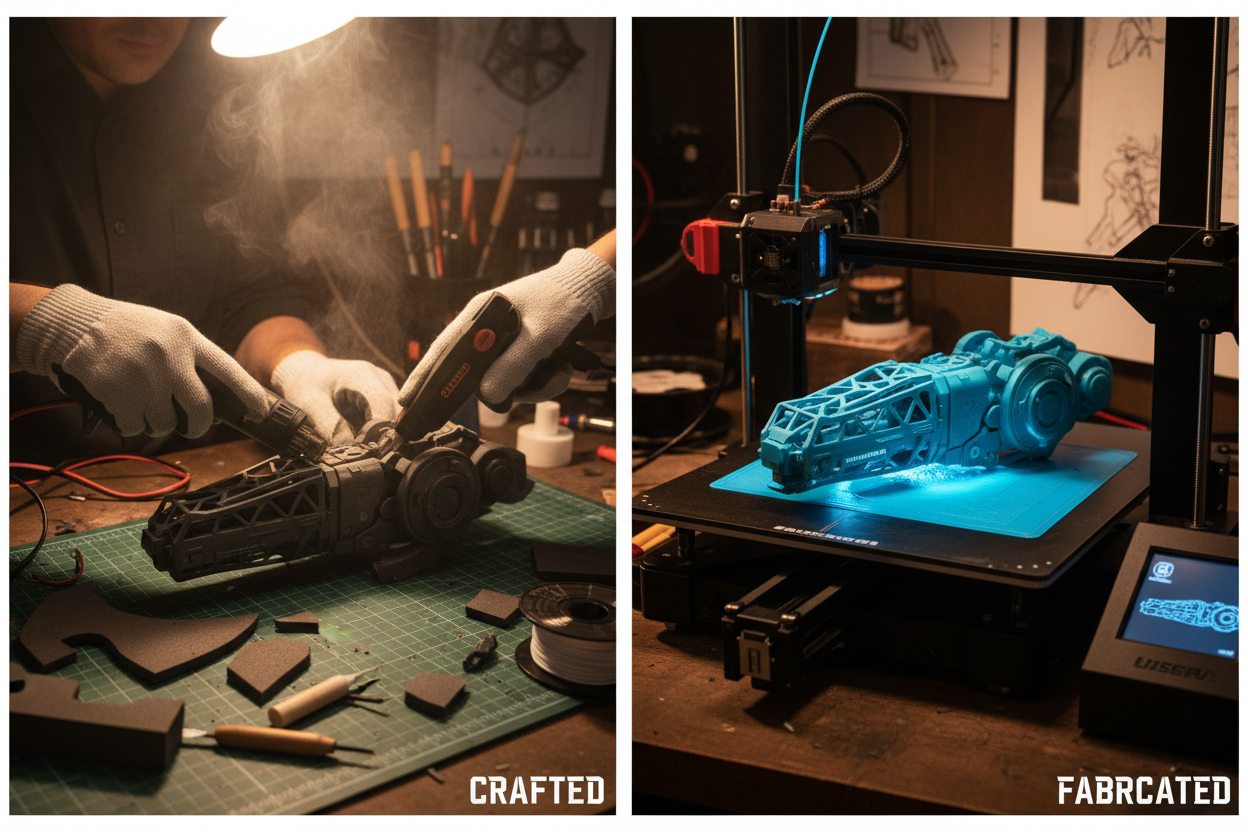
Wuthering Waves characters like Yinlin and Changli are built around intricate, mechanical, streamlined weapon and armor designs that push prop-makers toward increasingly advanced fabrication methods — and that's put a real, ongoing debate back in the spotlight across cosplay competition communities on Reddit and YouTube:
Should a purchased, downloaded 3D print file count the same as a piece cut and sculpted from EVA foam over hundreds of hours?
It's not just online arguing, either — major conventions have genuinely updated their masquerade and craftsmanship judging rules in response, with several now requiring competitors to disclose 3D-printing methods, credit original file creators, and, in some cases, cap how much of a costume can come from purchased or unmodified pre-made pieces.
This roundup breaks down seven real prop-making approaches for a Wuthering Waves build, evaluated against three criteria: how well each method actually performs for complex mechanical designs, what it typically costs in time and money, and — importantly — how each one is treated under current, real convention competition rules.
Quick Comparison
| Method | Best For | Cost | Competition Standing (2026 Rules) |
| Hand-Carved EVA Foam | Traditional craftsmanship purists | $30–$100 in materials | Fully eligible for all craftsmanship categories |
| Worbla/Thermoplastic Sculpting | Detailed, durable armor pieces | $60–$180 | Fully eligible, widely respected technique |
| Self-Modeled 3D Printing | Complex mechanical geometry, tech-savvy builders | $50–$300+ (printer/filament) | Scores highly — judged as an advanced technique when self-designed |
| Purchased File, Self-Finished | Builders who want print precision without modeling skills | $20–$80 per file + finishing materials | Eligible with mandatory credit/disclosure; scored differently than self-modeled |
| Fully Purchased, Pre-Finished Print | Personal wear, no competition intent | $50–$250+ | Generally excluded from top craftsmanship awards |
| Resin Casting/Molding | Duplicating detailed props at scale | $80–$200+ in materials/tools | Fully eligible, respected traditional-adjacent technique |
| Hybrid (Traditional Shell + 3D Printed Details) | Balancing realism with efficiency | $50–$200 | Fully eligible if self-modeled portions are disclosed |
1. Hand-Carved EVA Foam
-
Core highlight: Cutting, heat-shaping, and layering EVA foam by hand remains the most universally respected and accessible traditional prop-making method, and it's fully eligible across every major convention's craftsmanship category without any disclosure requirements or scoring caveats.
-
Pros: Low material cost, no specialized equipment required beyond basic tools, and it's a technique judges are trained to evaluate closely — meaning skilled foam work is genuinely recognized and rewarded in craftsmanship judging.
-
Cons: Time-intensive, and achieving the ultra-smooth, precise mechanical curves in designs like Yinlin's weapon is genuinely harder with foam than with a 3D-printed or molded approach.
-
Best for: Cosplayers competing specifically in traditional craftsmanship categories, or anyone who values the hands-on process as much as the finished result.
2. Worbla or Thermoplastic Sculpting
-
Core highlight: Worbla and similar thermoplastics let you achieve sharper detail and more durable, armor-like finishes than foam alone, and — like foam work — it's a well-established, fully respected traditional technique with no competition eligibility concerns.
-
Pros: Excellent for durable, con-worn pieces that need to survive a full day of handling; achieves crisper detail than foam for panel lines and mechanical edges.
-
Cons: More expensive than foam and has a steeper initial learning curve for heat-shaping technique.
-
Best for: Builders who've outgrown basic foam work and want more precision and durability for armor-heavy designs.
3. Self-Modeled 3D Printing
-
Core highlight: Designing your own 3D model from scratch and printing it yourself is increasingly treated by major competitions as a legitimate advanced technique on par with traditional sculpting — several 2026 convention rulebooks explicitly score self-modeled prints more favorably than purchased ones, provided you can document your modeling process.
-
Pros: Unmatched precision for complex mechanical geometry — exactly the kind of streamlined, technical weapon design Wuthering Waves characters are known for — and it's explicitly recognized as a real technical skill by current judging standards, not treated as a shortcut.
-
Cons: Requires learning CAD or sculpting software plus print-finishing skills (sanding, priming, painting), and upfront printer costs if you don't already own one.
-
Best for: Tech-comfortable builders willing to learn modeling software, especially for weapon designs with complex curves or mechanical detail that would be extremely difficult to hand-sculpt accurately.
4. Purchased 3D Print File, Self-Finished
-
Core highlight: Buying a pre-made 3D print file from another designer, then printing, sanding, priming, and painting it yourself, is a real middle-ground option — and current competition rules increasingly treat this the same way they've long treated commercial sewing patterns: permitted, but only with clear credit to the original file's creator.
-
Pros: Gets you precise, complex geometry without needing modeling skills yourself, while the finishing work (which is genuinely time-consuming and skill-dependent) still counts as your own labor.
-
Cons: Scored lower than a fully self-modeled piece under most current rules, and skipping the disclosure requirement is treated as a serious violation, not a minor oversight — some competitions have explicitly listed failure to disclose as grounds for having an award revoked.
-
Best for: Builders who want print-level precision on a complex design but don't have the time or interest to learn 3D modeling from scratch — as long as you're prepared to credit the file's creator clearly.
5. Fully Purchased, Pre-Finished 3D Printed Prop
-
Core highlight: Buying a prop that's already printed, assembled, and finished with no additional work from you is the fastest and least labor-intensive way to get an impressive, screen-accurate Wuthering Waves weapon — but it's explicitly treated as a "purchased item" under most 2026 competition rules, meaning it typically won't score in top craftsmanship categories regardless of how good it looks.
-
Pros: Fast, requires zero fabrication skill, and can look genuinely excellent for photos or general convention wear.
-
Cons: Generally excluded from craftsmanship awards outright under current judging rules — this option is really about appearance and convenience, not competition standing.
-
Best for: Cosplayers who want a striking prop for photos and casual convention wear without any competitive craftsmanship ambitions at all.
6. Resin Casting and Molding
-
Core highlight: Sculpting a master piece once, then creating a mold to cast multiple resin copies, is a longstanding, well-respected traditional-adjacent technique — useful for Wuthering Waves builds that need matched, symmetrical prop pieces (like paired weapon elements) with a consistent, high-quality finish.
-
Pros: Produces a durable, high-detail finish and lets you create multiple identical pieces efficiently once the initial mold is made; fully eligible without any disclosure requirements.
-
Cons: The initial sculpting and mold-making process has a real learning curve and requires specific materials and ventilation considerations.
-
Best for: Builders working on props with repeated or symmetrical elements, or anyone wanting a traditional technique that still achieves a highly polished, precise finish.
7. Hybrid Approach — Traditional Shell with 3D-Printed Detail Work
-
Core highlight: Combining a hand-built foam or Worbla base structure with smaller, self-modeled 3D-printed detail pieces (buckles, mechanical joints, fine trim) is an increasingly common approach that plays to the strengths of both methods, and it complies cleanly with the percentage-based assistance caps several major competitions now enforce.
-
Pros: Balances efficiency with hands-on craftsmanship, keeps overall cost more moderate than a fully 3D-printed build, and naturally satisfies disclosure requirements since you're documenting a genuine mixed-technique process.
-
Cons: Requires competency in two different skill sets rather than mastering just one, which can mean a longer initial learning curve.
-
Best for: Experienced builders tackling a complex Wuthering Waves weapon or armor piece who want the precision of 3D printing for fine mechanical details without abandoning traditional techniques for the overall structure.
How to Choose the Right Method for Your Build
If you're planning to compete for craftsmanship awards, check your specific convention's rules before you start — this isn't a minor detail, since real 2026 rulebooks vary meaningfully:
-
Some cap purchased or outside assistance at around 30%.
-
Others require at least 75% of the work to be your own.
-
Several explicitly score self-modeled 3D prints higher than purchased files, which are themselves scored higher than fully pre-finished purchased props.
Building with competition eligibility in mind from the start — leaning toward self-modeled printing, hand-sculpting, or a disclosed hybrid approach — will save you from finding out too late that your beautifully finished prop doesn't qualify for the category you wanted.
If you're building purely for personal wear, photos, or convention fun without competition ambitions, a fully purchased and finished 3D print is a completely reasonable choice, and there's no craftsmanship "obligation" attached to casual cosplay. For most builders working on Wuthering Waves' genuinely complex mechanical weapon designs, a hybrid approach tends to offer the best balance — precise geometry where it matters most, with real hands-on craftsmanship layered around it.
Summary
The "3D printing vs. traditional craftsmanship" debate isn't just online noise — it's actively reshaping how real conventions judge competitions, with disclosure requirements and technique-based scoring differences that are worth understanding before you commit hundreds of hours (or dollars) to a build.
Whether you go fully traditional, fully digital, or somewhere in between, matching your method to your actual goal — competition standing versus personal enjoyment — will save you time, money, and disappointment down the line.

Hinterlasse einen Kommentar
Diese Website ist durch hCaptcha geschützt und es gelten die allgemeinen Geschäftsbedingungen und Datenschutzbestimmungen von hCaptcha.