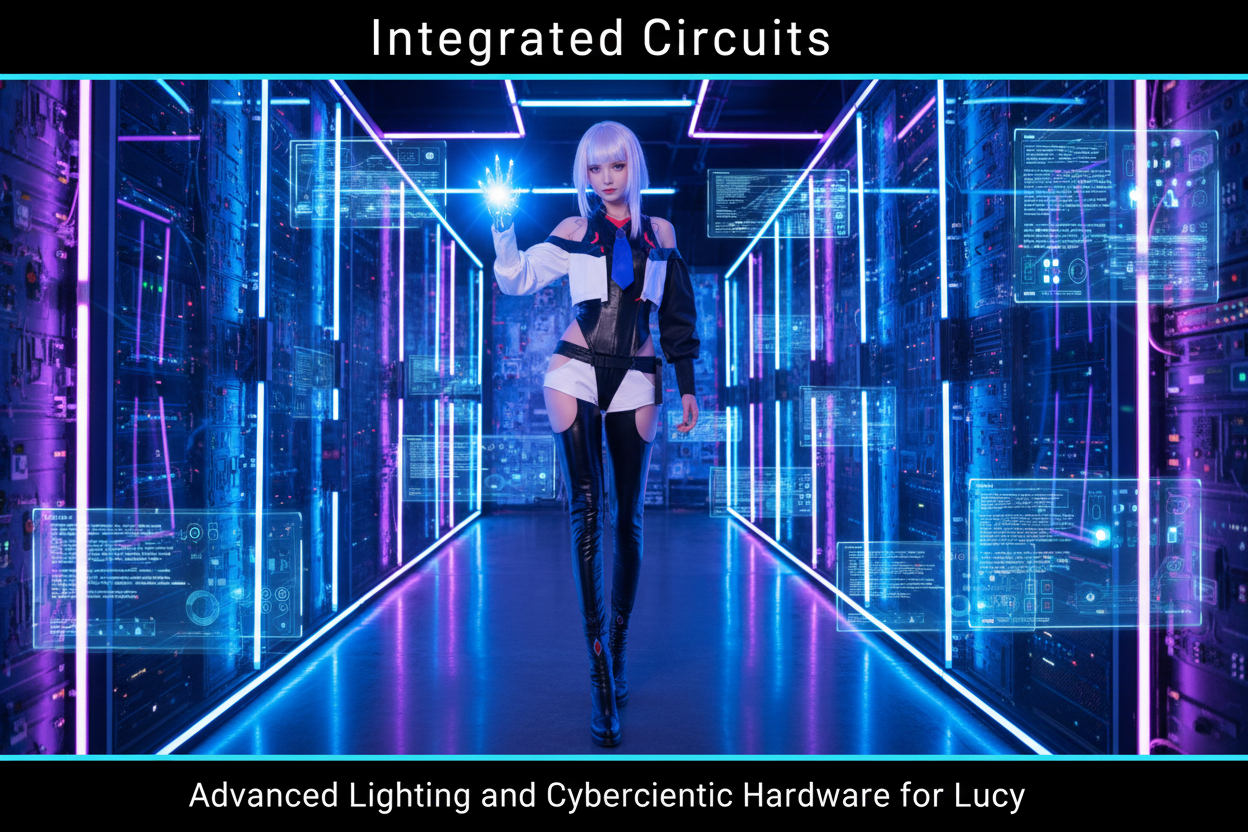
In the Cyberpunk aesthetic, the costume is incomplete without the integration of light. Lucy’s look is punctuated by glowing geometric accents—the heartbeat of her cybernetic identity. For many, this translates to basic LED strips stuck on with tape, which results in a flickering, uneven mess that screams "low-budget."
To achieve the "Edgerunner" standard, you must move beyond decoration and embrace Integrated Systems Engineering. Your lighting should be an extension of the costume’s architecture, not an afterthought. Achieving this requires professional-grade electronic integration, focusing on light diffusion, low-profile cable management, and stabilized voltage delivery.
🧭 The Hardware Audit: Electronic Integration Standards
When building your cybernetic accents, audit your setup against these three "Tech-Grade" standards:
1. Volumetric Light Diffusion
Exposed LED diodes create "hot spots"—distracting bright points that ruin the aesthetic. You want a smooth, solid line of light.
-
The Technical Target: High-density LED strips (minimum 144 LEDs/meter) paired with specialized silicone-channel diffusers.
-
Why it Matters: True diffusion forces light to blend into a singular, solid "neon" beam, creating the illusion of genuine energy rather than simple decorative bulbs.
2. Low-Profile Power Management
Visible battery packs and bulky wiring are the enemies of a sleek cyberpunk silhouette.
-
The Technical Target: 5V-3.7V ultra-thin Li-Po (Lithium Polymer) cells integrated into hidden lumbar compartments, paired with a PWM (Pulse Width Modulation) dimmer.
-
Why it Matters: Hidden power allows for a seamless, "factory-original" look. PWM dimming also prevents the light from looking "over-bright" in photography, which often blows out the sensor and loses all color detail.
3. Circuit Stability & Durability
Outdoor movement causes vibration, which is the primary cause of solder joint failure in DIY setups.
-
The Technical Target: Flexible PCB (Printed Circuit Board) strips with silicone potting (waterproofing/vibration resistance).
-
Why it Matters: Your lighting must withstand the physical stress of travel and movement. Potting protects the delicate circuitry from both moisture and mechanical shock.
🛠️ The Electronic Performance Audit
| Integration Variable | Amateur Setup | Professional Grade |
| LED Density | 30-60 LEDs/m (Visible dots) | 144 LEDs/m (Continuous Beam) |
| Wiring | Surface Tape / Exposed | Internal Channel Routing / Invisible |
| Power Supply | Standard AA Battery Pack | Slim Li-Po Cell + PWM Dimming |
[Technical Expert Note]: Always utilize a heat-shrink solder seal for every connection. Even if you aren't an electrical engineer, the use of heat-shrink ensures a vibration-proof bond that won't fail in the middle of a 4-hour shoot.
💡 Practical Application: Capturing "Pulse" Light in Photography
To maximize the effect of your cybernetic lighting, synchronize your camera with the hardware:
-
The Neutral Density (ND) Strategy: If your LEDs are too bright for your camera’s sensor, use an ND filter on your lens. This allows you to expose for the ambient environment and the LEDs simultaneously, preventing the light from turning into "blobs" of pure white.
-
Color Temperature Matching: Set your camera’s Kelvin scale to match your LEDs (e.g., 5600K for cool white, 3200K for warm). If your lights are "cool blue," pull your white balance toward the blue spectrum to make the LEDs appear "punchy" and vibrant.
-
The "Slow-Sync" Effect: For static shots, use a slightly slower shutter speed (1/60s). This allows the light to "bleed" slightly into the surrounding edges of the suit, enhancing the cybernetic integration look.
❓ Developer's FAQ
Q: Do these lights drain battery quickly?
A: By using a PWM dimmer, you significantly increase battery efficiency. We prioritize 3.7V Li-Po cells which offer the best power-to-weight ratio for long-duration field wear.
Q: Can I wash the suit with integrated LEDs?
A: Absolutely not. The integration kits we use are modular. Always design your lighting to be removable via micro-connectors before the garment goes into the cleaning protocol.
Q: Why do my LEDs flicker in photos?
A: This is due to the "refresh rate" of the LED controller being incompatible with your shutter speed. Always test your lighting settings against your camera's shutter speed at home before heading to a shoot.
🏁 The Final Frame
Cybernetic hardware is not just a gimmick; it is an aesthetic language. When you integrate light with the same precision you apply to fabric texture, you bridge the gap between "costume" and "living machine." By mastering these electronic integration protocols, you ensure that your character isn't just standing there—they are powered on.
Your suit is now hardware. Own it.

Hinterlasse einen Kommentar
Diese Website ist durch hCaptcha geschützt und es gelten die allgemeinen Geschäftsbedingungen und Datenschutzbestimmungen von hCaptcha.