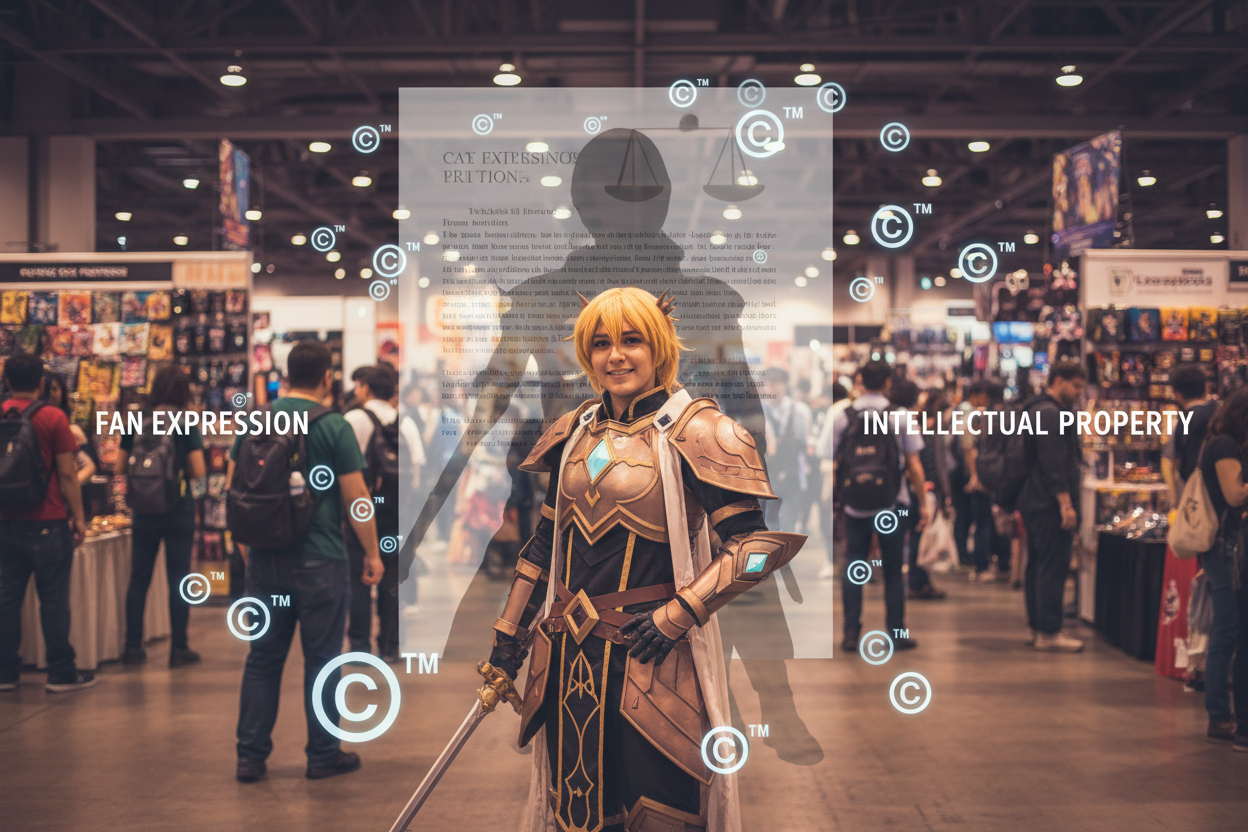
TL;DR: Wearing a cosplay costume for personal, non-commercial use is not illegal, and it's extremely rare for companies to take legal action against individual cosplayers. That said, characters and logos are genuinely protected by copyright and trademark law, and the reason cosplayers rarely get sued isn't that cosplay is automatically legal — it's that most major studios have found it's better business to stay friendly with fans than to enforce their IP rights against them.
(Disclaimer: This article explains the general legal landscape for informational purposes — it isn't legal advice, and if you're facing an actual cease-and-desist letter or planning to sell costumes commercially, talk to an actual intellectual property attorney.)
This exact question got a rare mainstream spotlight in 2025, when NPR's The Indicator from Planet Money devoted a full episode to it, titled "When is cosplay a crime?" The episode dug into the specific arrangement between Lucasfilm and Star Wars cosplayers — including members of the 501st Legion, a well-known Star Wars costuming group — and interviewed an intellectual property lawyer about why this legal gray area exists and why it mostly stays gray rather than resolving one way or the other.
Why This Is Genuinely a Gray Area, Not a Myth
The core legal facts here are more concrete than a lot of online debate suggests. Fictional characters — Darth Vader, Superman, any studio-owned design — are protected intellectual property, generally through a mix of copyright (which covers the original creative expression, like a character's design) and trademark (which covers branding elements meant to identify a source, like a logo or an insignia). According to the IP lawyer interviewed on the NPR episode, something like the Superman "S" shield is a textbook example of the kind of insignia trademark law is built to protect, and a fully-detailed character costume touches copyright protection too. In principle, that means a company legally could pursue a cosplayer over an unauthorized costume, in the same way it could pursue any other unlicensed reproduction of its IP.
In practice, that almost never happens, and the reasoning is more about business strategy than legal necessity. The lawyer's explanation on the episode was blunt: companies have simply found that going after cosplayers is bad for business. Fan-made costumes generate free promotion, community goodwill, and — particularly in Star Wars' case — genuine charitable and marketing value, since costuming groups like the 501st Legion regularly appear at official Lucasfilm-sanctioned events and charity functions in a mutually beneficial, informal arrangement. As one of the show's hosts put it, this dynamic has become a kind of economic symbiosis: cosplayers get to express their fandom and build community, and studios get enthusiastic, free brand ambassadors who show up in full costume to conventions, charity drives, and hospital visits. Suing that same community would be a strange way to capitalize on it.
The genuinely important nuance, though, is the one the lawyer emphasized directly: this arrangement is a social norm, not a legal guarantee. Companies retain the legal right to change course, and the fact that they haven't enforced against individual cosplayers historically doesn't mean cosplay is inherently protected activity the way, say, parody or clearly transformative commentary might be under fair use doctrine. It's a gray area precisely because the legal exposure is real, even though the practical risk, for most cosplayers in most situations, is low.
Where the Actual Risk Scales Up: Key Scenarios
Understanding this topic well means understanding that "cosplay" isn't one single legal category — the actual risk changes significantly depending on what you're doing with the costume:
-
Wearing a costume for personal use at a convention or for photos is, by a wide margin, the lowest-risk scenario, and it's the situation the NPR episode's Star Wars example primarily covers. This is the activity companies have shown the most consistent, long-standing tolerance for, and it's extremely rare to hear of any individual cosplayer facing legal action purely for wearing a costume in public or posting personal photos online.
-
Selling handmade costumes or costume pieces commercially shifts the calculus meaningfully. Once money changes hands, you're closer to the kind of unauthorized commercial use that IP law is specifically designed to police, since it more directly overlaps with a company's own licensed merchandise business. This is where cease-and-desist letters are more likely to actually appear — not because a seller was "caught" doing something uniquely different from personal cosplay, but because commercial reproduction is a categorically different legal question than personal wear.
-
Monetized content built around branded characters — sponsored posts, paid livestreams, or content where a costume is central to a business model rather than incidental to fan expression — sits somewhere in between. It hasn't drawn the same level of enforcement attention as outright bootleg merchandise sales, but it's a meaningfully different legal posture than a hobbyist posting convention photos, since there's a direct commercial benefit being drawn from the character.
-
Original, heavily reinterpreted designs (see our earlier guide on canon-accurate versus culturally-reimagined costume choices generally carry lower risk than screen-accurate reproductions, simply because the further a design drifts from a company's specific protected expression, the harder it is to argue infringement — though a character's name and core identity remaining recognizable still carries some trademark-adjacent risk regardless of how much the visual design has changed.
Common Myths and Things to Watch For
1. "If I'm not selling it, I'm automatically in the clear."
Not quite — personal, non-commercial cosplay is low-risk in practice because of the social norms described above, not because it's categorically exempt from copyright or trademark law. It's a real distinction: low practical risk isn't the same as zero legal exposure.
2. "Cosplay is protected under fair use."
This is one of the most common misconceptions, and it's not accurate as a blanket claim. Fair use is a specific, case-by-case legal defense that typically hinges on factors like transformation, commentary, or parody — a straightforward, accurate costume replica doesn't automatically qualify just because it's a fan creation. Some reinterpreted or clearly parodic costumes may have a stronger fair-use argument than a screen-accurate replica would, but this is genuinely a "consult an actual lawyer for your specific situation" question, not a rule of thumb you can apply confidently on your own.
3. "Getting a takedown notice means I definitely did something illegal."
Not necessarily. Platforms frequently honor takedown requests preemptively to limit their own legal exposure, without a court ever weighing in on whether the underlying use was actually infringing. A takedown is a signal that a rights holder objected, not a legal ruling on the merits.
4. "Trademark and copyright are basically the same thing."
They protect different things and work differently. Copyright covers original creative expression — a character's design, a costume's specific artistic details. Trademark covers source-identifying branding — logos, symbols, sometimes specific names or taglines meant to signal "this comes from us." A costume can raise questions under either, or both, depending on what specifically is being reproduced.
5. "Since Company X has never gone after cosplayers, they legally can't."
This confuses precedent with obligation. As the NPR episode's lawyer noted directly, companies retain the right to change their approach — historical tolerance is a business choice, not a binding legal waiver, and it can shift if a company's broader IP strategy changes.
Summary and Further Reading
The honest answer to "is cosplay illegal" is that personal cosplay exists in a genuine legal gray area that, in practice, functions more like a long-standing, mutually beneficial social arrangement between fans and studios than a hard legal rule — but that arrangement is built on business incentives, not a guaranteed exemption, and it shifts substantially the moment money, commercial sales, or heavy monetization enter the picture.
If you're cosplaying for personal enjoyment and convention photos, the practical risk is low; if you're building a costume-selling business, it's worth understanding where you sit on that risk spectrum before you scale up.
For more on navigating this responsibly, check out our guides on the difference between custom-commissioned and ready-to-wear costumes, and our breakdown of canon-accurate versus reimagined designs — both touch on how far a costume can diverge from source material while still capturing a character's spirit.

Hinterlasse einen Kommentar
Diese Website ist durch hCaptcha geschützt und es gelten die allgemeinen Geschäftsbedingungen und Datenschutzbestimmungen von hCaptcha.