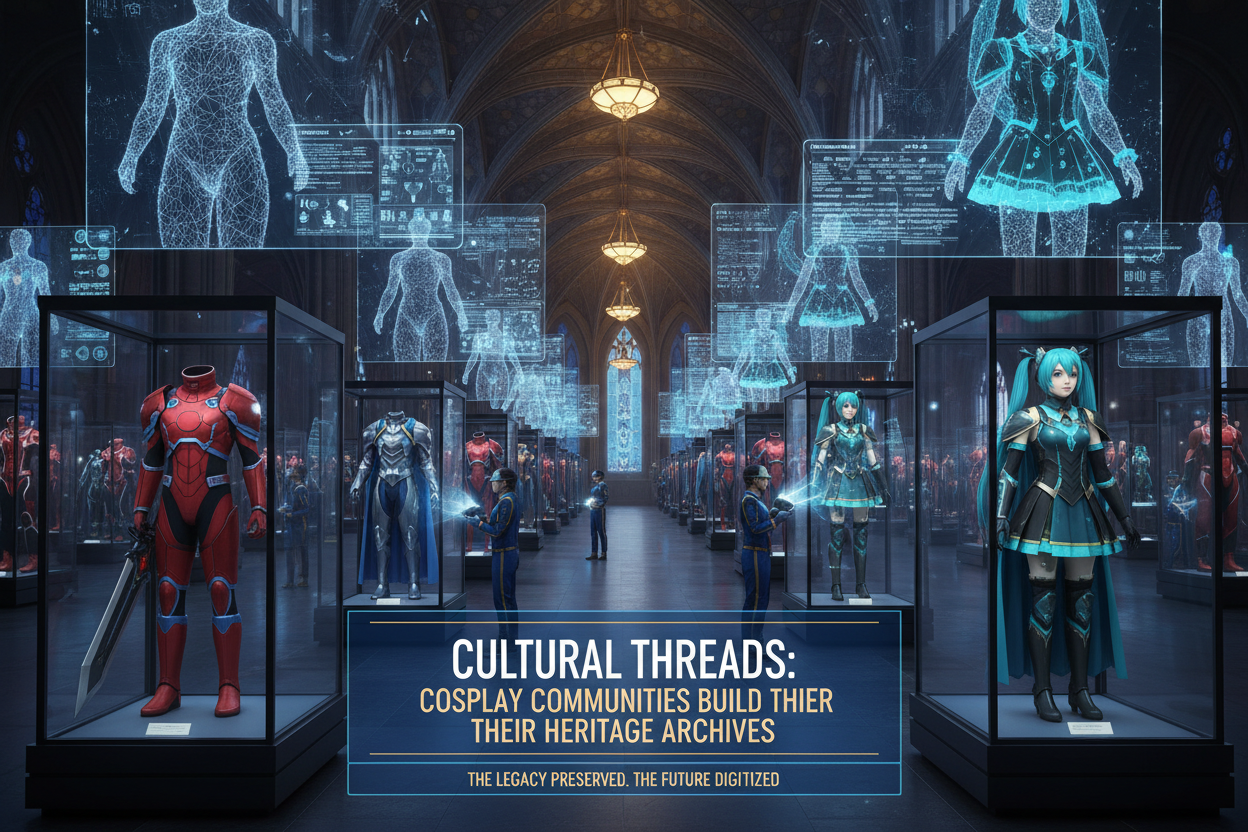
💡 Systemic Briefing: As foundational gaming and anime intellectual properties cross the 20-to-30-year threshold, the global subculture is undergoing a structural transition. Within media sociology, cosplay is shifting from a fleeting act of contemporary performance to a vital pillar of Fandom History Preservation. This movement directly interfaces with the established practices of Digital Preservation and Cultural Heritage Preservation. For decades, community history—consisting of early high-fidelity physical costumes, foundational construction tutorials, and legendary photo archives—was treated as disposable, short-term content. In 2026, as early internet platforms decay and corporate entities sunset old servers, cosplay communities are actively building independent, decentralized digital and physical archives to protect their material culture from permanent erasure.
1. From Trend to Heritage: The Ephemerality Crisis of Subcultural Media
The urgent push for "Cosplay Preservation" stems from a harsh reality facing the digital-native generations: the internet is losing its memory. The early golden eras of online fandom—ranging from late-1990s dedicated web forums to mid-2000s independent image boards—are rapidly disappearing due to domain expirations, corporate platform restructuring, and link rot.
[ THE TRADITIONAL DISPOSAL CYCLE ]
Physical Garment Worn ──► Social Image Posted ──► Platform Algorithm Decays ──► Server Deletion / Material Rot

[ THE 2026 PRESERVATION COMPUTE ]
Physical Garment Stabilized ──► 3D Photogrammetry Scan ──► Metadata Tagged File ──► Decentralized Cultural Ledger
For decades, the mainstream world viewed cosplay through the lens of short-term hobbyism. However, from the perspective of Cultural Heritage Preservation, a subculture's physical artifacts and structural knowledge bases constitute an invaluable historical record.
When a community loses early construction tutorials (such as foundational 2005 forum posts detailing how to heat-form EVA foam without modern industrial tools) or early convention photo galleries, a piece of vernacular art history is permanently erased. In 2026, preservation is no longer seen as a nostalgic indulgence; it is a critical defensive action to save the physical and digital evolution of a global art form.
🏛️ 2. The Preservation Matrix: Case Studies in Chronological Conservation
The technical and cultural requirements of preservation change drastically depending on the age of the intellectual property and the historical materials used by early creators.
1. Neon Genesis Evangelion (30+ Year Legacy) — Conserving the Industrial Dawn of Sci-Fi Fabrications
🧬 The Preservation Challenge
As an intellectual property that has thrived for over three decades, Evangelion represents the foundational era of modern, high-tier armor fabrication. Early 1990s and 2000s costumes of characters like Rei Ayanami or Asuka Langley Soryu were constructed using volatile, non-archival materials: low-grade synthetic PVC plastics, early industrial contact cements, and basic commercial spandex blends.
┌────────────────────────────────────────────────────────────────────────┐
│ [TECHNICAL PRESERVATION DIRECTIVE: 1990s PU/PVC STABILIZATION]         │
│                                                                        │
│   ├─── [PHYSICAL STABILIZATION CELL] ────────────────────┐            │
│   │    Environment: 18°C (64.4°F) / 40% Relative Humidity│            │
│   │    Support: Custom Acrylic Internal Core Mannequin   │            │
│   │                                                      │            │
│   ├─── [DIGITAL TWIN ARTIFACT] ──────────────────────┐   │            │
│   │    Scan: 8K Photogrammetry Surface Mapping       │   │            │
│   │    Metadata: Original Chemical Adhesive Log      │   │            │
│   │                                                  │   │            │
│   │              [ARCHIVAL PRESERVATION PATHWAY]     │   │            │
│   │             ┌────────────────────────────┐        │   │            │
│   │             │   Prevent Plasticizer Loss │        │   │            │
│   └────────────►│   Freeze Molecular Decay   │◄───────┴───┘            │
│                 │   Secure Historical Record │                         │
│                 └────────────────────────────┘                        │
└────────────────────────────────────────────────────────────────────────┘
🛡️ Archival Methodologies
Preserving a 20-year-old Plugsuit requires advanced polymer conservation. Polyurethane and PVC fabrics from this era suffer from "plasticizer migration," causing the surfaces to become brittle, sticky, or completely disintegrate.
Community archivists are partnering with independent textile museums to store these legacy garments in climate-controlled environments kept at a steady 18°C (64.4°F) with 40% relative humidity to slow molecular decay. Concurrently, these garments are recorded via 8K photogrammetry scans, preserving the exact stitching, patterns, and physical structural decisions of early creators as an immutable digital blueprint.
2. Final Fantasy Classic Era (20+ Year Legacy) — Protecting the Transition from Pixels to Heavy Textiles
🧬 The Preservation Challenge
The golden era of the Final Fantasy franchise (FFVII, FFVIII, FFIX, and FFX) represents the historical bridge where video game costuming transitioned from abstract, low-polygon pixel sprites into complex, multi-layered costume designs. Costumes from characters like Tifa Lockhart, Squall Leonhart, or Yuna required early creators to invent real-world textile translations for garments that were never designed to obey the laws of physics.
                        [ FINAL FANTASY LEGACY NODE ]

                           ▲  [Historical Artifact]
                           │  (Early 2000s Hand-Dyed Silks)
                           │
                  ┌────────┴────────┐
                  │                 │
                  │ (Textile Decay) │
                  ▼                 ▼
         ┌───────────────────────────────────┐
         │     THE MATERIAL RECOVERY LAB      │
         ├───────────────────────────────────┤
         │ Preservation Protocols Active:     │
         │ • Acid-Free Tissue Interleaving   │
         │ • De-acidification of Paper Patterns│
         │ • Digitization of VHS Video Guides│
         └───────────────────────────────────┘
🛡️ Archival Methodologies
The physical components of this era—often built with heavy wools, hand-dyed silks, and custom-molded leather elements—face severe degradation from improper storage, sweat residues, and UV exposure.
Preservation teams are systematically acquiring these legendary grassroots pieces, utilizing acid-free tissue interleaving to prevent color bleeding, and treating early paper sewing patterns with de-acidification sprays. Furthermore, community archivists are digitizing early 2000s instructional media originally distributed on VHS tapes or burned CD-ROMs, rescuing the lost craft techniques of the community's pioneers before the physical media becomes unreadable.
3. Hatsune Miku (Continuous Era Symbol) — Chronicling the Infinite Versions of a Living Digital Culture
🧬 The Preservation Challenge
Unlike traditional IPs bounded by a single canon storyline, Hatsune Miku operates as a continuous, decentralized ecosystem of user-generated content. Over nearly two decades, Miku has accumulated thousands of unique, community-designed variations (ranging from official concert modules to viral internet music video outfits). The challenge here is not just preserving a single iconic costume, but documenting the dizzying, constant evolution of a living digital symbol.
                  [ DECENTRALIZED MIKU ARCHIVE FLUX ]

                    ┌───────────────────────────┐
                    │     Vocaloid Media Lab    │
                    │   (Track Community Memes) │
                    └─────────────┬─────────────┘
                                  │
                                  ▼
                    ┌───────────────────────────┐
                    │    Systemic Web-Scraping  │
                    │ (Save HTML Guides & Code) │
                    └─────────────┬─────────────┘
                                  │
                                  ▼
                    ┌───────────────────────────┐
                    │    Vector Pattern Vault   │
                    │  (Open-Source Laser Files)│
                    └───────────────────────────┘
🛡️ Archival Methodologies
For Miku, preservation is heavily focused on the digital landscape. Communities have established dedicated media labs that deploy systemic web-scraping scripts to crawl abandoned blogs, dead image hosting servers, and historical video-sharing platforms.
They extract and categorize digital patterns, high-resolution photo reference sets, and community-made embroidery code files. These files are then uploaded into open-access, decentralized storage vaults, ensuring that future generations can accurately recreate any historic iteration of Miku with flawless textile accuracy.
3. The Architecture of Preservation: Archival Methods for Subcultural Memory
To transition cosplay into a formal field of cultural conservation, preservationists have established standardized protocols across three core areas of subcultural material history:
-
Physical Artifact Stabilization (The Costume Vault)
Costumes selected for historical preservation are stripped of organic contaminants (adhesives, body oils) using specialized chemical washes. They are then mounted on custom, inert acrylic mannequins rather than cheap wood or wire forms, which can leach harmful chemicals or distort the garment’s original shape over time.
-
Digital Ephemera Recovery (The Tutorial Archive)
Early internet text guides, low-resolution JPEG progress photos, and schematic diagrams are preserved using non-proprietary file formats (like PDF/A and uncompressed TIFF). This ensures that these technical documents remain completely readable across modern operating systems centuries into the future, immune to software obsolescence.
-
Oral History Documentation (The Performance Record)
Because cosplay is an inherently active, performing art style, preserving the costume is only half the battle. Independent preservation groups are recording video interviews with veteran creators from the 1990s and 2000s, documenting their performance choices, early community structures, and the emotional context behind their historical fabrications.
📊 4. The Technical Preservation Grid: Materials, Media, and Threats
The following analytical matrix charts the specific technical vulnerabilities facing subcultural artifacts across different eras and the exact preservation strategies needed to counteract them in 2026.
| Era Registry Category | Dominant Material/Media Used | Primary Degradation Threat | Core Preservation Protocol | Target Archival Outcome |
|
Early Sci-Fi Era (e.g., Neon Genesis Evangelion) |
Volatile PU/PVC Leathers, Spandex, & Industrial Contact Cement. | Plasticizer migration, surface stickiness, and adhesive breakdown. | Climate-controlled vaults (18°C/40% RH) paired with 8K photogrammetry scans. |
Physical/Digital Synergy Halts the chemical rot of the physical suit while locking in an exact digital twin. |
|
Pixel-to-Textile Era (e.g., Final Fantasy VII–X) |
Custom-Dyed Silk, Heavy Wool, Paper Patterns, & VHS Video Media. | Mold growth, insect damage, UV fading, and video tape magnetic decay. | Acid-Free tissue wrapping, paper de-acidification, and lossless digital video conversion. |
Technical Craft Recovery Saves the physical patterns and early instructional videos from media decay. |
|
Decentralized Digital Era (e.g., Hatsune Miku) |
Digital Vector Patterns, Flash Web Assets, & Low-Res JPEG Records. | Link rot, server shutdowns, domain expirations, and format obsolescence. | Systemic web-scraping, migration to open-access storage, and PDF/A archiving. |
Open-Source Permanence Maintains a permanent, accessible library of community fashion history. |
5. ❓ Frequently Asked Questions (FAQ)
Q: Why should old cosplay costumes be preserved instead of simply being remade using superior modern 2026 techniques?
A: Remaking a costume with modern tools like 3D printers and laser cutters updates the look, but it erases the historical craft record. An original costume from 2001 shows exactly how a creator solved complex design problems using only basic hand tools, found materials, and raw ingenuity. Preserving the original artifact honors that historical problem-solving process, providing an authentic benchmark for how subcultural engineering has evolved over time.
Q: Do copyright holders and game companies support these independent community-led preservation archives?
A: The relationship is complex. While some protective corporations view independent archiving as a potential trademark risk, progressive publishers recognize that these history projects keep their legacy fanbases intensely loyal. In 2026, forward-thinking studios are beginning to grant official permissions to community archives, treating them as free, highly authentic historical preservation assets that protect the corporate brand's own cultural legacy.
Q: Can everyday cosplayers contribute to the preservation movement, or is it restricted to formal historians?
A: Every creator can act as a preservationist. By simply organizing old build logs, saving digital patterns in stable file formats, properly cleaning and packing away older outfits in breathable garment bags, and avoiding volatile adhesives, everyday cosplayers protect their own personal history. Subcultural preservation is, at its heart, a decentralized effort driven by the collective care of the community itself.
🎯 Conclusion: Retaining the Subcultural Blueprint
The rise of the "Cosplay Preservation" movement in 2026 marks a profound maturation of global fandom. By looking at their creations through the serious lens of cultural heritage and digital conservation, cosplay communities are asserting their rightful place in the broader history of modern art and fashion design.
Preserving these artifacts ensures that the creative triumphs of the subculture's pioneers are not swallowed up by digital link rot or physical decay. It builds a permanent bridge between generations, allowing the fabricators of tomorrow to stand on the shoulders of the creators who first looked at a screen of low-polygon pixels or an early anime cell and said, "I can bring that into the physical world."

Hinterlasse einen Kommentar
Diese Website ist durch hCaptcha geschützt und es gelten die allgemeinen Geschäftsbedingungen und Datenschutzbestimmungen von hCaptcha.