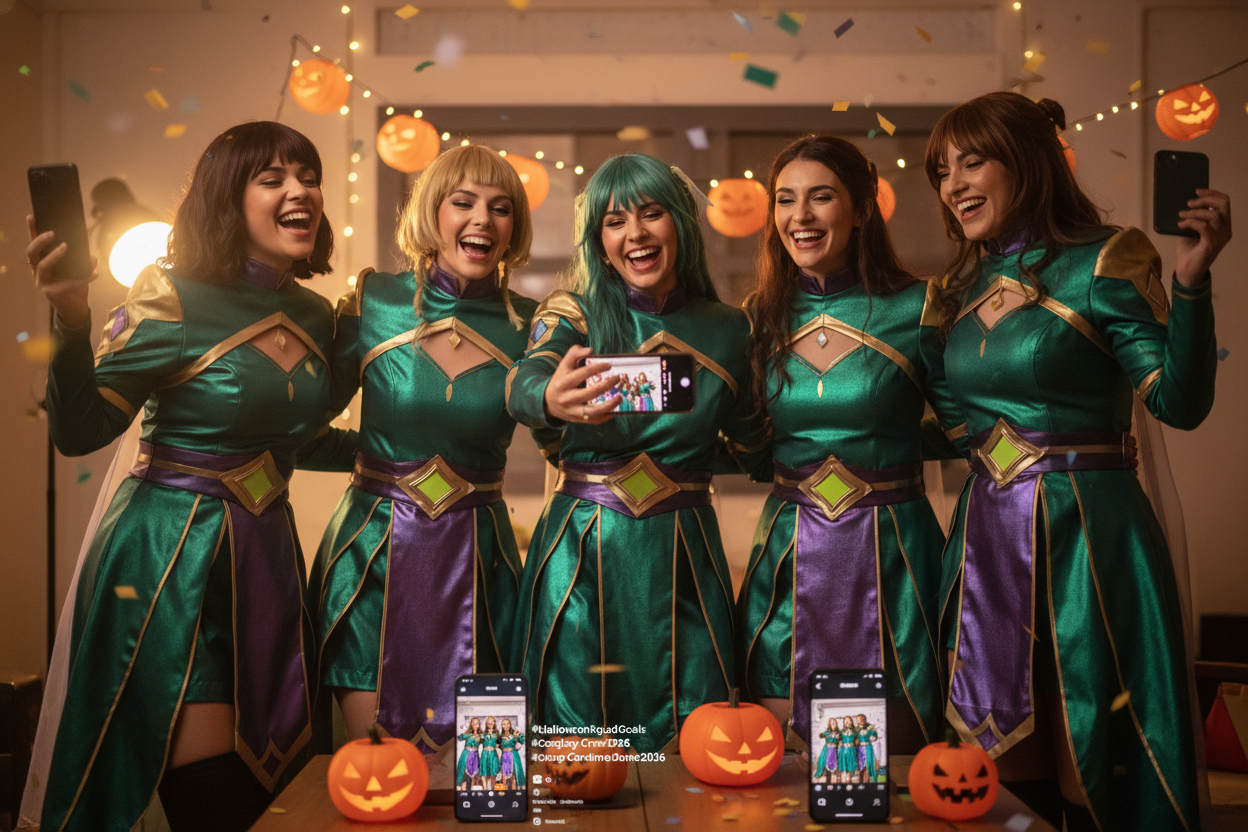
Scroll through any Halloween prediction thread this year and you'll notice something: the conversation isn't just about individual characters anymore. People are planning family costumes, matching costumes, and full group costumes built around a shared concept — one popular thread even had someone call a viral bush-costume bit "such an easy and fun group costume," with others immediately jumping in to plan doing the whole thing as a group. Halloween group cosplay is having a real moment in 2026, and the more interesting question isn't "what should our group dress as" — it's why this specific format has become so dominant. Here are the five questions worth answering first.
Question 1: Why is Halloween group cosplay having such a big moment in 2026?
Direct answer: Group costumes generate more social engagement per person than solo costumes do — more photos, more tagged friends, more recognition — and platforms built around shareable content have made that payoff more visible and more motivating than ever.
The core mechanic is simple: a solo costume gets recognized by whoever happens to see you. A group Halloween costumes 2026 concept gets recognized collectively, and every person in the group becomes a distribution point for the same photo or video — tagging each other, cross-posting, reacting. That multiplies the social payoff of the exact same amount of costume effort. This isn't a new psychological pattern, but it's being amplified by how naturally group content performs on short-form video and photo-sharing platforms compared to a single person in costume standing alone. A costume concept that only "clicks" when you see the whole group together — like a themed bush costume, a matching character set, or a coordinated color scheme — is inherently more shareable than any one piece of it in isolation, which is a big part of why these concepts are dominating this year's prediction and planning threads.
Question 2: What actually makes a group Halloween costume idea work?
Direct answer: The concept needs to be recognizable as a group even before anyone identifies the individual characters — silhouette, color coordination, or a shared visual gimmick that reads instantly, rather than requiring someone to already know the reference.
This is the real insight behind why "recognizable group concept" is beating out more elaborate individual-character group sets this year. A group of five people each dressed as a different, unrelated character technically counts as a "group costume," but it doesn't read as one at a glance — a viewer has to identify each person separately before the group makes sense as a unit. Compare that to a recognizable group costumes concept where the visual gimmick itself is the joke or the reference (matching colors, a repeated silhouette, an absurd shared prop), and the group reads as a cohesive idea instantly, even to someone who has zero context for what's being referenced. This is exactly the appeal of something like the bush-costume trend mentioned above — it doesn't require any specific fandom knowledge to land, which makes it dramatically more shareable across a broader audience than a deep-cut character reference would be. The takeaway for planning your own group costume: prioritize a shared visual concept that reads as a group first, and worry about individual character accuracy second.
Question 3: How do you plan matching Halloween costumes when everyone in the group likes different fandoms?
Direct answer: Pick a unifying structural element — color palette, a shared prop type, or a common silhouette — and let each person apply it to their own preferred character or fandom rather than forcing everyone into the same source material.
This exact problem shows up constantly in planning threads, including one specific case of siblings wanting to combine an anime character and a DC character into a single matching Halloween costumes concept. The solution isn't to compromise on fandom — it's to find the structural thread that can run through both choices. A shared color scheme is usually the easiest unifying device: if both characters can be represented in a matching palette (even if the characters themselves are unrelated), the group reads as coordinated without requiring anyone to abandon their preferred fandom. A shared prop type or costume category (both in "hero" silhouettes, both carrying a signature weapon-style prop, both in a specific color-blocked style) works similarly. This approach also scales well for genuinely mixed groups — friend groups spanning multiple fandoms, or families where kids and adults have very different interests — since the unifying element does the coordinating work, not a forced shared character choice nobody actually wants.
Question 4: What's different about planning family Halloween costumes versus a friend or couple group?
Direct answer: Family costumes generally prioritize durability, comfort, and easy movement over precise character accuracy, since kids' costumes especially need to survive trick-or-treating, not just posing for photos — while adult friend and couple groups can lean further into detail and complexity.
Family Halloween costumes 2026 planning tends to have practical constraints that adult-only groups don't: costumes need to handle real movement (walking door to door, sitting in a car seat, running around), weather layering (a costume that looks great alone but can't accommodate a coat underneath is a real problem in colder climates), and a wider age and size range to coordinate across. This generally pushes family group concepts toward simpler, sturdier designs with less intricate detail work than what you'd see in an adult friend group or couples Halloween costumes 2026 concept, where the group can commit to a more elaborate, stationary, photo-focused look without needing to functionally survive several hours of active trick-or-treating. Neither approach is more "correct" — they're solving for different practical realities, and recognizing which category your group actually falls into early avoids the common mistake of over-designing a family costume that turns out to be impractical for the actual night, or under-designing a photo-focused adult group costume that ends up looking thin in pictures.
Question 5: How far in advance should a group start planning coordinated Halloween costumes?
Direct answer: Start earlier than you would for a solo costume — group logistics (coordinating everyone's sizing, budget, and schedule) take meaningfully longer than solving for just yourself, even if the individual costume pieces aren't complicated.
The planning bottleneck for coordinated Halloween costumes is almost never the costumes themselves — it's the coordination. Getting agreement from an entire group on a concept, confirming everyone's sizing and budget, and making sure orders go out with enough lead time for every single person's pieces to arrive (not just the fastest shipper in the group) all take real calendar time that a solo costume planner doesn't have to deal with. A reasonable rule of thumb: start the concept conversation at least a month earlier than you would for an equivalent solo costume, specifically to account for the back-and-forth of group decision-making before any actual ordering happens. Groups that wait until a few weeks out often end up defaulting to whatever's fastest to source for everyone, rather than the concept the group actually wanted — starting the coordination conversation early preserves more of the group's original ambition for the costume.
Summary & Further Reading
The rise of Halloween group cosplay in 2026 isn't really about any single costume idea — it's about groups prioritizing concepts that read as a cohesive unit at a glance over concepts that require identifying each person's individual reference first. Whether you're coordinating a family costume built for durability, a couples costume built for photos, or a mixed-fandom friend group solved through a shared color palette or prop style, the through-line across all of this year's most successful Halloween group costume ideas is the same: recognizability as a group comes first, and everything else gets built around that.
If you found this useful, here's where to go next:
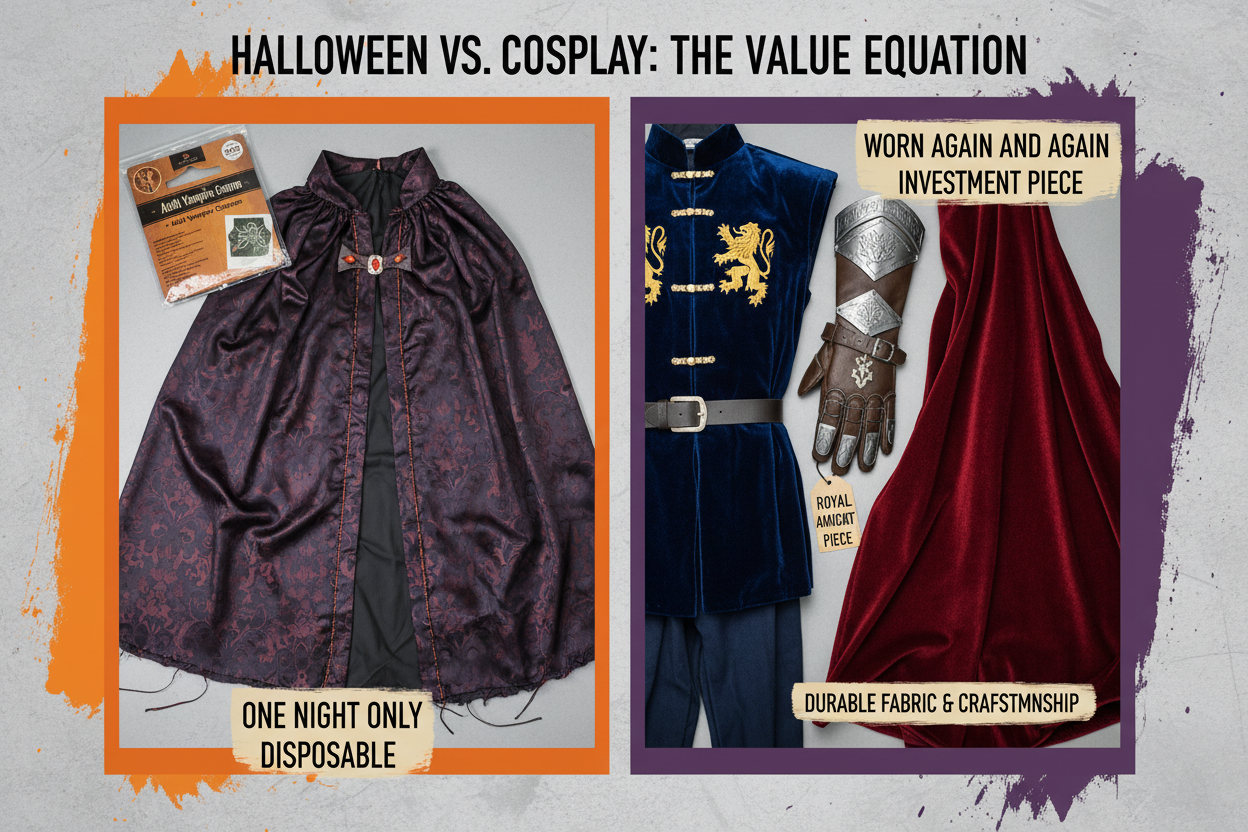
- A full breakdown of the Halloween costume vs. cosplay spectrum, useful if your group is debating how detailed to go with a shared concept
- A guide to building a reusable, modular cosplay wardrobe, especially handy for groups planning to coordinate costumes more than once
- A practical timeline guide for solo Halloween cosplay planning, useful context for setting realistic expectations on group timing

Hinterlasse einen Kommentar
Diese Website ist durch hCaptcha geschützt und es gelten die allgemeinen Geschäftsbedingungen und Datenschutzbestimmungen von hCaptcha.