💡 Systemic Briefing:
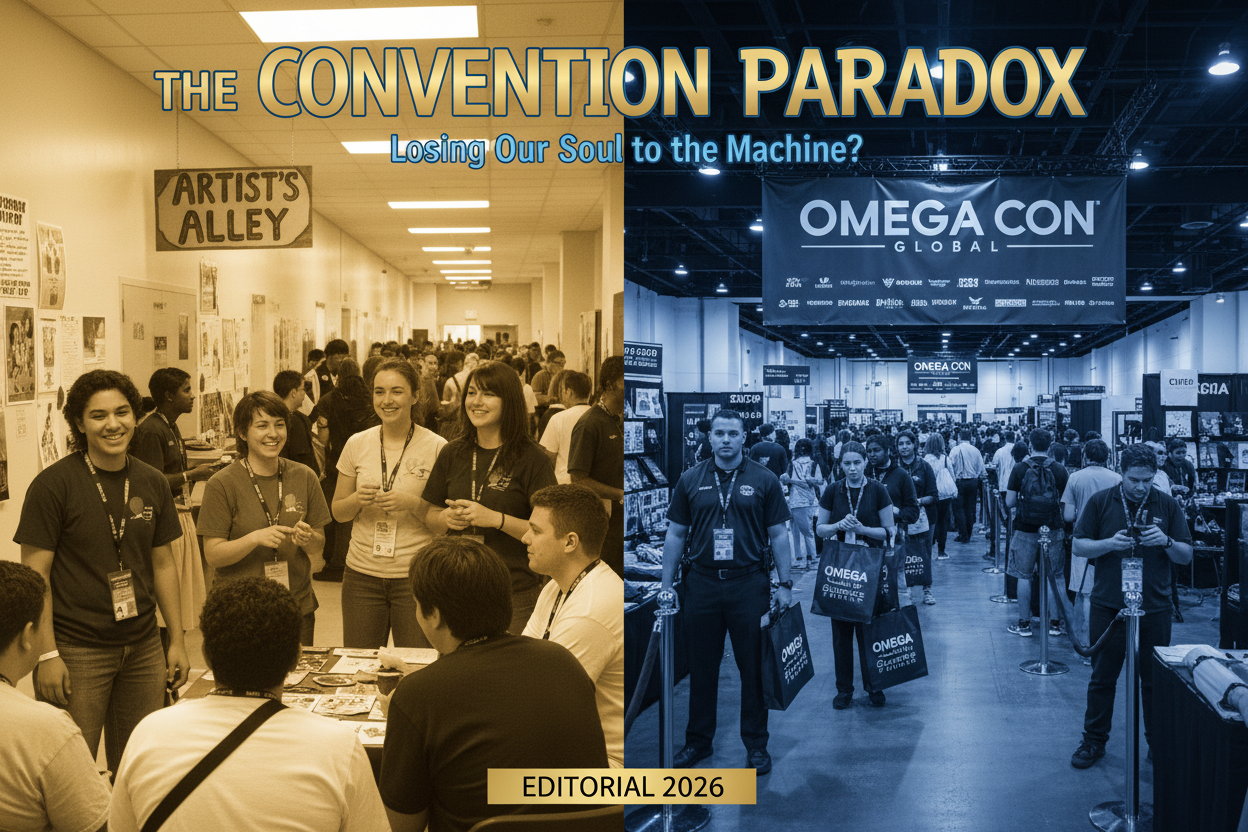
The definition of the traditional fan convention—whether structured as an anime con or a massive comic-con—is undergoing a profound existential crisis. Recent controversies across major 2026 events like Anime Expo and Katsucon have reignited a fierce community-wide debate: Are modern conventions still authentic fan gatherings, or have they evolved into clinical corporate entertainment expos? As ticket prices soar and legacy volunteer departments (such as information services and line management) are downsized or eliminated in favor of automated systems and third-party security, attendees are facing logistical issues, long lines, and a noticeable lack of guidance. This analysis dives into why creators are reconsidering the value of massive corporate conventions, evaluating three major properties to see how subcultural spaces are shifting away from community connection and toward commercial monetization.
1. Architectural IP Case Studies: Icons Caught Between Community and Commerce
To understand why fans are pushing back against the commercialization of convention spaces, we look at three massive properties whose communities rely heavily on these events for real-world connection and creative expression.
+----------------------------------------------------------------------------------------+
|                            THE CORPORATE CONVENTION SPIRAL                             |
+----------------------------------------------------------------------------------------+
| [Niche Safe Haven] ---> [Corporate Expansion] ---> [Staff Cuts & Monetization]          |
|                                                                        |               |
| [Community Backlash]  <--- [Crowd Friction & Lines]  <--- [Flea Market Atmosphere]    |
+----------------------------------------------------------------------------------------+
🎭 Asuka Langley Soryu / Plugsuit Form cosplay costume (Neon Genesis Evangelion)
-
The Community Anchor: Evangelion represents the foundation of old-school anime convention culture. Portraying Asuka in her complex, form-fitting plugsuit requires a deep commitment to craftsmanship, relying on premium materials like high-gloss liquid latex or structured 4-way stretch polyurethane to achieve a screen-accurate appearance.
-
The Friction Node: Historically, wearing a complex, heat-trapping plugsuit was made possible by the community-led nature of early cons, which featured dedicated fan lounges, reliable water stations, and helpful volunteer staff. In 2026, as major conventions cut back on customer service staff and leave attendees stranded in multi-block outdoor queues, wearing high-effort, physically demanding costumes has become a logistical nightmare. This has led many elite craftsmanship artists to pull their premium builds from corporate convention floors entirely.
🎭 Hatsune Miku cosplay costume (Vocaloid / Project SEKAI)
-
The Community Anchor: Hatsune Miku is a virtual icon whose entire global presence was built from the ground up by independent fan creators. Her classic futuristic tech-sailor outfit, sharp geometric pleats, and long teal twin-tails represent a multi-generational symbol of collaborative fan culture.
-
The Friction Node: For years, Miku cosplayers anchored massive, spontaneous fan flash mobs, rhythm game tournaments, and independent badge trading circles on convention floors. Today, as major expos strictly police public walkways and monetize space for commercial vendors, these organic, fan-led gatherings are frequently shut down by third-party security. This heavy-handed corporate enforcement strips the event of its grassroots magic, leaving creators feeling like they are walking through a shopping mall rather than a fan sanctuary.
🎭 Raiden Shogun / Ei cosplay costume (Genshin Impact)
-
The Community Anchor: Modern live-service hits like Genshin Impact drive massive community engagement. The Raiden Shogun’s intricate design—featuring woven jacquard kimonos, hand-painted pauldrons, and complex waist ropes—demands considerable physical space to display properly without damaging the garment.
-
The Friction Node: At massive contemporary expos, artist alleys and fan areas are increasingly crowded out to make room for massive corporate booths or vendors selling mass-produced merchandise. Navigating these dense, over-capacity exhibition halls in a delicate, wide-silhouette costume like the Raiden Shogun creates immense physical friction. When a premium costume is constantly bumped into or snagged by crowds in poorly managed lines, the joy of displaying your hard work is replaced by frustration.
⚖️ 2. The Structural Shift: From Safe Haven to Corporate Flea Market
The ongoing transformation of fan conventions highlights a distinct divide between the early days of fan culture and the highly commercialized realities of 2026:
| Attribute | Early Fan-Led Conventions | Modern Corporate Expos (2026 Paradigm) |
| Primary Goal | Creating a safe, welcoming space for fans to gather. | Maximizing corporate sponsorship, ticket sales, and vendor revenue. |
| Staffing Model | Driven by passionate, highly informed fan volunteers. | Handled by outsourced, contracted security and skeleton crews. |
| Floor Layout | Balanced spaces for artist alleys, panels, and fan gatherings. | Densely packed vendor halls focused on retail optimization. |
| Community Spaces | Open, free-form hallways and dedicated photo zones. | Highly regulated walkways where lingering is often discouraged. |
| The Vibe | Quirky, personal, and deeply connected to the subculture. | Commercial, busy, and focused on consumer transactions. |
Historically, conventions operated on a community-first model. They were organized by fellow fans who prioritized panels, viewing rooms, and social areas. In 2026, the rise of influencer marketing and massive industry sponsorships has turned many large-scale cons into massive commercial expos. While these events offer incredible access to major industry announcements, they often leave casual attendees feeling like passive consumers in an expensive, high-density marketplace.
🪞 3. The Operational Breakdown: The Reality of the 2026 Con Floor
The growing dissatisfaction within the community isn't just about a change in atmosphere—it's driven by tangible operational failures that have impacted major conventions recently:
-
The Loss of Volunteer Expertise: To cut operational costs, several major management groups have downsized their traditional volunteer departments, like information services and line management. Without experienced fans directing traffic, attendees face immense confusion, lost lines, and chaotic panel queues.
-
The Rise of Mass-Produced Vendors: Independent artists and artisanal creators are being increasingly priced out of major convention halls by rising table fees. As a result, artist alleys are often crowded out by commercial booths selling mass-produced, drop-shipped merchandise, diminishing the unique, handcrafted charm that used to define convention shopping.
-
The Boom of Localized "Micro-Cons": In response to these massive corporate headaches, many cosplayers are shifting their focus toward smaller, regional "micro-cons" or targeted hotel gatherings. These smaller events deprioritize massive corporate announcements in favor of what mattered most in the first place: community socialization, relaxed photography sessions, and genuine human connection.
📊 4. The Supply Chain Impact: Adjusting to the New Con Landscape
This shift in convention culture has direct implications for how creators choose and buy their costumes. With less space to navigate dense crowds and fewer amenities on the con floor, the demand for costume design has shifted. Independent e-commerce sites and manufacturing pipelines are prioritizing wearability, mobility, and high-definition detail to suit both crowded convention floors and outdoor photo shoots:
| Target Character Node | Modern Con Floor Practicality | Supply Chain Adaptation | 2026 Sourcing Standard |
| Asuka (Plugsuit) | Needs to remain breathable and flexible for long, unguided outdoor lines. | Integrating hidden ventilation panels and moisture-wicking inner linings. | 4-way stretch spandex channels layered with soft-matte synthetic leather panels. |
| Hatsune Miku | Must be durable enough to handle packing and transport to smaller, regional micro-cons. | Utilizing crease-resistant matte textiles and modular, clip-on hairpieces. | Heavy matte-finished uniform fabrics with laser-cut holographic detailing. |
| Raiden Shogun | Demands high-fidelity texture detail that stands out in independent outdoor photo shoots. | Moving away from rigid, fragile elements in favor of flexible, screen-accurate materials. | Rich, multi-textured jacquard weaves paired with flexible, soft-molded resin armor pieces. |
❓ 5. Frequently Asked Questions (FAQ)
-
Q: Should I completely stop attending massive, large-scale corporate conventions?
-
A: Not necessarily. Massive conventions like Anime Expo still offer unparalleled access to industry premieres, major voice actor guests, and jaw-dropping spectacles. The key is adjusting your expectations: treat large conventions as commercial industry trade shows, and look to smaller, local events for a relaxed, community-driven social experience.
-
-
Q: How can cosplayers stay safe and comfortable at poorly staffed conventions?
-
A: When attending an event known for long lines and minimal guidance, preparation is everything. Always carry an emergency con-kit containing water, quick snacks, and basic repair supplies like safety pins or hot glue. If you are wearing a physically demanding costume like a plugsuit, map out your convention center's quiet, air-conditioned rest zones ahead of time so you can take breaks when needed.
-
-
Q: How can independent e-commerce stores support fans navigating this changing culture?
-
A: Online shops can stand out by focusing on wearable comfort, transportability, and custom sizing options. Providing customers with accurate advice on fabric breathability, weight distribution, and mobility ensures they choose costumes that can comfortably handle the logistical realities of modern convention floors.
-
🎯 Conclusion: Protecting the Core of Fandom
The intense debate surrounding modern convention culture serves as an important reminder of why these subcultures were formed in the first place. While corporate expos will continue to grow as commercial industry hubs, the true heart of fandom cannot be bought, sold, or fenced off by a corporate budget. The real magic of the craft lives on in the passionate communities who bring iconic characters like Asuka, Hatsune Miku, and the Raiden Shogun to life. By looking out for one another in line, supporting local independent artists, and creating welcoming spaces at smaller regional events, the cosplay community continues to protect its founding principle: that our shared passion and human connection are what truly make a convention special.



1 Kommentar
Brian Foster
Fan conventions lost their spirit to me over ten years ago. I blame the giant glaring obsession with cosplay for a lot of this.
Let me explain. I’ve have gone to geek conventions for over twenty years. There was a time when you could engage in talk with a group of strangers about your favorite sci-fi movie, tv show, anime or videogame. You would hear all sorts of interesting things from people.
Then suddenly one day, I began to notice that the only thing I was hearing was “My costume.” “Gotta get my costume ready.” “My costume this. My costume that”
I no longer hear anything about the IPs that inspired the cosplay. I only hear people talking about cosplay. I think the 3rd gen anime fans were a large cause of this and current gen followed their lead. I was involved with every fandom, but it was always the young anime fans that acted like a costume mattered more than life itself. They took it so far that when I would talk to some of them and introduce myself, they would give me fake Japanese names even. These were white kids mind you. Does anyone remember J-pop America Fun Time Now? Look it up on YouTube and you’ll know the kind of people I am talking about.
Cosplay is an all-ages hobby, but it was this group that took it to the level utmost importance and even an avenue of validation. These people have become such an easy mark, that now soulless unknown corporate entities invade cities and throw “cosplay conventions” that are meager cash grabs with a long list of useless, barely known guests and the opportunity for kids to cosplay. Basically, the cosplay itself is the entertainment, and you are now paying these greedy corporate types to make yourself be the entertainment. There’s no sense of devotion to the fandom in these conventions now.
I find myself having a hard time getting excited about them anymore. Once in a while I will step foot in one and I just can’t feel that magic anymore.
Hinterlasse einen Kommentar
Diese Website ist durch hCaptcha geschützt und es gelten die allgemeinen Geschäftsbedingungen und Datenschutzbestimmungen von hCaptcha.