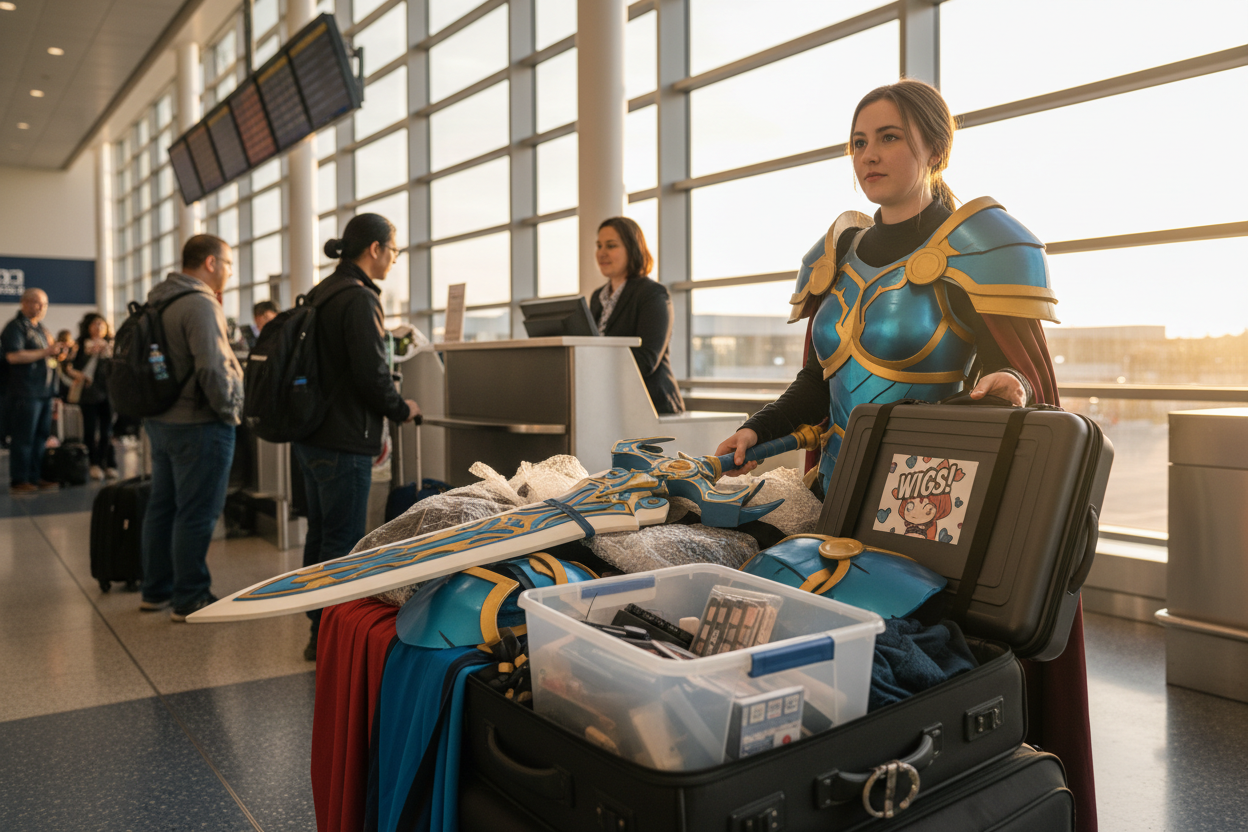
If you've ever searched "can I bring a cosplay sword through airport security" or "how do I keep a wig from getting crushed in my suitcase" the week before a con, you're in good company — these are consistently among the most-asked questions in r/animeexpo, r/dragoncon, and r/SDCC in the weeks leading up to a major event. Getting your costume and props to a convention in one piece is its own logistics puzzle, separate from actually building the cosplay. Here are the five questions that come up most often, answered directly first, then explained in more depth.
Question 1: Can I bring cosplay props like swords, knives, or staffs through TSA?
Direct answer: It depends heavily on the material and design — foam and lightweight 3D-printed props are generally fine, but anything with a sharp edge, a rigid metal core, or a design that could pass as a functional weapon is a risk, even if it's "just a costume prop." When in doubt, check it rather than carry it on.
TSA agents aren't trained to distinguish "obviously a costume prop" from "obviously a real weapon" the way a fellow cosplayer would — their job is to assess whether an item could function as one, and prop weapons are evaluated on that basis rather than on intent or context. This is exactly why foam and soft PVC-style props tend to clear security screening without issue, while wooden or rigid-core props are far more likely to get flagged for secondary inspection or confiscated outright, even when they're clearly costume pieces with painted detailing. 3D-printed props generally fall somewhere in between — plastic filament typically isn't treated as a weapon risk, but a design with a functional-looking blade edge or a metal core insert (common for structural rigidity in longer props) can still trigger the same scrutiny as a wooden version.
The safest overall strategy is checking any prop that isn't unmistakably soft and harmless, rather than gambling on a carry-on approval at the gate. A confiscated prop is a bigger loss than a slightly less convenient checked bag.
Question 2: Should cosplay props go in checked luggage or carry-on?
Direct answer: Checked luggage is the safer default for almost any prop beyond something soft and clearly non-weapon-like. Carry-on is only worth risking for props you're confident read unambiguously as costume pieces to airport security.
The tradeoff here is risk versus convenience. Carry-on keeps your prop with you and avoids the possibility of checked-bag damage, but it also means a security agent makes a judgment call on the spot, and if they decide against it, you may lose the prop entirely rather than just being inconvenienced. Checked luggage removes that judgment-call risk almost entirely, but introduces a different one: rougher handling during loading and transit, which matters a lot for anything rigid or delicate.
If you do check a prop, pack it as if it needs to survive being dropped — wrap it in soft clothing or bubble wrap, position it in the center of the suitcase away from the outer walls, and avoid packing anything heavy directly on top of it. For props that are genuinely fragile or expensive to replace, some cosplayers specifically choose lightweight foam builds over their original wood or resin plans purely because foam tolerates rough baggage handling far better — a Lightweight Foam Props option isn't just easier to travel with through security, it's also less likely to arrive at your destination cracked or bent from being checked.
Question 3: How do I pack a long wig without crushing it or making it tangle?
Direct answer: Store the wig on its own stand or form if possible, or loosely coil it inside a breathable bag with the roots secured and the ends left unrestricted — never stuff a styled wig flat into the bottom of a suitcase.
This is one of the most consistently discussed logistics problems in cosplay travel communities, and for good reason: a wig that's been carefully styled can lose that shape entirely if it's crammed flat under other luggage for a multi-hour flight. The core packing principle is to avoid sharp folds or compression at the roots, since that's where synthetic fiber is most prone to permanent creasing.
If you're traveling with a wig cap or a collapsible travel wig stand, securing the wig on that before placing it in your bag — rather than removing it and packing the loose wig directly — keeps the internal shape intact and prevents the strands from shifting and tangling against each other during transit. A mesh wig bag adds an extra layer of protection against friction-based tangling without adding meaningful bulk to your luggage. Investing in proper Cosplay Wig Storage & Accessories before your trip is genuinely one of the highest-value purchases for frequent convention travelers, since a single crushed or tangled wig can cost far more in replacement or professional restyling than a travel case does upfront.
Question 4: How do I get wrinkles out of my costume without an iron in a hotel room?
Direct answer: A travel-size garment steamer is the most reliable hotel-room fix, but if you don't have one, hanging the costume in the bathroom during a hot shower for 15–20 minutes with the door closed will loosen most fabric wrinkles through ambient steam.
This is a genuinely common last-minute scramble, since most hotel rooms either don't have an iron at all or only provide one at the front desk with a wait involved. A compact travel steamer solves this cleanly and works on far more fabric types than an iron does, since steaming doesn't require direct fabric contact and heat pressure the way ironing does — which matters for costume pieces with beading, printed designs, or delicate trims that an iron could easily damage or melt.
If you didn't bring a steamer, the hot-shower method is a genuinely effective backup: run the shower as hot as it will go, hang your costume piece on the back of the bathroom door or shower rod (not directly in the water), close the door, and let the steam build up in the enclosed space for 15–20 minutes. It won't produce results as crisp as an actual steamer, but it reliably softens moderate travel-fold wrinkles enough to look presentable in photos. This trick shows up constantly in con-prep TikTok content precisely because it requires zero extra packing — you're using something every hotel room already has.
Question 5: What do I do if my wig gets tangled or damaged during travel?
Direct answer: Start with a wide-tooth comb from the ends upward in small sections, never brushing from the root down through a tangle. For heat-friendly synthetic wigs, a light mist of wig-safe detangling spray before combing makes a significant difference; for non-heat-resistant wigs, avoid any direct heat entirely.
Emergency wig repair is one of those situations where doing it wrong can cause more damage than the tangle itself. Brushing straight down through a knot from the root pulls and stretches synthetic fibers, sometimes permanently, whereas working small sections from the very ends upward gradually loosens the tangle without putting stress on fibers that are already caught. A wide-tooth comb is far gentler than a standard hairbrush for this kind of repair work, and it's worth packing one specifically for travel even if you don't normally use one at home.
If the wig is heat-resistant, a light detangling spray followed by very low, brief heat application (a travel-size flat iron on its lowest setting, used sparingly) can help reset flattened or bent sections that a comb alone won't fully correct. If you're not certain your wig is heat-resistant, skip this step entirely — applying heat to a non-heat-resistant synthetic wig can melt or warp the fiber instantly and irreversibly, which is a far worse outcome than a tangle you can still work out by hand.
Summary & Further Reading
Getting your cosplay to a convention intact comes down to anticipating the two biggest travel risks — security screening for props, and compression/tangling for wigs — and packing deliberately around both rather than treating cosplay gear like regular luggage. Foam and lightweight prop materials clear security more reliably and survive checked-bag handling better than rigid alternatives, and a wig that's properly stored and supported during transit will save you significant restyling time once you arrive.
Suggested further reading:



Hinterlasse einen Kommentar
Diese Website ist durch hCaptcha geschützt und es gelten die allgemeinen Geschäftsbedingungen und Datenschutzbestimmungen von hCaptcha.