Table of Contents
-
Chapter 3: Advanced Perspective — Where Most Creators Actually Land
-
Chapter 4: Tools and Resources for Every Point on the Spectrum
If you've spent any time in cosplay spaces on X or TikTok recently, you've likely seen a version of this argument play out — often around characters with striking, popular designs like Chainsaw Man's Makima or Power, or Stellar Blade's Eve.
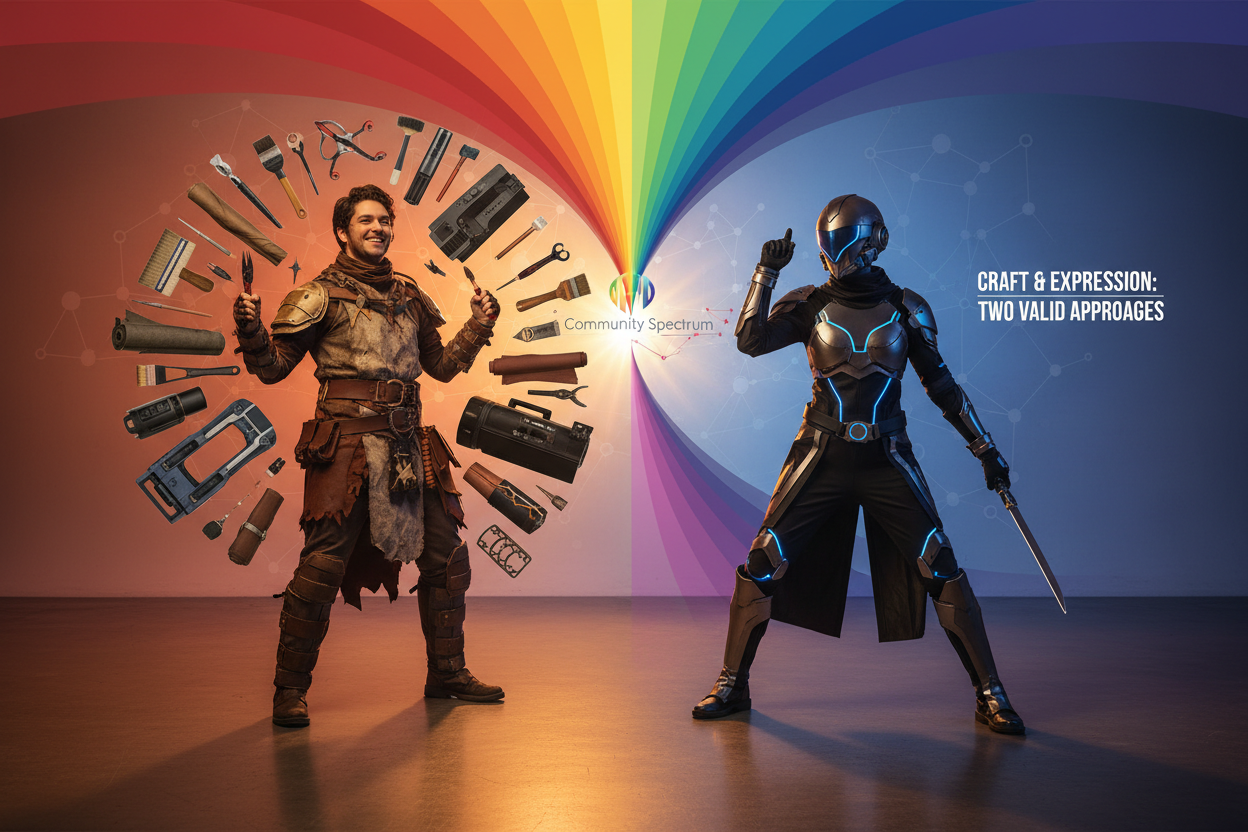
One side argues that a wig paired with a form-fitting or revealing outfit bought off the shelf isn't "real" cosplay, and that it crowds out creators who spend dozens or hundreds of hours building screen-accurate costumes and props from scratch. The other side argues that this framing is gatekeeping dressed up as craftsmanship discourse, and that cosplay has always been, at its core, about expressing love for a character — not about meeting an unofficial labor requirement, and definitely not about policing what someone's body looks like in the process.
This debate isn't new, but it resurfaces hard every time a striking character design goes viral, and it's worth understanding both sides clearly — not to pick a winner, but so you can figure out where you actually stand and build your own cosplay practice with intention rather than getting pulled into a fight that isn't really about you.
Chapter 1: What the "Gatekeeping" Debate Actually Is
At its core, this argument is about two different (and both legitimate) things people value in cosplay, colliding under the same label.
-
The craftsmanship-focused view holds that cosplay's value comes largely from the labor and skill involved — sewing, prop-building, wig styling, armor fabrication — and that a costume assembled almost entirely from pre-made pieces, especially when a large part of its appeal is a revealing or sexualized presentation, doesn't reflect that same investment, even if it recreates the character's silhouette accurately. From this view, the concern isn't really about modesty — it's about a sense that skill-intensive work is getting less visibility and support than lower-effort content optimized for a different kind of engagement.
-
The expression-focused view holds that gatekeeping around "what counts" as real cosplay has a long, uncomfortable history — cosplay communities have previously drawn lines around body type, gender, race, and now presentation, often in ways that disproportionately target women and hypersexualized character designs specifically, rather than applying consistent standards across the board (a hyper-detailed armored costume rarely gets accused of "not really counting" the way a minimal, skin-baring one does). From this view, insisting on a labor threshold for legitimacy misses the point that plenty of characters — including both Makima, Reze, and Eve — are themselves designed with sex appeal as a deliberate part of the character, and a cosplayer choosing to lean into that isn't cheapening the craft, they're interpreting the character accurately.
It's worth being honest that both of these positions are coherent and held in good faith by a lot of people, and that most of the loudest online arguments collapse a nuanced disagreement into an all-or-nothing fight. Understanding that nuance is the actual useful takeaway here — not deciding which side is "right."
Chapter 2: A Framework for Deciding Your Own Approach
Rather than trying to settle a community-wide argument, it's more useful to figure out what you personally want out of your own cosplay practice, since that answer will look different for almost everyone reading this.
-
If your primary motivation is skill development and craft, then the amount of construction, prop-building, and detail work you put in is genuinely part of what you're getting out of the hobby — the process itself is the reward, separate from how any single video or post performs. In that case, leaning further into build-heavy, technically ambitious projects will likely be more personally satisfying than chasing views with a quick, low-build-effort look, regardless of what anyone else is doing.
-
If your primary motivation is character expression and connection, then focusing on getting a character's essence — color, silhouette, energy, personality — across as effectively as possible, by whatever means genuinely work for you, is a completely legitimate goal on its own terms. A cosplayer who feels most connected to Makima through a sleek, form-fitting interpretation isn't required to justify that choice against an external labor standard to make it "count."
-
If your primary motivation is audience growth and content performance, it's worth being clear-eyed that these are different goals from either of the above, and that's fine — but it's useful to actually name that to yourself rather than pretending the choice is purely about craft or expression when it's really about what performs well in the algorithm. There's nothing wrong with optimizing for engagement; it's just a different lens than the other two, and being honest about which lens you're using helps you make decisions (and handle criticism) more confidently.
Most cosplayers, in practice, are working from some blend of all three motivations depending on the project, the character, and the moment — which is exactly why this debate keeps reigniting instead of resolving. There's no single correct ratio.
Chapter 3: Advanced Perspective — Where Most Creators Actually Land
The loudest voices in any online debate tend to represent the extremes, but the more instructive middle ground is worth studying directly. A meaningful share of experienced cosplayers who've been through several rounds of this exact argument have landed on a version of the same conclusion: craftsmanship and self-expression aren't actually opposites, and framing them as a binary is what makes the debate feel so unresolvable in the first place.
Plenty of highly skilled costume-builders also produce lighter, lower-build "closet cosplay" or styled looks between major projects — not as a lesser substitute for their craft work, but as a genuinely different, faster form of the same underlying hobby. Likewise, plenty of cosplayers known primarily for stylized, sensual interpretations of characters also invest real skill into wig styling, makeup artistry, and posing — forms of craft that don't always get counted in "how many hours did you sew" discourse, but are genuine skills nonetheless.
It's also worth noting a case that repeatedly shows up in cosplay discourse: characters whose official source-material design is already form-fitting or overtly sexualized — which both Makima and Eve arguably are — put pressure on the "low effort" framing specifically, since a screen-accurate recreation of those characters inherently involves a revealing silhouette regardless of how much construction work went into achieving it.
This is a genuinely useful thing to sit with regardless of which side of the debate you lean toward: some of the harshest "that's not real cosplay" criticism gets aimed at costumes that are, in fact, highly accurate to a character's actual canon design — which suggests the real disagreement in a lot of these arguments is about sexualized content broadly, using craftsmanship language as the vehicle, rather than being purely about labor and effort at all.
Chapter 4: Tools and Resources for Every Point on the Spectrum
Whichever end of this spectrum you're building toward, there's a legitimate toolkit for it, and most active cosplayers end up drawing from both categories over time.
-
For build-heavy, craftsmanship-focused projects: pattern-drafting software and printed patterns for accurate garment construction, EVA foam and worbla for armor and prop fabrication, a reliable sewing machine and serger for clean seams, and quality wig-styling tools (heat-safe combs, wig clips, a canvas head) for accurate hair sculpting.
-
For styled, expression-focused looks: high-quality pre-styled wigs in accurate colors, well-fitted bodysuits or lingerie-adjacent pieces in character-accurate colors and patterns, colored contact lenses, and body-safe makeup and contouring kits for definition and character-accurate markings.
-
For everyone, regardless of approach: a good lighting setup and camera or phone rig (covered in more detail in our editorial cosplay photography guide, and posing references specific to your character, since posing and expression do as much work as the costume itself in selling a character's energy either way.
Frequently Asked Questions
-
Is there an official definition of what "counts" as cosplay? No. Cosplay has never had a formal, universally agreed-upon definition or requirement, which is part of why this debate resurfaces so consistently — there's no governing body settling it, just an ongoing, evolving community conversation.
-
Are the craftsmanship-focused critics always wrong to feel frustrated? Not necessarily — concerns about skilled, labor-intensive work getting less visibility than lower-build content reflect a real and understandable frustration about how attention and algorithms currently work, separate from any judgment about individual creators' choices.
-
Is it fair to call this criticism "gatekeeping" across the board? Not always, and it's worth applying the label carefully — some criticism genuinely is about broader visibility and algorithm dynamics rather than policing any individual's presentation, while other criticism specifically singles out sexualized content or certain body types in ways that echo cosplay's less flattering history around exclusion. Both patterns show up in real discourse, and it's worth distinguishing which one you're actually looking at case by case.
-
Do I have to pick a side to participate in cosplay? No. The framework in Chapter 2 is designed specifically so you can build a personal practice around your own motivations without needing to publicly align with either camp — most cosplayers who've been in the hobby a while have learned to tune this particular argument out rather than engage with it directly.
Summary and Related Resources
This debate isn't going to resolve into a single consensus anytime soon, and it's genuinely served by both perspectives being heard rather than one side definitively "winning" — craftsmanship concerns about visibility and labor are real, and so are concerns about inconsistent, exclusionary policing of presentation and body type. What's actually useful is getting clear on your own motivations rather than getting pulled into a fight about someone else's.
If you're figuring out where your own next project falls on this spectrum, check out our guides on build-heavy prop and armor fabrication basics, wig styling for accurate character silhouettes, and posing techniques that sell a character's energy regardless of build complexity.

Hinterlasse einen Kommentar
Diese Website ist durch hCaptcha geschützt und es gelten die allgemeinen Geschäftsbedingungen und Datenschutzbestimmungen von hCaptcha.