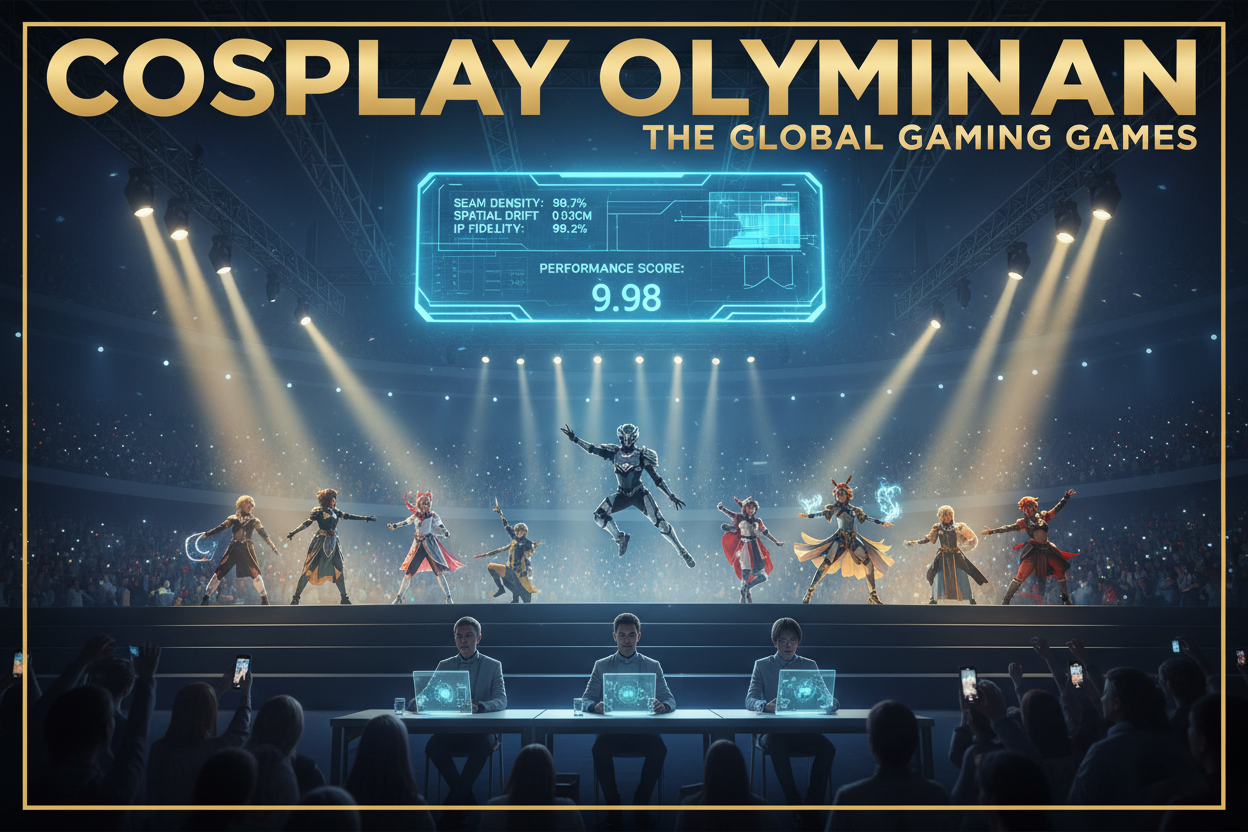
💡 Editorial Note: For nearly three decades, the pinnacle of competitive cosplay—typified by global structures like the World Cosplay Summit (WCS) network—operated on a foundation of "subjective theatrical magic." Winners were crowned based on a judge's emotional resonance, visual shock value, and artistic intuition. In 2026, that romantic era of romanticized judging has come to an end. Driven by institutional scaling and the need for transparent corporate auditing, major global cosplay events are replacing panels of guest judges with rigorous, codified Formal Judging Standardization Systems. By transforming a community hobby into a structured sport with strict metrics, the industry faces an identity crisis: Is cosplay undergoing a necessary evolution into an elite sport, or is the scoring system destroying the creative soul of the subculture?
1. The 2026 Institutional Upgrade: From Artistic Mood to Mathematical Scoring
The traditional backstage of a premier cosplay championship used to be a space of frantic artistic energy, where judges roamed with clipboards making notes on "presence," "vibe," and "creative spirit." If a costume was slightly flawed but possessed a brilliant theatrical spark, it could easily sweep the podium.
In 2026, the backstage has been replaced by an environment resembling an Olympic gymnastics marshal's ring. Under the newly deployed Standardized Scoring Models, global tournaments have officially declared war on the "impression score."
This transition represents an aggressive structural upgrade from open-ended artistic critique to an automated, auditable utility index. The motivation behind this change is structural. As major game publishers and global media conglomerates inject substantial cash prizes and marketing investments into international competition circuits, they require verifiable, clear results that can withstand corporate scrutiny.
If a performance wins purely because a judge liked a specific character's portrayal, it creates an unpredictable marketing environment. By institutionalizing a rigid scoring matrix, events have removed personal preference from the equation, forcing the art form to align with the objective criteria of a technical sport.
2. The Precision Grid: Deep Dive Into the Standardized Judging Matrix
To achieve total auditing transparency, the 2026 standard judging architecture splits a competitor’s entry into three completely independent, non-overlapping scoring categories. Each category is calculated down to two decimal places using a fixed set of technical parameters.
                  ┌─────────────────────────────────────────┐
                  │   2026 Standardized Cosplay Scoring     │
                  └────────────────────┬────────────────────┘
                                       │
         ┌─────────────────────────────┼─────────────────────────────┐
         ▼                             ▼                             ▼
┌─────────────────┐           ┌─────────────────┐           ┌─────────────────┐
│     COSTUME     │           │   PERFORMANCE   │           │  PRESENTATION   │
│ CRAFTSMANSHIP   │           │   ENGINEERING   │           │  & IP FIDELITY  │
│     (40%)       │           │      (30%)      │           │      (30%)      │
├─────────────────┤           ├─────────────────┤           ├─────────────────┤
│ • Seam Density  │           │ • Tech Timing   │           │ • Perspective   │
│ • Material Rep  │           │ • Spatial Drift │           │ • Dynamic Lift  │
│ • Inner Linings │           │ • Load Balances │           │ • Flow Rates    │
└─────────────────┘           └─────────────────┘           └─────────────────┘
| Primary Evaluation Category | Weight | Specific Technical Metric Evaluated | Objective Verification Methodology |
| Costume Craftsmanship | 40% |
• Stitch Consistency & Seam Tension • Raw-Edge Overlocking & Lining Integrity • Material Authenticity & Pattern Math |
Structural stress testing; microscopic check of interior garment linings and seam allowances under raw lighting. |
| Performance Engineering | 30% |
• Audio-Visual Cue Synchronization • Spatial Drift & Prop Stability • Mechanical Load-Bearing Integrity |
Electronic time-stamp logging against stage media feeds; motion-tracking analysis of structural prop deviation. |
| Presentation & IP Fidelity | 30% |
• Specular & Reflective Index Matching • Architectural Proportion Accuracy • Dynamic Fluid Material Kinematics |
Real-time optical analysis comparing physical movement and textile float curves against original in-game asset files. |
📋 3. Technical Breakdown: Iconic Characters Under the Scoring Matrix
To demonstrate how this mathematical transition alters the competitive reality for elite fabricators, we reverse-engineer four top-tier character designs across gaming, contemporary performance, and classic anime. Under the 2026 judging system, each presents specific technical bottlenecks where a single millimeter of error results in automated point deductions.
1. Mona Genshin Impact Cosplay Costume
Architectural Demands & Material Selection
The design of the Astrologist Mona Megistus from Genshin Impact is a masterclass in high-tension silhouette construction. Her look centers on a skin-tight, asymmetrical indigo-and-violet leotard contrasted against a massive, top-heavy astrologer's hat and intricate, floating metallic accents.
To survive the Costume Craftsmanship (40%) inspection matrix, a premium mona genshin impact cosplay costume must abandon generic four-way stretch materials. Under tension, standard spandex thins out, causing color distortion and white-out under stage lighting. Advanced fabricators deploy a 380g custom-dyed nylon-lycra double-knit composite, providing consistent opacity across deep flex zones.
The primary craftsmanship checkpoint is the integration of the thigh-high gradient stockings:
-
The transition from midnight violet to bare skin must avoid visible seam lines.
-
The pattern maker must execute a flawless flat-lock flat-seam stitch (Flatlock 3-Needle/4-Thread) directly into the leotard base.
-
This ensures the vertical seam runs precisely along the anatomical mid-line of the leg without twisting or puckering during stage movement.
The Scoring System Death Trap
Under the 2026 rules, the greatest risk factor for Mona sits within the Performance Engineering & Prop Stability category. Her massive hat is highly susceptible to aerodynamic drag when moving across a stage.
If the internal support frame shifts even 1.5 centimeters off-center during an athletic turnaround, the real-time tracking cameras log a structural deviation, triggering an automatic deduction under the "Spatial Drift" sub-metric. To counter this, elite competitors build an internal vacuum-formed thermoplastic skullcap liner lined with medical-grade silicone grip pads, mechanically securing the hat to the cranium independently of the wig fibers.
Specs
-
Critical Metric: Structural hat axis drift and flatlock seam tracking under maximum garment tension.
-
Material Formula: 380g nylon-lycra composite, internal vacuum-formed thermoplastic crown, 3-needle flatlock seams.
-
Scoring Risk: High penalty vulnerability in Performance Engineering due to aerodynamic destabilization of headwear assets.
2. Changli Wuthering Waves Cosplay Set
Architectural Demands & Material Selection
Changli, the counselor of Jinzhou from Wuthering Waves, embodies a sophisticated "New Chinese Kinetic Fluidity" aesthetic. Her uniform is defined by an asymmetrical, split-paneled gradient chiffon gown that flows out like a vermillion bird's wings, stabilized by a rigid, strapless leather bodice and structural side hip panels.
When evaluating a competitive changli cosplay wuthering waves set under the Presentation & IP Fidelity (30%) category, judges focus heavily on Dynamic Fluid Material Kinematics. The gradient skirt cannot use flat polyester georgette, which gathers static electricity and clings to the legs, disrupting the flow of the garment.
The standard requires a premium 75D high-twist pure silk chiffon, which has been treated with a specialized anti-static coating. The edge of her asymmetrical hem must be completed with an ultra-fine three-thread rolled hem stitch (0.5mm density) using weighted monofilament thread, ensuring the edge maintains natural weight to guide the fabric's movement through the air during stage choreography.
The Scoring System Death Trap
The absolute scoring trap for Changli lies in her rigid side hip flaps, which must project outward at a crisp 45-degree angle from her waist. Under the old system, static appearance was everything. Under the 2026 system, judges enforce the Active Silhouette Retention test.
During the pre-stage engineering audit, the competitor must perform a standard lateral jump. If those side flaps drop, flex, or lose their precise angular alignment upon impact due to inadequate reinforcing, the craftsmanship score drops automatically. Competitors are forced to abandon simple foam inserts, turning instead to 0.8mm internal spring-steel plates riveted directly into a heavy-weight horsehair braid core.
Specs
-
Critical Metric: Active silhouette retention of structural hip wing modules under kinetic load testing.
-
Material Formula: 75D anti-static high-twist silk chiffon, 0.5mm weighted rolled hems, 0.8mm internal spring-steel support plates.
-
Scoring Risk: Severe deductions in IP Fidelity if the gradient chiffon panels bunch, stick, or show uneven color saturation across motion capture sweeps.
3. K-Pop Rumi Stage Performance Outfit
Architectural Demands & Material Selection
Representing the modern intersection of high-octane stage performance and contemporary subculture streetwear, Rumi's outfit from the K-Pop Demon Hunters universe introduces a distinct class of apparel into competitive arenas: Performance-Grade Haute Couture. The look demands a complex fusion of hyper-reflective holographic vinyl, heavy industrial chrome hardware, and structured tactical mesh panels optimized for high-velocity choreography.
The construction of a competitive kpop rumi stage performance outfit operates under the strict rules of Stage Haute Couture & Fast-Motion Resilience:
-
The main cropped jacket must be drafted from a high-molecular-weight holographic PU laminate that remains flexible under quick articulation.
-
Standard adhesive backing is illegal under this scoring matrix; every individual holographic panel must be interlocked using an industrial-grade nylon bonded thread (Size 69) to prevent seam failure during rapid choreography.
The critical craftsmanship checkpoint is the tensile strength of the inner performance corset. The garment must feature a triple-layered coutil lining fitted with spiral steel boning to withstand continuous 140 BPM dance routines without shifting out of alignment on the torso.
The Scoring System Death Trap
Rumi’s design faces intense scrutiny under the Technical Execution & Motion Resilience criteria. If a competitor executes a high-impact dance routine and a single metallic fringe, rhinestone accent, or chrome buckle detaches and falls onto the stage floor, the system registers a Major Material Dislodgement Failure.
Similar to a gymnastics deduction for stepping out of bounds, this triggers an automatic, unappealable point drop. To pass this technical audit, every single metal accent must be cross-stitched manually through the primary fabric and secured on the interior with industrial nylon locking washers.
Specs
-
Critical Metric: Seam tensile strength and absolute attachment integrity of metallic hardware under high-impact motion.
-
Material Formula: Holographic PU laminates, size 69 bonded nylon threads, triple-layer coutil cores, internal spiral steel bones.
-
Scoring Risk: High point deductions for accent loss or garment displacement during high-velocity performance routines.
4. Mitsuri Kanroji Cosplay Demon Slayer Uniform
Architectural Demands & Material Selection
The Love Hashira, Mitsuri Kanroji from Demon Slayer, presents a deceptive structural challenge that combines traditional Japanese sewing with highly unrealistic weapon physics. Her ensemble includes a custom-tailored Demon Slayer Corps uniform jacket with an open chest panel, a pleated skirt, a sweeping white haori coat, and her unique, whip-like nichirin blade.
The primary hurdle for a mitsuri kanroji cosplay demon slayer entry in the Costume Craftsmanship tier is the construction of her white haori. The matrix rejects simple polyester sheets. It demands a traditional heavy-weight woven jacquard cotton featuring a subtle tone-on-tone basket-weave texture.
The open-chest jacket requires precise stabilization: to ensure the plunging lapels remain flush against the skin during sudden stage movements without gaping open, pattern makers must build a hidden contoured internal twill tape stay matrix anchored to a flesh-toned, medical-grade silicone inner adhesive strip.
The Scoring System Death Trap
The ultimate scoring challenge for Mitsuri is her whip-like sword under the Performance Engineering & Spatial Dynamics sub-category. In the anime, the blade bends freely like ribbon steel. Replicating this effect safely on stage while maintaining control is an engineering obstacle.
If the whip blade flops loosely or twists uncontrollably during swings, the performer loses valuable points for weapon handling. To maximize points within the 2026 standardized guidelines, elite fabricators use a custom tapered 1095 high-carbon spring steel strip, ground down to a thickness of 0.6mm at the tip. This creates a blade that flexes fluidly along a singular, predictable vector, allowing for clean, rhythmic swings that track perfectly across automated stage capture sensors.
Specs
-
Critical Metric: Controlled fluid vector tracking of the whip-blade and lapel stability during high-velocity swings.
-
Material Formula: Heavy woven jacquard cotton, 1095 high-carbon spring steel (0.6mm taper), internal twill tape stay matrices.
-
Scoring Risk: High potential for deductions under Performance Engineering if the flexible sword blade exhibits chaotic, unpredictable movement arcs.
4. The Structural Battleground: Creativity vs. The System
The deployment of these formal judging standardization systems has sparked an intense ideological war across community hubs like Reddit, Discord, and international artisan circles. The community has fractured into two distinct philosophical camps.
┌─────────────────────────────────────────────────────────────────────────────────────────┐
| r/cosplay • Posted by u/Artisan_Tailor_01 • 5 days ago                                  |
| 🧵 The Death of the Art: How Standardization is Choking Out Cosplay Creativity          |
|                                                                                         |
| I watched the WCS qualifying rounds yesterday, and the results broke my heart. A builder |
| presented an incredible, experimental multimedia costume made from hand-woven organic   |
| bark and raw textured canvas to represent a rare fantasy creature. It was a masterpiece.  |
|                                                                                         |
| But because the raw canvas edges were intentionally left frayed to match the character's |
| wild design, the new standardized matrix penalized it under "Seam Finish Integrity."    |
| It lost to a clean, basic school uniform build that scored perfectly on stitch count.    |
|                                                                                         |
| We are no longer encouraging artists to push boundaries. We are training automated       |
| seamstresses to build low-risk, uninspired garments that check boxes on an audit sheet. |
|                                                                                         |
| 💬 2.1k Comments  |  Share  |  Save  |  Hide                                           |
+-----------------------------------------------------------------------------------------+
📉 The Case for the Scoring System: Total Accountability
Proponents of standardization argue that a structured matrix is the only way to ensure fairness in an industry that has grown into a major professional sector. Under the old subjective system, judging panels were regularly accused of bias, giving higher marks to well-known influencers or favoring flashy, oversized prop builds over superior tailoring work.
A quantified, transparent scoring grid levels the playing field completely. It ensures that an unknown, independent craftsman from a small workshop can step onto a global stage and defeat an industry celebrity purely on the merits of their technical execution. For these advocates, standardization doesn't limit the craft—it honors it by treating cosplay with the same objective respect given to elite sports like figure skating or competitive diving.
📉 The Case for Creative Freedom: The Loss of the Subculture Soul
Conversely, critics argue that the athletic codification of cosplay is systematically destroying its creative core. When every stitch, material choice, and performance second is monitored for point optimization, artists stop taking creative risks.
To guarantee high marks under a rigid matrix, competitors naturally gravitate toward predictable, safe materials and proven, formulaic character designs. Experimental fabric manipulation, avant-garde silhouettes, and unconventional performance choices become major financial and competitive liabilities. The subculture risks trading its history of bold, transformative imagination for a sanitized, corporate-friendly product loop.
5. ❓ Frequently Asked Questions (FAQ)
Q: Do these standardized rules apply to casual convention attendees and hallway cosplay?
A: Not at all. These formal judging systems are strictly confined to premier, high-tier competitive tracks like WCS qualifiers, national championships, and corporate-sponsored gaming events. Casual hallway cosplay, fan meetups, and open convention costume showcases remain entirely unregulated, celebrated for their community spirit and personal creative expression.
Q: How can independent builders adapt their workflows to succeed under the 2026 scoring rules?
A: Success under the new rules requires treating the interior of a garment with the exact same focus as the exterior surface. Competitors must implement clean, professional finishing techniques, including clean overlocked seams, hidden zipper paths, and fully finished interior linings. Additionally, documenting every step of the fabrication process with precise engineering logs helps verify material choices and pattern math during the pre-stage judging audit.
🎯 Conclusion: The Balance Between Precision and Passion
The rise of formal judging standardization systems represents a major milestone in the maturation of global cosplay culture. The transition from an unstructured hobby into an audited, performance-driven discipline reflects the massive global reach of modern ACG intellectual properties.
For event organizers and corporate sponsors, these metrics provide the stability and clarity needed to support large-scale international investments. For the creator community, it presents a demanding test of technical skill and adaptability.
The ultimate challenge for the competitive scene moving forward will be ensuring that precision does not erase the passion that built the subculture. Whether engineering the perfect structural hat support for a mona genshin impact cosplay costume, reinforcing the precise angular lines of a changli cosplay wuthering waves set, securing every metallic accent on a kpop rumi stage performance outfit, or tuning the carbon-steel flex of a whip-blade for a mitsuri kanroji cosplay demon slayer entry—the master competitors of 2026 are proving that true artistic excellence does not fear documentation. It uses the rules to build a flawless showcase of physical craftsmanship.


Hinterlasse einen Kommentar
Diese Website ist durch hCaptcha geschützt und es gelten die allgemeinen Geschäftsbedingungen und Datenschutzbestimmungen von hCaptcha.