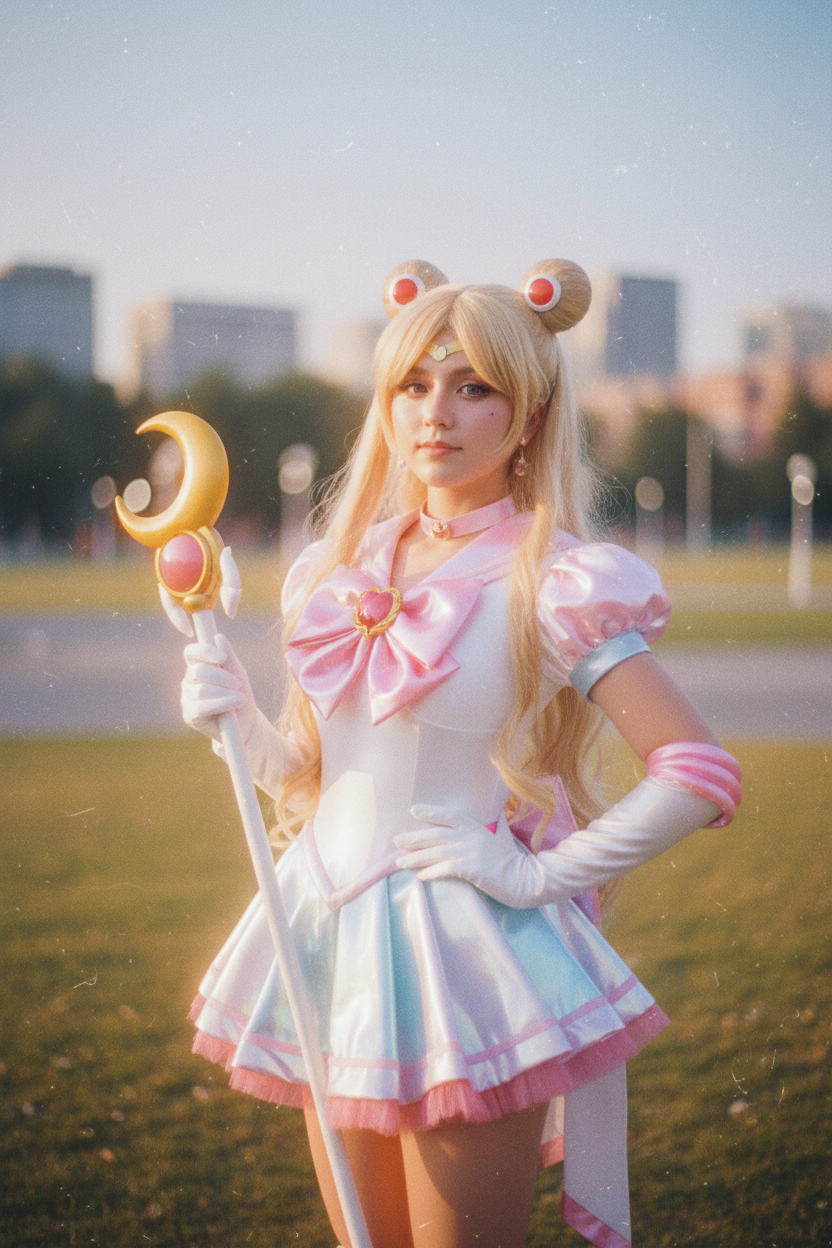
Retro anime Facebook groups have been having a moment. Longtime fans of Sailor Moon, Yu Yu Hakusho, and Neon Genesis Evangelion are trading their high-resolution, heavily edited convention photos for something rougher, softer, and deliberately imperfect — shot on old CCD digital cameras, vintage point-and-shoots, or film, chasing the same hazy, slightly oversaturated look those shows actually had when they aired.
It's part of a much bigger CCD digicam revival sweeping social media generally, but in retro anime communities specifically, it's become something closer to a genuine renaissance — nostalgia not just for the characters, but for exactly how those characters used to look on a CRT television in the 90s. Here are the three questions people are asking most as this trend keeps growing.
Question 1: What is the "CCD digicam" look, and why does it fit retro anime cosplay so well?
Direct answer: CCD cameras use an older sensor type that produces soft, slightly grainy, oversaturated images with a distinct color cast — an aesthetic that closely echoes the warm, slightly hazy visual texture of hand-painted cel animation from the 80s and 90s.
The technical explanation is genuinely part of why this look feels so nostalgic. CCD (Charge-Coupled Device) sensors, standard in digital cameras throughout the early-to-mid 2000s before CMOS sensors took over, have notably lower dynamic range and less sophisticated white balance processing than modern smartphone cameras. In practice, this produces blown-out highlights, a subtle blue-green or cyan-magenta color cast under certain lighting, soft micro-grain at base ISO, and punchy, slightly unnatural color straight out of the camera — all quirks that read as "flaws" by modern photography standards but that people are now deliberately chasing for exactly the mood they create.
What makes this especially fitting for retro anime cosplay is that 80s and 90s cel animation has its own set of visual "imperfections" that modern digital animation smoothed away — soft color gradients from hand-painted cels, a slightly warm and desaturated palette compared to today's vibrant digital coloring, and a gentle graininess from film-transfer broadcasting. Shooting a Sailor Moon or Yu Yu Hakusho cosplay on a CCD camera essentially layers one generation's "imperfect" visual texture on top of another's, and the two turn out to complement each other closely enough that the resulting photo genuinely feels like it could be a freeze-frame from the original broadcast rather than a modern reference to it. It's a meaningfully different goal from most cosplay photography, which typically chases maximum clarity and color accuracy — here, the "flaws" are the entire point.
Question 2: Which retro anime series are driving this Facebook nostalgia wave, and why?
Direct answer: Sailor Moon, Yu Yu Hakusho, and Neon Genesis Evangelion are the three anchor franchises, largely because each has a passionate, aging fanbase old enough to remember watching them air, alongside strong crossover appeal to a wider Y2K nostalgia audience already primed for retro content.
Each of these shows carries a slightly different flavor of nostalgia, which is part of why they're driving group discussion so effectively rather than just individual posts.
-
Sailor Moon benefits from being tightly wrapped up in the broader mid-2010s and Y2K nostalgia wave already sweeping social media — its soft pastels, magical girl transformation aesthetic, and status as many millennials' first anime make it a natural anchor point for a "remember when" post, and its character designs translate especially well to CCD photography's soft, glowing highlight style.
-
Yu Yu Hakusho, currently approaching its 25th anniversary and still actively supported with new official merchandise and artwork, draws a slightly different crowd — fans nostalgic for a specific, grittier shonen era before more modern anime visual conventions took over, and its darker color palette photographs with a moodier, more atmospheric quality under CCD's characteristic contrast.
-
Evangelion sits in its own category almost entirely — its combination of cultural weight, iconic character design (Misato and Rei in particular), and a visual style that was already moody and atmospheric even in its original broadcast form makes it an especially strong match for the grainy, slightly melancholic quality that CCD photography naturally produces.
Facebook groups built around these franchises also tend to skew toward an older, more established member base than newer platforms, which is exactly the audience most likely to have genuine memories of watching these shows during their original broadcast — a big part of why "I remember exactly where I was when I watched this" comments show up so consistently under these posts, and why they tend to generate long, engaged comment threads rather than quick likes and scrolls past.
Question 3: What do you actually need to recreate the CCD look for your own cosplay photos?
Direct answer: Either a genuine vintage CCD-sensor digicam (many Canon PowerShot, Sony Cyber-shot, and Nikon Coolpix models from the early-to-mid 2000s work well and are inexpensive secondhand) or a dedicated digicam-style editing app or preset applied to modern photos — both approaches are widely used within the trend.
If you want the most authentic version of this look, sourcing an actual CCD-sensor camera is more accessible than it might sound — plenty of early-2000s compact digicams from Canon, Sony, and Nikon can be found secondhand for well under $100, and their small size makes them genuinely easy to bring along to a con or a photoshoot alongside your usual camera gear. Shooting with the camera's built-in flash rather than avoiding it is often part of getting an authentic result, since the flat, slightly overexposed quality of built-in digicam flash is a defining feature of the aesthetic, not a mistake to correct in editing.
If sourcing a real camera isn't practical, a genuinely large share of people participating in this trend are working entirely through editing apps and presets designed specifically to replicate the CCD look on modern photos — the technique generally involves deliberately clipping (blowing out) highlights rather than protecting them, boosting vibrance and color saturation well beyond what looks "natural," adding a moderate amount of grain or noise, and avoiding the softened, lifted-black adjustments associated with film emulation, since digicam and film aesthetics are visually distinct despite both falling under a broader "retro" umbrella.
For retro anime cosplay specifically, pairing either method with lighting and posing choices reminiscent of the original character art — softer, more diffused lighting rather than sharp directional light, and posing that echoes iconic character stills rather than dynamic action shots — tends to sell the overall effect more convincingly than the camera or editing technique alone.
Summary and Further Reading
The CCD and retro anime photography revival works because it's chasing something deeper than a filter trend — it's recreating the actual visual texture of how these shows were originally experienced, which is exactly what makes it land so effectively with the older, nostalgia-driven Facebook communities built around them. Whether you go the route of a genuine secondhand digicam or a dedicated editing preset, the core principle is the same: lean into the imperfections rather than correcting them.
If you're building out a retro-styled cosplay photoshoot, check out our guides on styling accurate 90s anime hairstyles and wigs , choosing costume fabrics that hold up well under flash photography, and putting together a Sailor Moon or Yu Yu Hakusho-accurate look from the ground up.

Hinterlasse einen Kommentar
Diese Website ist durch hCaptcha geschützt und es gelten die allgemeinen Geschäftsbedingungen und Datenschutzbestimmungen von hCaptcha.