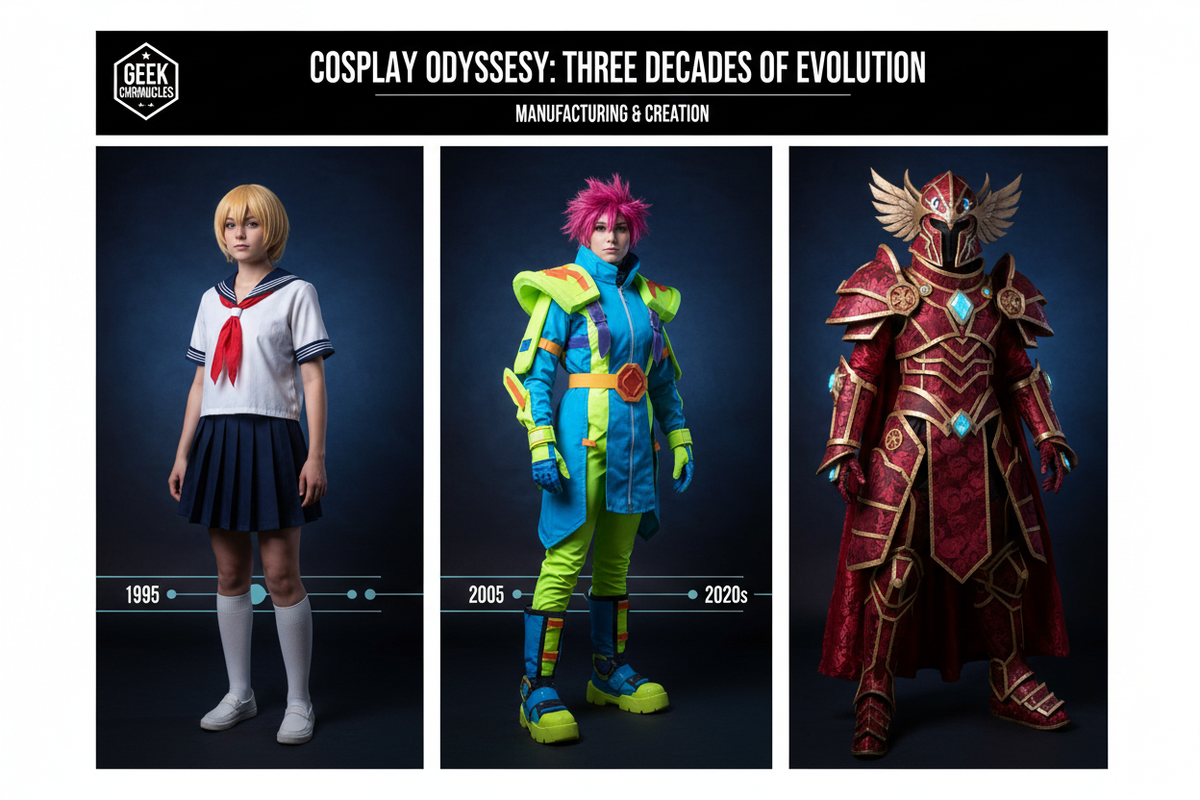
Commercial costume production is often perceived as a recent byproduct of modern social media culture. However, the commercial cosplay costume manufacturing industry spans over three decades of systematic refinement. Beginning with the founding of pioneering specialized apparel manufacturers like COSPA in May 1995 in Tokyo, ready-to-wear costumes shifted from localized home tailoring into an organized global market.
Understanding this history provides valuable perspective on how manufacturing techniques, sizing standards, and material choices have transformed over thirty years.
Table of Contents
-
Quick Comparison: The 3 Eras of Commercial Cosplay Production
-
1. The Licensed Pioneer Era (1995 – Mid-2000s): Standardized Off-the-Shelf Outfits
-
2. The Global E-Commerce Expansion Era (Mid-2000s – Mid-2010s): Mass Factory Direct
-
3. The High-End & Artisan Hybrid Era (Late 2010s – Present): Bespoke Screen Realism
-
How to Navigate the "Commercial vs. Handmade" Debate: A Historical Perspective
Quick Comparison: The 3 Eras of Commercial Cosplay Production
| Evolution Era | Core Manufacturing Characteristics | Advantages | Limitations | Target Audience & Primary Use Case |
| Era 1: Licensed Pioneer (1995 – Mid-2000s) | Official studio licensing, standardized woven polyesters, basic screen printing | High copyright compliance, durable stitch work, reliable sizing | Limited character rosters, static sizing charts, basic synthetic fabrics | Convention attendees seeking officially approved staple anime uniforms. |
| Era 2: Global E-Commerce (Mid-2000s – Mid-2010s) | Direct-to-consumer factory output, digital dye-sublimation, broad character catalogs | Rapid costume availability, lower entry prices, expanded size ranges | Inconsistent fabric weight, flat printed textures, thin lining materials | Budget-conscious fans requiring fast turnarounds for emerging media trends. |
| Era 3: High-End Hybrid (Late 2010s – Present) | High-density jacquard, 3D printing, embedded ventilation, modular multi-layer tailoring | Screen-accurate 3D depth, ergonomic long-wear comfort, structured drape | Higher price investment, specialized dry-cleaning requirements | Veteran cosplayers, stage performers, and convention floor marathoners. |
1. The Licensed Pioneer Era (1995 – Mid-2000s): Standardized Off-the-Shelf Outfits
Core Features & Industry Foundation
The origin of professional cosplay costume manufacturing was established when Japanese media conglomerates recognized fan demand for officially approved garments. Companies introduced strict quality control, durable stitching, and official licensing tags. Early manufacturing relied on heavy synthetic wovens, simple cotton twills, and standard screen-printed emblems to recreate iconic school uniforms, martial arts gi sets, and classic anime robes.
                    [ 30-YEAR MANUFACTURING EVOLUTION PATH ]
                                       │
     ┌─────────────────────────────────┼─────────────────────────────────┐
     ▼                                 ▼                                 ▼
1995: Licensed Pioneer             2005: Global E-Commerce           2020s: High-End Hybrid
- Standardized uniform cuts        - Mass factory production         - High-density jacquard & brocade
- Basic polyester & twill          - Dye-sublimation printing        - Hidden mesh ventilation & 3D prints
- Official studio approvals        - Direct global web shipping      - Modular tailored sets
Strengths & Limitations
-
Pros: Established the legitimacy of commercial cosplay, introduced consistent garment durability, and protected intellectual property rights.
-
Cons: Production cycles were slow, character selection was confined to top-tier mainstream titles, and rigid sizing lacked flex for non-standard body proportions.
Ideal Audience
Ideal for fans collecting historical officially licensed apparel or cosplayers seeking classic, durable school and military uniforms.
2. The Global E-Commerce Expansion Era (Mid-2000s – Mid-2010s): Mass Factory Direct
Core Features & Industry Foundation
With the rise of international e-commerce platforms, commercial cosplay costumes underwent a massive globalization shift. Dedicated garment factories in East Asia streamlined mass production using automated pattern cutters and heat-transfer dye sublimation. This era democratized access worldwide, allowing fans to purchase full costume packages—including wigs, props, and garments—from centralized online storefronts.
Strengths & Limitations
-
Pros: Dramatically reduced retail prices, expanded catalog choices to thousands of niche characters, and shortened order turnaround times.
-
Cons: Over-reliance on thin, flat dye-sublimated polyester created a uniform glossy shine under flash photography, frequently sacrificing tactile fabric texture.
Ideal Audience
Ideal for entry-level cosplayers, casual convention attendees, and group costumes operating under strict budget constraints.
3. The High-End & Artisan Hybrid Era (Late 2010s – Present): Bespoke Screen Realism
Core Features & Industry Foundation
Modern cosplay manufacturing combines industrial textile technology with bespoke artisan craftsmanship. Today’s premium costumes move away from flat printed polyesters, adopting high-density woven jacquard, raised brocades, laser-cut faux leather, and integrated 3D-printed armor fittings. Furthermore, manufacturers now prioritize long-wear ergonomics, featuring breathable inner mesh linings and modular layering systems.
This era led to the development of all-in-one high-end finished sets, offering cosplayers studio-ready garments right out of the box.
Strengths & Limitations
-
Pros: Exceptional visual depth under camera lighting, screen-accurate structural drape, reinforced stress seams, and enhanced wearability during multi-hour convention days.
-
Cons: Involves higher initial investment costs and requires careful maintenance, such as spot-cleaning or dry-cleaning delicate embroidered elements.
Ideal Audience
Ideal for competitive stage performers, convention floor photography, and veteran cosplayers who prioritize realistic material textures over low-cost alternatives.
How to Navigate the "Commercial vs. Handmade" Debate: A Historical Perspective
The debate surrounding commercial production versus self-made tailoring has existed since commercial manufacturing first emerged in 1995. Examining thirty years of industry data reveals that commercial production did not replace individual craftsmanship—it expanded the community's overall reach.
                      [ THE MODERN HYBRID COSPLAY ECOSYSTEM ]
                                         │
     ┌───────────────────────────────────┴───────────────────────────────────┐
     ▼                                                                       ▼
Commercial Base Garments                                    Independent Tailoring & Modifications
- Provides complex heavy jacquard coats                     - Customized fit using independent patterns
- Delivers screen-accurate embroidery                       - Hand-weathered paint & LED integration
- Saves hundreds of hours on base construction              - Personalized prop & wig styling
Modern cosplayers frequently adopt a hybrid approach:
-
Time Efficiency: Utilizing pre-manufactured base outfits crafted with complex weaves allows makers to concentrate their time on advanced prop construction, wig styling, and LED programming.
-
Material Accessibility: Industrial looms produce intricate jacquard and brocade patterns that would be cost-prohibitive for individual hobbyists to weave from scratch.
-
Pattern Integration: Many makers pair commercial structural garments with independent designer cosplay patterns to modify, resize, or heavily weather outfits for bespoke artistic expression.
Summary & Further Reading
Over the past thirty years, professional cosplay manufacturing has evolved from simple licensed fan apparel into an advanced textile sector focused on material realism and ergonomic comfort. Recognizing this history highlights how industrial innovations continue to support fan creativity across all skill levels.
Related Industry Analyses & Tailoring Guides:
-
All-in-One High-End Finished Cosplay Sets: Exploring modern bespoke tailoring and screen-accurate costume sets.
-
Independent Designer Patterns vs. Commercial Sets: A balanced comparison of self-tailored patterns versus factory production.
-
Professional Cosplay Costumes Collection: Explore heat-optimized, high-density jacquard garments built for convention durability.
![Genderbend Cosplay Ultimate Guide: From Beginner to Master [2026 Edition]](http://www.cosplayreal.com/cdn/shop/articles/cover-genderbend-cosplay.png?v=1789148679&width=1248)

Leave a comment
This site is protected by hCaptcha and the hCaptcha Privacy Policy and Terms of Service apply.