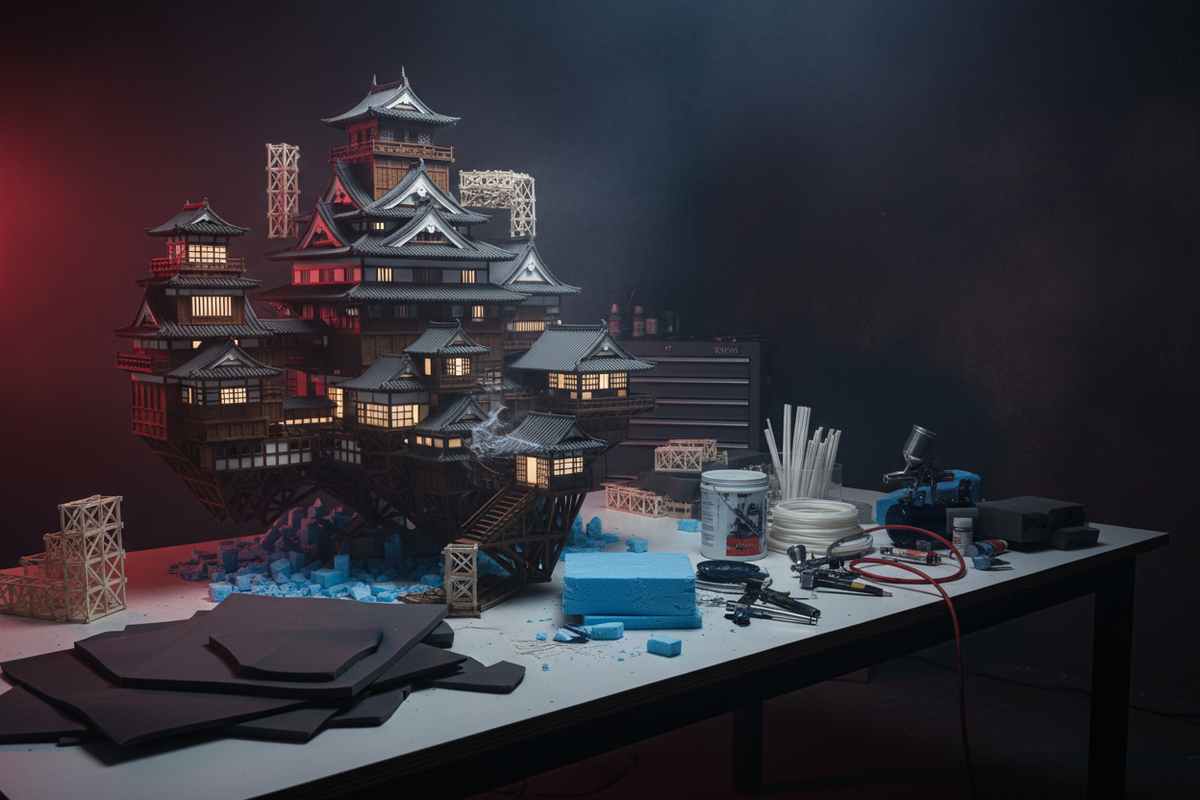
When creator sam_meeps posted the final reveal of their handcrafted Demon Slayer Infinity Castle coffee table prop on TikTok, the clip exploded past 1.5 million likes and 8,000 comments. The viral success proved a dominant social media trend: audiences are obsessed with witnessing the end-to-end cosplay prop making process for massive, complex builds.
Recreating the distorted, gravity-defying wooden architecture of Nakime’s Dimensional Infinity Castle requires more than standard cardboard. From load-bearing interior framing to intricate Japanese Shoji lattice work, executing a large-scale Infinity Castle cosplay prop demands specialized materials that balance structural durability with lightweight portability.
This guide breaks down the top 5 essential materials and tools used by top prop makers to construct large Demon Slayer cosplay props, evaluated by structural strength, ease of fabrication, and overall cost.
Selection Criteria & Target Audience Overview
This roundup is tailored for intermediate to advanced makers, prop sculptors, and content creators planning ambitious convention displays or viral video builds. Each recommended material was selected based on three criteria:
-
Structural Strength-to-Weight Ratio: Can it support large architectural volumes without warping or collapsing under convention handling?
-
Surface Finish Versatility: Does it accept wood-grain scoring, wood stains, priming, and weathering?
-
Short-Form Content Impact: Does the fabrication process yield visually satisfying transition frames for TikTok and Instagram Reels?
Quick Comparison Table: Top Large-Scale Prop Making Materials
| Material / Tool | Core Highlight | Relative Cost | Workability / Ease | Ideal Structural Use |
| 1. High-Density EVA Foam (100–125 kg/m³) | Flexible, heat-formable, sharp edge retention | Moderate ($20–$45 / roll) | High (Cutter & Heat Gun) | Beams, sliding doors, decorative trims |
| 2. XPS Insulation Board (Extruded Polystyrene) | Ultra-lightweight massing for large structures | Low ($15–$35 / sheet) | High (Hot Wire & Saw) | Base architecture, castle walls, staircases |
| 3. 3D Printing Filaments (PETG/PLA+) | Precision geometry for intricate lattice work | Moderate ($18–$30 / kg) | Moderate (CAD & Printer setup) | Shoji screens, biwa instruments, lanterns |
| 4. Epoxy Resins & Fiberglass Reinforcement | Armor-like rigidity & load-bearing support | High ($40–$90 / kit) | Advanced (Safety gear required) | Internal skeletons, table frames, joint pins |
| 5. Gravity-Feed Airbrush & Weathering Acrylics | Realistic wood-grain depth & aged shadows | Moderate ($50–$120 / set) | Moderate (Layering technique) | Final painting, wood staining, aged patina |
1. High-Density EVA Foam (100–125 kg/m³) — The Universal Builder's Choice
High-density Ethylene-Vinyl Acetate (EVA) foam remains the backbone of modern DIY cosplay props. Unlike soft floor mats, high-density foam allows sharp beveling, clean bevel scoring for wood-like planks, and crisp seam sealing.
                   [ EVA FOAM WOOD-BEAM WORKFLOW ]

1. Score Planks ──────► 2. Heat Expand ──────► 3. Wire Brush Grain ──────► 4. Seal & Prime
Cut line grooves for    Open foam pores with   Scrape brass wire along    Coat with Flexbond/
timber planking look    heat gun treatment     surface for natural timber Flex Seal before paint
-
Core Features: Easily cut with utility knives, heat-shaped at $250^\circ\text{F}$, and glued using contact cement. Retains crisp engraved details when textured with a rotary tool or brass wire brush.
-
Pros: Highly resilient to impacts; lightweight enough for wall-mounted or floating castle modules.
-
Cons: Requires thorough priming (Flexbond, Kwik Seal, or PlastiDip) before painting to prevent acrylic absorption.
-
Ideal For: Crafting timber beams, sliding fusuma doors, roof tiles, and wearable structural accents. Essential for any store of cosplay prop making supplies.
2. Extruded Polystyrene (XPS) Foam — Maximum Volume with Zero Weight
When tackling a massive Demon Slayer Infinity Castle prop tutorial build, filling vast spatial volumes with solid wood or resin is impractically heavy. Pink or blue XPS insulation foam board offers maximum physical presence with minimal weight.
                 [ XPS ARCHITECTURAL STRUCTURAL PIPELINE ]
                                   │
 ┌─────────────────────────────────┴─────────────────────────────────┐
 ▼                                                                   ▼
1. Hot Wire Block Carving                           2. Surface Hardening
- Cut multi-tiered wooden staircases                - Coat in PVA glue / Sculpting Compound
- Stack floating room platforms                     - Sand smooth for wood-plank texturing
-
Core Features: Dense closed-cell foam that can be carved cleanly with hot-wire cutters, rasps, and sandpaper without crumbling like cheap styrofoam.
-
Pros: Extremely affordable per square foot; allows creators to construct full-scale room dioramas or coffee table bases.
-
Cons: Solvents in spray paint will dissolve raw XPS foam; must be coated in PVA glue, Worbla, or foam coat first.
-
Ideal For: Large architectural bases, multi-level stairs, inverted ceilings, and floating room modules.
3. 3D Printing Filaments (PETG/PLA+) — Precision Digital Craftsmanship
The labyrinthian architecture of Nakime's fortress features repetitive, highly complex wood lattices, paper screens, and ornamental fixtures. 3D printing allows creators to turn 3D models into exact physical components.
                   [ DIGITAL TO PHYSICAL WORKFLOW ]

[ 3D Model Design ] ──► [ PETG High-Strength Slice ] ──► [ Resin/Filler Sanding ]
Design Shoji lattice     Print with 3 perimeter walls    Fill layer lines with primer
-
Core Features: PETG and PLA+ filaments deliver high tensile strength and fine detail resolution. SLA resin printers handle micro-details like Nakime's Biwa tuning pegs.
-
Pros: Guarantees 100% geometric symmetry across dozens of identical window screens or structural bracket joints.
-
Cons: Long print times; requires post-processing (sanding and filler primer) to eliminate visible layer lines.
-
Ideal For: Kumiko-style wooden lattices, mini lanterns, structural connectors, and delicate instrumental props.
4. Epoxy Resin & Glass Composite Reinforcement — Structural Rigidity for Load-Bearing Builds
For builds like sam_meeps' viral coffee table or large large-scale cosplay props designed for convention floors, pure foam lacks the structural strength to support weight or withstand crowd bumps. Reinforcing structural spines with epoxy resin and fiberglass mesh creates an unbreakable shell.
-
Core Features: Two-part low-viscosity epoxy resin cures into a rock-hard composite matrix when combined with fiberglass cloth or carbon-fiber rods.
-
Pros: Provides structural load-bearing capabilities; locks foam layers into a rigid, permanent shape that will never bend or sag.
-
Cons: Requires strict safety gear (organic vapor respirator, nitrile gloves, adequate ventilation); longer cure times ($12\text{–}24\text{ hours}$).
-
Ideal For: Internal support skeletons, tabletop surface coatings, load-bearing joint pins, and transparent glowing resin elements.
5. Airbrush Systems & Acrylic Weathering Paints — Bringing Ancient Wood to Life
The Infinity Castle aesthetic relies heavily on rich, aged wood tones, dark shadows, and atmospheric contrast. A gravity-feed airbrush paired with fluid acrylic washes elevates raw foam into weathered historical timber.
                  [ WOOD-GRAIN PAINTING TECHNIQUE ]
                                   │
 ┌─────────────────────────────────┼─────────────────────────────────┐
 ▼                                 ▼                                 ▼
1. Dark Base Coat                 2. Warm Timber Mid-Tones          3. Ambient Shadowing
- Deep reddish-brown acrylic      - Golden oak airbrush spray       - Black/burnt umber glaze
- Fills deep grain grooves        - Highlights raised wood grain    - Enhances depth under lighting
-
Core Features: Dual-action airbrushes allow precise control over paint flow and misting, enabling smooth shading along panel joints and interior corners.
-
Pros: Creates realistic depth in seconds; uses minimal paint layer weight compared to heavy brush coats.
-
Cons: Requires regular cleaning to prevent needle clogs; demands practice to master subtle shading transitions.
-
Ideal For: Wood grain staining, tatami mat shading, faux lantern glow effects, and dramatic depth accentuation.
How to Choose the Right Cosplay Prop Making Supplies for Your Build?
Choosing the ideal combination of materials depends on your project's physical requirements and display environment:
-
For Portable Convention Props: Combine High-Density EVA Foam with internal carbon fiber rods. This keeps the build ultra-lightweight while resisting accidental hall impacts.
-
For Large Photo Backdrops & Room Dioramas: Use XPS Insulation Board as your primary volumetric base, sealed with PVA and airbrushed with acrylics to save hundreds of dollars in material costs.
-
For High-Strength Display Furniture or Centerpieces: Build a structural skeleton using Epoxy Resin & Fiberglass, then skin the outer surfaces with 3D Printed Lattice and textured EVA foam for maximum visual realism.
Summary & Creator Resources
Mastering how to make large cosplay props requires blending lightweight volume materials like XPS and EVA foam with high-precision tools like 3D printing and airbrush weathering. By selecting the right structural foundations, you can transform ambitious digital concepts into viral, real-world masterpieces like the Infinity Castle.
Ready to Start Your Next Epic Prop Build?
Upgrade your workshop before tackling your next project! Explore our verified selection of cosplay prop making supplies to find premium EVA foam sheets, thermoplastic, structural adhesives, and detailing tools. For more step-by-step fabrication breakdowns, check out our cosplay guides and tutorials hub!



Leave a comment
This site is protected by hCaptcha and the hCaptcha Privacy Policy and Terms of Service apply.