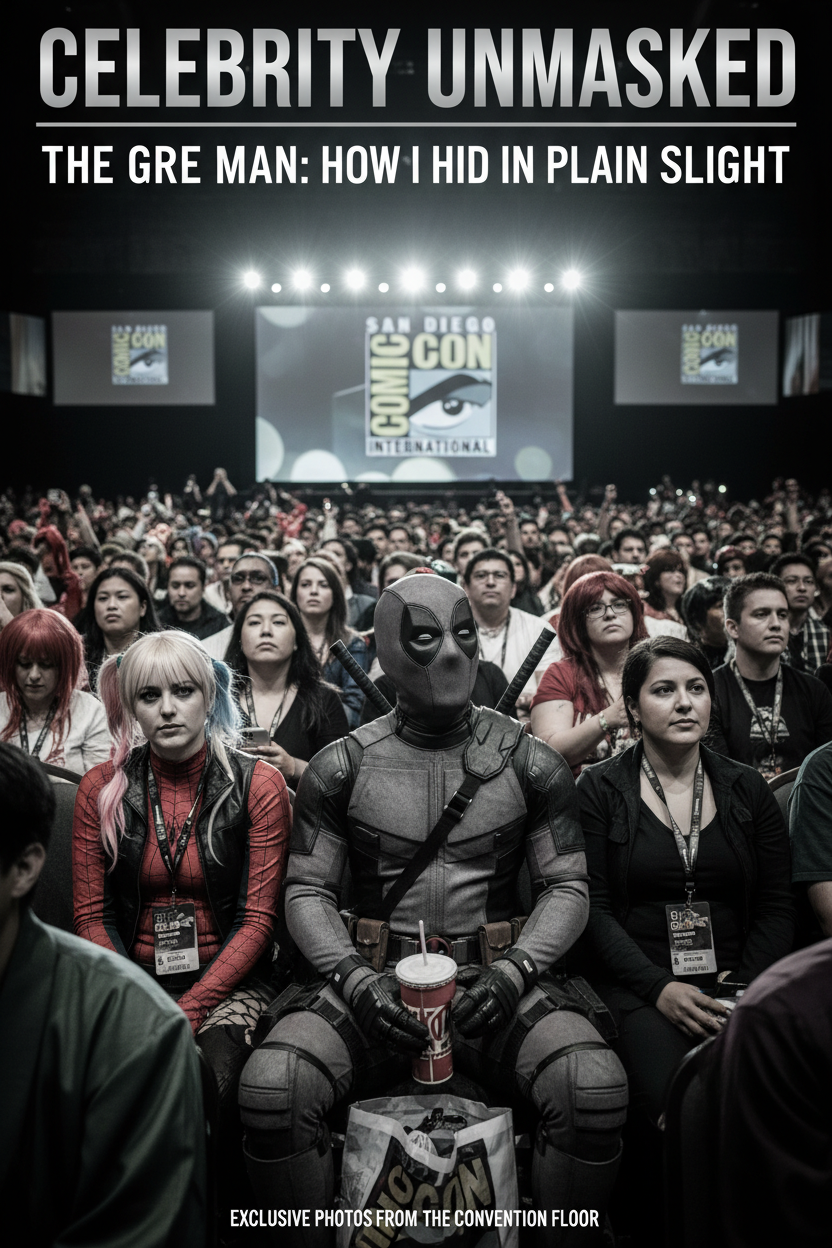
TL;DR: At San Diego Comic-Con 2026, Ryan Reynolds spent part of Marvel Studios' Hall H panel sitting in the audience disguised as a grey X-Force version of Deadpool, going by the name "Ricky," before <cite index="14-1">revealing himself during the panel by questioning the Avengers: Doomsday cast</cite>. Nobody in the crowd recognized him until the reveal. It's a fun story on its own, but it's also a genuinely useful case study in what actually makes a costume convincing — even Hollywood's own leading actors rely on the same craft principles any cosplayer does to disappear into a crowd.
Why This Story Resonates: The Deep Logic Behind Celebrity Incognito Cosplay
Ryan Reynolds cosplay stunts like this one land so well with audiences for reasons that go beyond simple novelty, and understanding those reasons says something real about why cosplay culture works the way it does.
It validates cosplay's core promise: a good enough costume genuinely erases identity. Cosplayers have always known that a well-executed build can make a person unrecognizable, but there's something uniquely satisfying about watching the actual actor behind a character prove that same principle works on them too. If Ryan Reynolds — one of the most recognizable faces in Hollywood — can sit in a packed Hall H audience and go completely unnoticed, it's strong, entertaining evidence that the transformative power cosplayers chase is real, not just wishful thinking.
The reveal format taps into a well-established SDCC tradition, which makes the payoff land harder. This wasn't an isolated stunt — it fits a recognizable pattern of <cite index="17-1">celebrities going incognito to create some of the convention's most talked-about surprises</cite>, with <cite index="17-1">Andrew Garfield once stepping up to a microphone in full Spider-Man costume years earlier</cite> as an early example of the format. Because audiences already have a mental category for "surprise celebrity cosplay reveal," a new instance of it — especially one as well-executed as Reynolds' — gets amplified by that existing pattern recognition rather than needing to explain itself from scratch.
It's an unusually effective, low-cost piece of promotion disguised as a fan moment. The stunt happened during a panel where <cite index="19-1">Reynolds interrupted with a question framed as a "long-time listener, first-time caller"</cite> — bringing attention to Deadpool without a formal studio announcement. This blurs the line between marketing and genuine fan culture in a way that reads as playful rather than manufactured, largely because it borrows the actual mechanics of real incognito cosplay (careful costume choice, sustained anonymity, a timed reveal) rather than faking them.
It reinforces something cosplayers already understand: character choice matters as much as execution. Reynolds didn't disguise himself as a random unrelated character — he chose Deadpool, a character built around unpredictability and breaking expectations. The stunt's own logic mirrors the character's personality, and that alignment between disguise and identity is a genuinely useful lesson for anyone building an incognito or surprise-reveal cosplay of their own: the costume works best when the character's nature reinforces the moment you're trying to create, not just when the craftsmanship is technically accurate.
Key Elements: What Makes an Incognito Celebrity Cosplay Actually Work
Looking across multiple real examples of this phenomenon at Comic-Con over the years reveals a consistent set of elements that separate a genuinely successful incognito appearance from one that gets spotted immediately.
Full Character Commitment, Not Just a Costume
The strongest examples go beyond wearing a costume and commit to full character behavior. When <cite index="22-1">Johnny Depp appeared in character as Ebenezer Scrooge for a surprise Comic-Con campaign in 2026</cite>, he stayed in character for an extended stretch, <cite index="22-1">working the crowd for close to half an hour in aging prosthetics, a top hat, and a Victorian overcoat</cite> rather than breaking character after a brief photo moment. This full commitment — accent, mannerisms, in-character responses to fans — is what keeps a disguise convincing under sustained scrutiny, not just a single glance.
Choosing a Look That Genuinely Changes Silhouette and Face
Simple masks alone are a common but imperfect approach — <cite index="16-1">Jack Black once tried to stay unnoticed at Comic-Con wearing a Stormtrooper helmet, though word of his disguise spread quickly anyway</cite>. The more effective examples change more than just the face: full-body costuming, altered posture, and a genuinely different color story (like Reynolds' grey-toned X-Force variant rather than the more famous red Deadpool suit) all work together to disrupt the specific visual cues people actually use to recognize someone.
Blending Into the Crowd Rather Than Standing Apart
Part of what made Reynolds' appearance work was that he behaved like an ordinary convention attendee rather than drawing attention to himself. This mirrors <cite index="18-1">Daniel Radcliffe's account of attending Comic-Con disguised as Spider-Man, where he adopted an American accent and carried a rucksack specifically to look like an ordinary attendee arriving at the convention</cite>, rather than someone performing a costume for attention. The goal in genuine incognito cosplay isn't to be noticed for the costume — it's to disappear into the general crowd until the intended reveal moment.
A Deliberate, Well-Timed Reveal
The moment of revelation matters as much as the disguise itself. <cite index="17-1">Rick Moranis revealed himself from beneath a giant Lord Dark Helmet costume during a Hall H panel</cite>, and <cite index="16-1">Bryan Cranston similarly walked the convention disguised in a realistic Walter White mask before revealing his identity at the Breaking Bad panel</cite>. In both cases, the reveal was planned around a specific moment rather than happening accidentally — which is exactly what turns a good disguise into a genuinely memorable convention moment rather than just an anecdote about someone who wasn't recognized.
Common Misconceptions & Things Worth Correcting
"This only works because they're famous — regular cosplayers can't replicate the effect." The underlying mechanics are identical to what any skilled cosplayer already uses: strong silhouette work, full character commitment, and blending naturally into a crowd rather than performing for attention. The only difference is that celebrities have a well-known face to disguise, which actually makes their success a stronger proof of concept for the technique, not a special case that doesn't apply to anyone else.
"A mask alone is enough to stay unrecognized." As the Jack Black example shows, a partial disguise — particularly one that leaves too much of a person's build, voice, or mannerisms unchanged — often isn't sufficient on its own. The strongest incognito appearances change multiple recognition cues at once (silhouette, coloring, behavior, voice) rather than relying on a single element like a mask or helmet to do all the work.
"These stunts are purely spontaneous fan moments with no promotional angle." Many of these appearances are timed deliberately around a panel, a film announcement, or a franchise moment — which doesn't make them less genuinely fun, but it's worth recognizing that studios and actors increasingly understand incognito cosplay as an effective storytelling and promotional tool, not just a spontaneous lark.
"Getting recognized ruins the stunt." Even when word spreads early, as it did with Jack Black's Stormtrooper appearance, the story itself still becomes part of the convention's folklore and gets covered and discussed regardless. A disguise not lasting the entire event doesn't erase the value or entertainment of the attempt.
Summary and Further Reading
Ryan Reynolds' incognito Deadpool appearance at SDCC 2026 is a fun standalone story, but it's also a genuine case study in what makes any disguise or surprise-reveal cosplay actually succeed: full character commitment, a costume that changes more than just the face, natural crowd-blending behavior, and a deliberately timed reveal. This isn't the first time a celebrity has pulled this off at Comic-Con — from Andrew Garfield and Daniel Radcliffe's Spider-Man appearances to Bryan Cranston's Walter White mask and Johnny Depp's extended Scrooge performance — and the pattern holds every time: the same craft principles that make any cosplay convincing are exactly what make these celebrity stunts work.
Related reading you might find useful next:
- A guide to screen-accurate superhero costume building, for anyone inspired to chase the same level of transformation
- A breakdown of what makes a "guess the cosplay" video format so engaging, since the underlying appeal — not recognizing someone until the reveal — is closely related to what made this SDCC moment go viral

Leave a comment
This site is protected by hCaptcha and the hCaptcha Privacy Policy and Terms of Service apply.