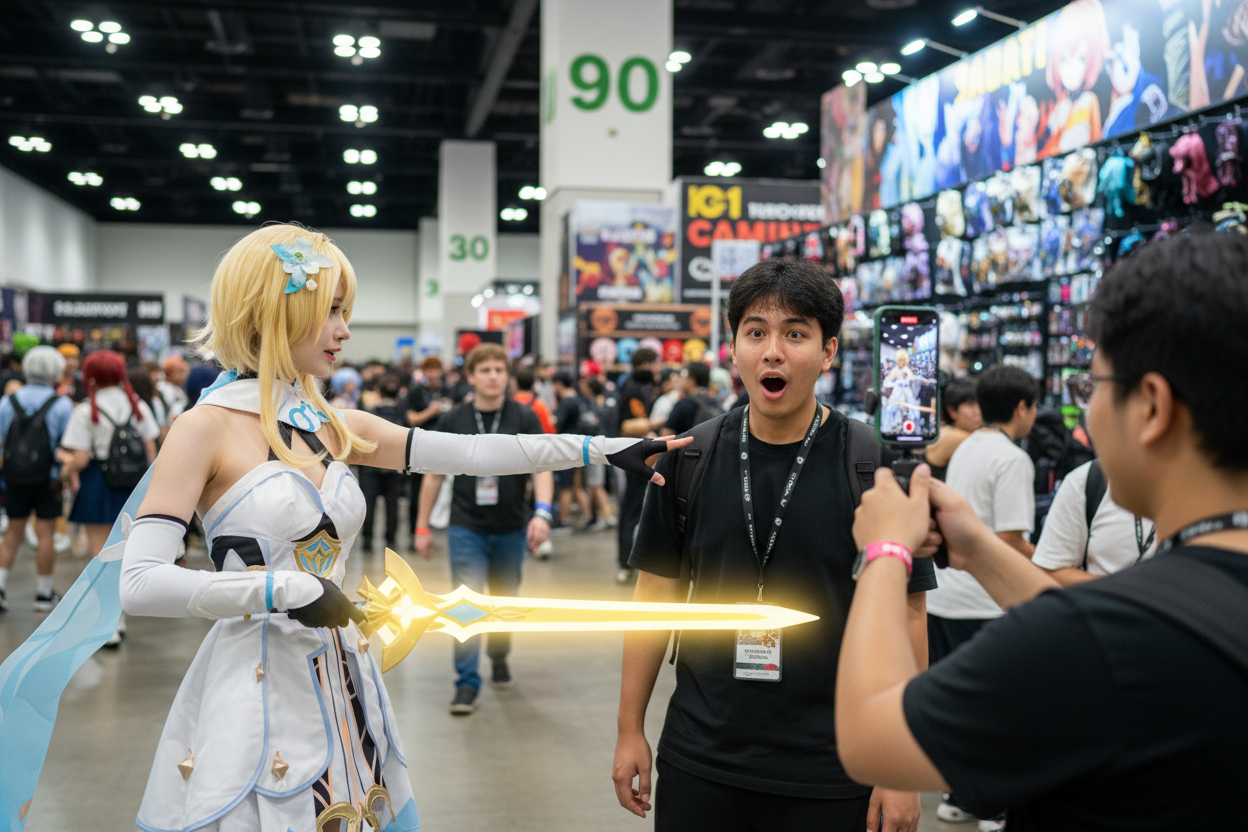
TL;DR: #NPCMode cosplay has cosplayers staying fully in character as a video game NPC — a Genshin Impact merchant, an Elden Ring wanderer, a Stardew Valley villager — performing a looping idle animation in public until a passerby walks close enough to "trigger" a scripted interaction, complete with a prop hand-off and a freeze back into idle. It's exploding on TikTok because it merges an already-viral internet meme (real people performing as "NPCs") with actual game-accurate cosplay, and because genuine, unscripted stranger reactions are some of the highest-performing content on the platform right now.
Why This Trend Is Working So Well Right Now
#NPCMode didn't come out of nowhere — it's the convergence of two trends that were already massive on their own. The first is the broader "NPC" internet phenomenon, where livestreamers began performing as background video-game characters, responding to viewer gifts with repetitive, looping catchphrases and exaggerated expressions, turning the idea of a "non-player character" into a widely recognized comedic bit well beyond gaming circles. The second is convention cosplay's long-running appreciation for in-character performance, where staying fully committed to a character — voice, posture, mannerisms — has always earned more respect and attention than the costume alone.
#NPCMode cosplay is essentially what happens when those two ideas collide: a cosplayer doesn't just dress as a game character, they perform the character's actual function in the game world, complete with the repetitive idle behavior and scripted trigger-based dialogue that defines how NPCs actually work in game design.
That game-design angle is a meaningful part of why the format resonates so strongly with gaming audiences specifically. Anyone who's spent time in an open-world game recognizes the exact rhythm being recreated — a background character stuck in a looping animation, waiting for a player to walk within range before a dialogue prompt fires and a short, often repetitive exchange plays out. Watching that exact interaction pattern performed by a real person, on a real person walking by, creates a strong recognition-based laugh that doesn't require any setup or context — if you've played the game, the joke lands almost instantly.
From a pure content-performance standpoint, this format has another major advantage: it's built entirely around genuine, unscripted reactions. TikTok's algorithm consistently rewards content with strong completion rates and organic engagement, and there's very little that captures authentic surprise, confusion, or delighted laughter better than a real stranger encountering something they didn't expect. Unlike a scripted skit where every reaction is planned, #NPCMode content captures something the creator genuinely can't fake — a passerby's actual, in-the-moment reaction — which gives every video a small element of real unpredictability that keeps viewers watching to see how the person reacts.
Key Elements and How It Plays Out Across Different Games
The strongest #NPCMode videos follow a consistent structural pattern borrowed directly from actual game design: an idle loop, a proximity trigger, a short scripted exchange, a physical prop hand-off, and a reset back to idle. How that structure gets dressed up changes a lot depending on the source game, which is part of what makes this trend so flexible across fandoms.
For a Genshin Impact-style merchant or wandering NPC, the idle loop usually involves small, repetitive gestures — restocking an invisible cart, gesturing toward a prop "shop" table, or repeating a short, sing-song idle phrase under their breath. When a passerby gets close enough, the cosplayer breaks into an exaggerated greeting and offers a small prop item — a fake gold coin, a paper "quest" note, or a small trinket — mimicking the game's dialogue-and-reward loop, then resets back into the idle loop the moment the interaction ends, exactly as an NPC would after a player walks away.
For an Elden Ring-style character, the tone shifts considerably — these performances lean into slow, deliberate movement, a hunched or weathered posture, and cryptic, half-mumbled lines delivered with a dramatic pause before the prop hand-off (often a folded note meant to resemble an in-game item description or a "rune" prop). The comedic contrast here usually comes from just how seriously the performer commits to an unsettling, atmospheric tone in the middle of a brightly lit convention hallway — the deadpan commitment is the joke as much as the game reference itself.
For a Stardew Valley-style villager, the energy flips again toward warm and cheerful — a friendly wave, a repeated small-talk line about the weather or the day's harvest, and a prop gift handed over (a fake vegetable, a small flower, or a "friendship" token), echoing the game's actual gift-giving relationship mechanic. This version tends to generate a different kind of viral reaction than the other two — less shock or confusion, more genuine warmth, which performs especially well with audiences who might not even recognize the specific game but respond to the sweetness of the interaction itself.
Across all three, the common thread is repeatability: a good #NPCMode script is short enough, and physically simple enough, to perform dozens of times in a row throughout a con day without breaking down, which matters both for the performer's stamina and for the content's ability to capture a wide range of different stranger reactions across a single afternoon of filming.
Common Mistakes and Things to Watch For
-
Breaking character too early — laughing, stepping out of the idle animation, or reacting normally to a passerby's response — which undercuts the entire bit. The strongest performers stay fully committed even when a passerby's reaction is unexpected or a little awkward, since that steady, deadpan consistency is a huge part of what sells the joke.
-
Prop durability is a frequent practical issue that gets overlooked in planning. Because a good #NPCMode routine might repeat the same hand-off gesture dozens of times over several hours, flimsy paper props or delicate small items tend to fall apart well before the day is over — it's worth building or sourcing durable convention props specifically designed to survive repeated use, rather than something that only needed to look good in a single photo.
-
Consent and comfort matter more in this format than in most cosplay content, and it's worth taking seriously. Approaching strangers unprompted, especially in a way that startles them, crowds their personal space, or doesn't give them an easy way to politely decline, can turn an intended fun interaction into a genuinely uncomfortable one — and a visibly unwilling or upset reaction doesn't perform well as content anyway. The most successful creators tend to design their trigger moment to be easy to opt out of (a light tap on a table, a gesture rather than a grab) and read body language quickly, disengaging warmly if someone clearly isn't interested rather than pushing the interaction further.
-
Overly complex dialogue is another common misstep — a scripted exchange that runs too long loses the snappy, game-accurate rhythm that makes the format recognizable, and it also cuts down how many interactions you can realistically capture in a day. Shorter, tighter scripts with a clear trigger, one or two lines, and a fast prop hand-off consistently outperform longer, more elaborate scenes.
-
Convention policies — check an event's specific policies before filming this kind of content on-site; some events have rules around approaching other attendees for planned content, staying within designated photo or performance areas, or restrictions on unscripted public interaction, and it's far better to check ahead of time than to get pulled aside by con staff mid-scene.
Summary and Further Reading
#NPCMode works because it takes something gaming audiences already instinctively recognize — the rhythm of an NPC's idle loop and trigger-based dialogue — and performs it with the kind of deadpan commitment that turns a genuine stranger's reaction into the real payoff of the video. If you're planning your own version, focus on a tight, repeatable script, durable hand-off props, and reading the room before you commit to the bit.
For more on building out a convincing NPC-style look, check out our guides on assembling merchant and wanderer-style costume accessories, choosing durable convention props that survive repeated handling, and staying in character for interactive cosplay performance.

Leave a comment
This site is protected by hCaptcha and the hCaptcha Privacy Policy and Terms of Service apply.