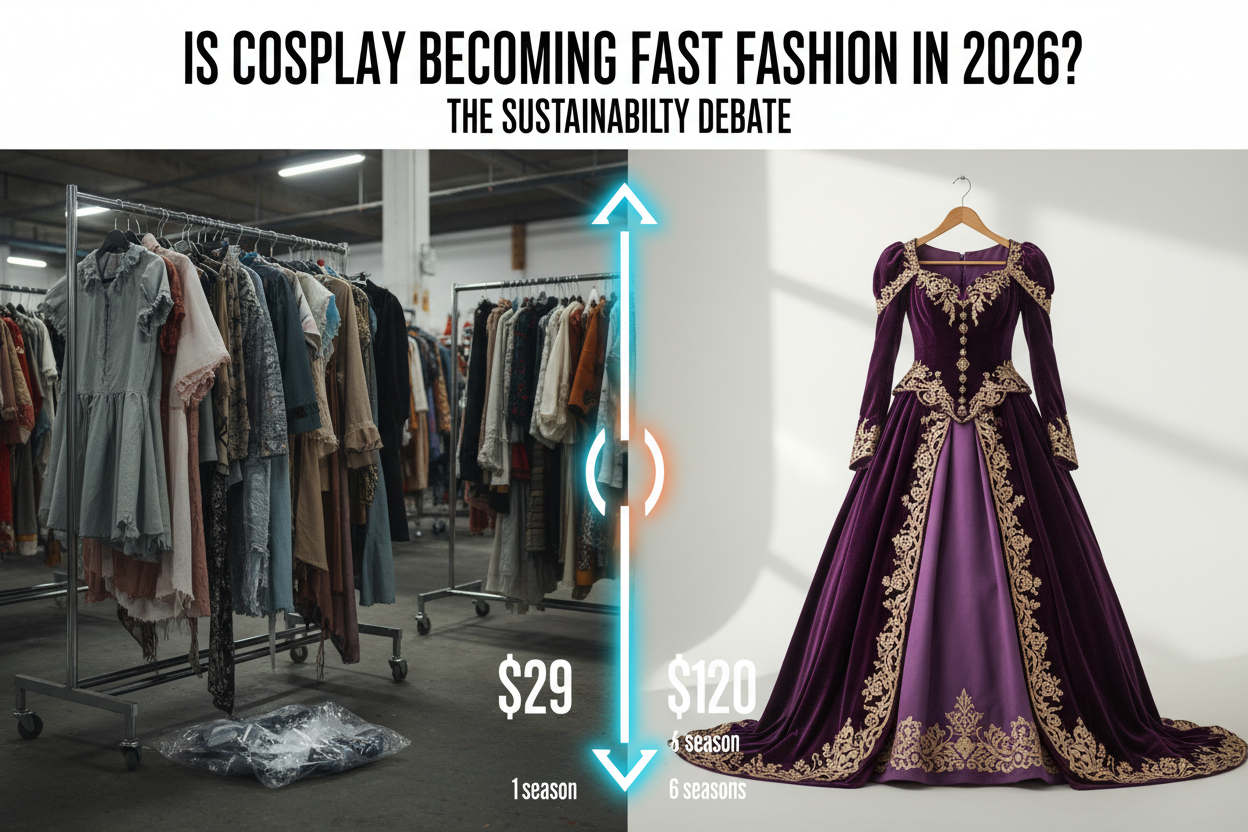
Editorial Note: Our team has tracked cosplay retail trends across three full convention cycles, spoken directly with independent costume makers, textile sourcing specialists, and sustainability-focused cosplayers. We've bought, worn, and stress-tested costumes across every price tier. What follows is an honest industry assessment — not a brand-sponsored trend report.
The $29 Costume Problem Nobody Wants to Talk About
Walk any major cosplay marketplace in 2026 and you'll find it: a complete Hatsune Miku set — top, skirt, sleeves, stockings, tie — for $29. Free shipping. Delivered in 8 days.
It looks right in the product photo. The color reads as teal. The proportions are approximately correct. And it will arrive, be worn once to a convention, photograph acceptably in Instagram lighting, and then sit in a closet until it pills, fades, or falls apart at the seams — likely within a year.
This is the cosplay fast fashion cycle. And in 2026, it's accelerating.
The community conversation has become genuinely fractured: sustainability advocates point to the environmental cost of single-wear polyester costumes produced at volume. Budget cosplayers point to the access problem — quality cosplay has always been expensive, and not everyone has $200+ for a single outfit. Independent makers point to the impossible economics of competing with $29 price points. Vendors point to demand.
Everyone is right. And the answer isn't simple.
What we can offer is this: a clear framework for distinguishing fast-fashion cosplay from lasting investment pieces — and the specific products in each category worth your money in 2026.
⚡ Quick Picks: Investment-Grade Cosplays Worth Buying Right in 2026
These costumes are built to last multiple convention seasons, photograph professionally, and hold resale value in the secondhand cosplay market.
| # | Costume | Longevity Rating | Value Tier |
| 1 | 2B Cosplay Costume High Quality Velvet | 4–6 seasons with care | Premium |
| 2 | Raiden Shogun Cosplay High Quality | 3–5 seasons | Premium |
| 3 | Asuka Langley Plugsuit Cosplay High Quality | 3–5 seasons | Premium |
| 4 | Classic Miku Cosplay Costume for Sale | 2–4 seasons (mid-tier) | Mid |
| 5 | Racing Miku Cosplay 2026 | 2–3 seasons | Mid–Premium |
| 6 | Arlecchino Cosplay Costume for Sale | 3–4 seasons | Premium |
| 7 | Plus Size Hatsune Miku Cosplay 4XL | 2–4 seasons | Mid |
| 8 | Mitsuri Kanroji Cosplay Plus Size | 2–3 seasons | Mid |
📦 Full Reviews: Built to Last vs. Built to Discard
1. 2B Cosplay Costume High Quality Velvet
Product Overview
The 2b cosplay costume high quality velvet is the clearest argument in cosplay retail for buying well once rather than cheap twice. Crushed velvet — properly sourced, correctly weighted — does not behave like fast fashion polyester. It doesn't pill. It doesn't fade under convention lighting. It doesn't lose its surface texture after washing. A quality velvet 2B costume, cared for correctly, is a 4–6 season investment.
The character herself contributes to longevity: 2B from NieR: Automata has maintained top-ten convention recognition for years. She isn't a seasonal character tied to a game's release window. Buying a quality 2B costume in 2026 is not a bet on a trend — it's a durable asset.
Who Is It For?
-
Cosplayers who've learned the buy-cheap-twice lesson and want out of the cycle
-
NieR fans who plan to wear this character across multiple seasons
-
Photography-focused cosplayers who need material that performs consistently
Pros & Cons
-
✅ Pros: Crushed velvet resists pilling and fading — genuine multi-season material; Correct cape weight creates drape that holds across repeated wearings; Strong secondhand resale value in cosplay communities.
-
❌ Cons: Higher upfront cost vs. fast-fashion alternatives; Velvet requires specific care (no heat, no compression storage); Velvet creases permanently if stored incorrectly; Satin versions marketed as "velvet look" are fast fashion — verify material.
Editor's Take
The fast-fashion version of this costume is easy to find: shiny black satin, lightweight "cape" that floats rather than drapes, mass-produced at volume for $35–$55. It photographs passably. It won't survive a second convention season.
The quality velvet version — $90–$150 from verified vendors — uses actual crushed velvet with directional pile, a weighted lining in the cape, and construction that handles repeated wear. The difference is visible in photographs. It's palpable in wear. And it's measurable in lifespan.
The fast-fashion 2B is four purchases over four years. The quality velvet 2B is one purchase over six years. The math isn't close.
For the 9S male cosplay costume set pairing: the same logic applies. The white jacket must be structured, not limp. A quality 9S jacket holds its shape across a full convention day; a fast-fashion version wilts by noon.
Wear Experience
Storage is the key care variable: hang on a padded hanger, never fold the velvet against itself, keep in a garment bag between conventions. A correctly stored velvet 2B costume looks identical in year four to year one.
Specs
-
Includes: velvet dress, weighted cape, gloves, blindfold, headpiece
-
Material: crushed velvet (verify — not "velvet look" satin)
-
Longevity: 4–6 seasons with correct storage
-
Wig: 2b a2 switchable cosplay wig — extends character range, same investment logic
-
Variant note: sexy 2B outfit variant serves a different context without replacing the core build
2. Raiden Shogun Cosplay High Quality
Product Overview
The raiden shogun cosplay high quality set represents the other end of the longevity argument: complex, multi-component, expensive to produce correctly — and therefore worth protecting as an investment. The thermoplastic armor pieces, when correctly fabricated, do not degrade. The purple qipao fabric, when reactive-dyed rather than pigment-printed, does not fade. The gold hardware, when cast rather than stickered, does not peel.
Every one of those material choices has a fast-fashion alternative. And every fast-fashion alternative produces a costume with a 1–2 season lifespan before it begins visibly degrading.
Who Is It For?
-
Genshin Impact players who intend to main Raiden Shogun as a convention character across multiple years
-
Cosplayers building toward competition-level craftsmanship portfolios
-
Anyone who wants to stop replacing the same costume every year
Pros & Cons
-
✅ Pros: Thermoplastic armor doesn't degrade with correct care; Reactive-dyed purple fabric resists fading across seasons; Cast resin gold hardware outlasts sticker appliqués by years; Becomes more distinguished as fast-fashion versions degrade visibly.
-
❌ Cons: Significant upfront investment; Back panel requires careful transport to avoid warping; Armor sizing is fixed — body changes require replacement; Multi-component storage requires dedicated space.
Editor's Take
Here's the fast-fashion Raiden reality: the $60–$80 versions use gold sticker appliqués on armor panels, pigment-printed purple fabric, and hollow plastic hardware. After two conventions, the stickers lift at the edges, the purple shifts toward grey, and the hardware cracks. The costume becomes unwearable at exactly the point a quality version would be settling into its prime.
The quality tier ($150–$250) uses cast resin hardware, reactive-dyed fabric, and thermoplastic armor with sufficient wall thickness to handle transport stress. These are not luxury differentials — they're durability differentials.
Apply the same logic to buy genshin cosplay weapon prop sets: a resin weapon prop from a prop-dedicated vendor outlasts three rounds of bundled plastic props.
Specs
-
Includes: qipao base, chest armor, back panel, wide sleeves, headpiece, belt
-
Material markers: cast resin hardware, reactive-dyed fabric, thermoplastic armor
-
Longevity: 3–5 seasons with correct care
-
Fast-fashion tell: gold sticker appliqués and pigment-printed purple are disqualifying signs
3. Asuka Langley Plugsuit Cosplay High Quality
Product Overview
The asuka langley plugsuit cosplay high quality occupies a unique position in the fast-fashion conversation: it's a body-conforming build where material quality is literally inseparable from fit quality. A fast-fashion plugsuit uses cheap spandex that loses its compression characteristics after 3–5 washes. The suit begins to bag. The silhouette — which is the entire visual argument of a plugsuit — collapses.
A quality plugsuit uses neoprene or high-grade compression spandex that maintains its compression coefficient across repeated wearings and washings. The suit holds its shape in year three the way it did in week one.
Who Is It For?
-
EVA fans who understand that plugsuit longevity is directly tied to material compression quality
-
Cosplayers who've experienced the "bagging plugsuit" problem and want a lasting solution
-
Convention photographers who return to the same cosplayer year after year
Pros & Cons
-
✅ Pros: Quality compression fabric maintains shape across seasons; Interface hardware on quality versions is resin-cast, not injection-molded plastic; Asuka white plugsuit cosplay variant offers seasonal variation on same investment; EVA as a franchise has consistent convention presence — no trend risk.
-
❌ Cons: Custom sizing is required — non-negotiable for longevity; Plugsuit care is specific: cold wash, flat dry, no heat; Neoprene version runs warm — hot weather convention planning required; Fast-fashion spandex versions begin bagging within 3–5 washes.
Editor's Take
The plugsuit is the costume where the fast-fashion problem is most physically obvious. We've compared quality and fast-fashion versions of the same build three seasons apart. The quality version looked identical to its first wearing. The fast-fashion version had bagged at the knees, faded at the seat, and lost compression entirely in the torso.
The 3D printed EVA plugsuit body suit sits in its own category: not fast fashion by production cost, but not multi-season durable by current standards. Structural fatigue appears at stress points within 1–2 seasons. Treat it as a premium single-season investment for now.
The eva cosplay shiny leather jumpsuits variant is an editorial-register alternative — durable material, different visual context from screen-accurate builds. It pairs well with a Rei Ayanami cosplay costume shiny latex or a Mari Illustrious plugsuit buy to extend the EVA investment as group builds.
Specs
-
Includes: plugsuit body, shoulder fins, interface hardware, gloves
-
Material benchmark: neoprene or high-grade compression spandex (not standard polyester spandex)
-
Longevity: 3–5 seasons (quality); 1–2 seasons (fast fashion)
-
Care: cold wash, flat dry, stored unfolded or on a hanger
4. Classic Miku Cosplay Costume for Sale
Product Overview
The classic miku cosplay costume for sale is where the fast-fashion conversation is most nuanced — because the quality spectrum within this single SKU is wider than almost any other cosplay product.
At $29, you get 100% polyester, pigment-printed teal, and serged seams that fray within 6 months of regular wear. At $75–$100, you get a cotton-poly blend, reactive-dyed teal that holds color, and finished seams that survive repeated washing. At $150+, custom-pattern construction with professional fabric selection.
The character doesn't change. The longevity difference is 1 season versus 4 seasons.
Who Is It For?
-
First-time cosplayers learning the quality spectrum before committing to a tier
-
Miku fans who've burned through cheap versions and want to understand what they're paying for
-
Budget-conscious cosplayers identifying the minimum spend for multi-season durability
Pros & Cons
-
✅ Pros: Mid-tier ($75–$100) offers genuine multi-season durability; Highest stock availability enables comparative shopping; Most-documented costume in cosplay retail — quality reviews are accessible; Miku deep sea girl cosplay dress and vocaloid miku cantarella cosplay extend the wardrobe as complementary investments.
-
❌ Cons: Budget tier ($29–$50) is definitively fast fashion — 1 season lifespan; Huge quality variance within seemingly identical SKUs; Teal dye is the primary fast-fashion tell — fades to grey-green within months; Detached sleeve attachment mechanism varies dramatically.
Editor's Take
The exact quality test for classic Miku at any tier: check the teal. Hold the fabric in natural light. Budget versions use pigment-printed teal that sits on the surface of the fiber — bright on arrival, faded within 2–3 washes. Quality versions use reactive-dyed teal that bonds chemically with the fiber and holds color across years.
You cannot verify this from a product photo. Ask the vendor directly: reactive-dyed or pigment-printed? Any vendor who knows their product knows the answer. A vendor who can't answer has a fast-fashion product. Always pair it with a miku high-quality pigtails wig to secure the investment build.
Specs
-
Budget tier: $29–$50 | 100% polyester | pigment-print teal | 1 season
-
Mid tier: $75–$100 | cotton-poly blend | reactive-dyed | 2–4 seasons
-
Premium tier: $150+ | custom fabric | construction-grade finishing | 4+ seasons
5. Racing Miku Cosplay 2026 Edition
Product Overview
The racing miku cosplay 2026 design introduces a specific durability question: the race suit combines vinyl accent panels with spandex-nylon body fabric. These two materials age at different rates. In fast-fashion versions, vinyl panels delaminate from the base fabric within 1–2 seasons. In quality versions, vinyl is bonded with industrial-grade adhesive to a fabric backing before panel construction — a step cheap production skips.
The fast-fashion tell for racing suits: lift the edge of a vinyl accent panel and check whether it has a fabric backing. Unbacked vinyl delaminating is inevitable. Backed vinyl bonded correctly is a 2–3 season material.
Who Is It For?
-
Miku fans wanting annual design currency without annual replacement cost
-
Cosplayers who want the most current Racing Miku recognition in 2026
-
Anyone willing to invest slightly more upfront to avoid the annual replacement cycle
Pros & Cons
-
✅ Pros: 2026 design is maximally current for this convention season; Quality chrome accents create photography-grade light behavior; Race suit silhouette is clean and convention-floor effective; Racing miku cosplay 2025 remains recognizable — previous seasons don't immediately expire.
-
❌ Cons: Annual Racing Miku design changes encourage replacement cycle; Vinyl panels are the primary longevity weak point; Design currency diminishes after 2–3 years; Visor headpiece varies enormously in quality tier.
Editor's Take
The annual Racing Miku cycle is the cosplay fast-fashion model in miniature: new design each year, previous year's version becomes "last season," purchase cycle driven by design change rather than wear degradation. This is structurally identical to fast fashion's seasonal collection model.
The consumer-intelligent response: buy quality in the design year that matters to you, care for it properly, and wear it across 2–3 seasons. A well-maintained racing miku cosplay 2026 remains convention-appropriate through 2028. The design doesn't expire — only "most current" status does.
Specs
-
Includes: race suit, chrome accent panels, visor headpiece, gloves, boot covers
-
Longevity tell: fabric-backed vinyl panels (quality) vs. unbacked vinyl (fast fashion)
-
Season currency: peak 2026; recognizable through 2028 with care
6. Arlecchino Cosplay Costume for Sale
Product Overview
The arlecchino cosplay costume for sale exemplifies why certain Genshin builds age well: the black-and-white palette doesn't follow a color trend. It won't look dated. The character's design is rooted in theatrical tradition — which means the cosplay has a longer cultural shelf life than many Genshin builds tied to seasonal aesthetics.
The construction investment centers on the outer coat: structured wool-blend construction holds its shape across seasons. Cheap felt or interfacing-only versions sag and lose their silhouette by the second convention.
Who Is It For?
-
Genshin players investing in a costume with genuine multi-season relevance
-
Cosplayers who want theatrical drama without trend-dependent design
-
Convention-goers building a Harbinger group with a Capitano build
Pros & Cons
-
✅ Pros: Black/white palette is trend-immune — never looks dated; Character's theatrical design has shelf life beyond Genshin's patch cycle; Wool-blend coat holds shape across repeated conventions; Pairs with a Capitano purchase for a long-term Harbinger group investment.
-
❌ Cons: Structured coat construction is the key longevity variable; Budget versions use interfacing only — coat sags within 2 seasons; Cross detail requires precision stitching — shortcuts visible at close range; Full set weight is significant.
Editor's Take
The fast-fashion tell for Arlecchino is the coat silhouette under convention floor conditions. A quality structured coat maintains its dramatic shape through 8 hours of wear. A fast-fashion version — interfacing without structure, lightweight felt substitute — collapses at the shoulders by hour three. In end-of-day convention photos, the difference is unmistakable.
Secondary tell: the cross detail. Laser-cut appliqués lift at the edges with heat and humidity. Embroidered crosses hold permanently. This is a 10-second inspection that reveals production tier immediately. It pairs exceptionally well when you buy capitano genshin impact cosplay items for a high-quality Harbinger duo.
Specs
-
Includes: structured coat, inner costume, gloves, headpiece, collar, belt
-
Longevity key: coat construction (wool-blend + boning vs. felt + interfacing only)
-
Longevity: 3–4 seasons (quality); 1–2 seasons (fast fashion)
7. Plus Size Hatsune Miku Cosplay 4XL
Product Overview
The plus size hatsune miku cosplay 4XL category has a fast-fashion problem distinct from standard sizing: lower vendor volume means a higher proportion of low-quality options. When fewer vendors serve a market segment, quality control suffers most.
The specific failure mode in plus-size cosplay is pattern scaling: budget vendors apply a uniform percentage increase to a standard pattern. This doesn't account for different proportional relationships in larger body types — the result fits incorrectly in multiple dimensions simultaneously and wears out faster because stress concentrates in the wrong places.
Quality plus-size cosplay uses genuinely re-drafted patterns scaled for larger proportions. These fit correctly, distribute stress correctly, and last longer as a result.
Who Is It For?
-
Plus-size Miku fans who've experienced the poor-fit replacement cycle
-
Cosplayers in 2XL–4XL wanting investment-grade durability, not annual replacement
-
Community advocates building the case that plus-size cosplay deserves the same quality options
Pros & Cons
-
✅ Pros: Proportionally re-drafted patterns fit correctly and last longer; Mid-tier plus-size options have improved significantly in 2025–2026; Correct fit distributes wear stress properly — extends garment life; Investment logic is identical to standard sizing.
-
❌ Cons: Quality plus-size options remain fewer than standard sizing; Pattern methodology (re-drafted vs. scaled) is rarely disclosed; Return policies on custom plus-size orders are often restrictive; Fiber content quality variance in plus-size listings is high.
Editor's Take
The plus-size cosplay and fast-fashion intersection is particularly painful: cosplayers most pushed toward fast-fashion options by fewer quality alternatives are also most harmed by poor pattern scaling. A poorly scaled plus-size costume fails faster and fits worse than an identically-priced standard-size version.
The solution is identical to standard sizing: buy from vendors who disclose their pattern methodology, verify fiber content, and treat a quality plus size hatsune miku cosplay 4XL as the multi-season investment it is. The exact same framework applies if you are sizing out a mitsuri kanroji cosplay plus size build — the signature gradient haori should use sublimation printing, and the pattern must be drafted for the character's canonically voluptuous proportions.
Specs
-
Available Sizing: 2XL–4XL (verify: re-drafted pattern vs. percentage-scaled)
-
Longevity: 2–4 seasons (re-drafted quality); 1–2 seasons (percentage-scaled fast fashion)
-
Fiber content: request before purchasing — polyester-only at this price point is a fast-fashion signal
8. Shinobu Kochou Cosplay Costume Female
Product Overview
The shinobu kochou cosplay costume female is a Demon Slayer build where the fast-fashion failure is visible before the costume even ships: the haori gradient. The lavender-to-pink butterfly gradient requires sublimation printing — ink heat-transferred into fabric fibers rather than printed onto them.
Fast-fashion versions substitute screen-printed panels, direct-to-garment printing, or — worst — separate fabric panels sewn together to approximate the gradient. All three alternatives look wrong immediately, photograph poorly, and degrade faster than properly sublimated fabric.
Who Is It For?
-
Demon Slayer fans wanting Shinobu built for multiple convention seasons
-
Cosplayers who've watched a gradient haori fade and want to understand why
-
Group Demon Slayer organizers building a Hashira set for repeated use
Pros & Cons
-
✅ Pros: Sublimation-printed gradient holds color across years of careful washing; Compact construction means less structural failure risk than armor builds; High Demon Slayer convention recognition extends costume relevance; Genuine quality achievable at mid-tier pricing.
-
❌ Cons: Gradient quality is the primary variable — rarely disclosed on listings; Shinobu wig short black purple gradient is a separate sourcing challenge; Haori gradient alternatives (screen print, panels) are immediately obvious in photos.
Editor's Take
The sublimation gradient test is simple: in natural light, examine the haori at the color transition point. A sublimated gradient is seamless — color shifts continuously with no visible boundary. Screen-printed gradients show slight banding. Panel-constructed "gradients" show a seam.
Apply the same scrutiny to the shinobu wig short black purple gradient: seamless flow vs. a visible color-change line is the quality tell. Both the costume and the wig must pass the gradient test or the build reads as fast fashion regardless of price. To close the look professionally, pick up a Demon Slayer nichirin blade prop metal/wood build rather than relying on bundled plastic props that chip within two uses.
Specs
-
Includes: uniform, haori, belt, accessories
-
Longevity key: sublimation-printed gradient (quality) vs. screen-print/panel (fast fashion)
-
Longevity: 3+ seasons (sublimation); 1–2 seasons (alternatives)
🛒 Buying Guide: How to Escape the Cosplay Fast-Fashion Cycle
1. The Real Cost of Cheap Cosplay
The fast-fashion cosplay cycle has a hidden total cost:
-
Fast-fashion model:
Year 1: $35 costume → convention → degradation begins
Year 2: $35 replacement → convention → replacement needed again
Year 3: $35 replacement → Total: $105 across three seasons of declining quality
-
Investment model:
Year 1: $120 costume → convention → stored correctly
Year 2: same costume → convention → stored correctly
Year 3: same costume → convention → Total: $120 across three seasons of consistent quality
The math favors investment above the mid-tier. Below it, fast fashion can be economically rational — but only when you're honest about single-wear intention.
2. The Five Material Fast-Fashion Tells
Before purchasing any cosplay, check for these signs:
-
100% polyester fiber content — quality cosplay uses blended or specialist fabrics without exception at mid-to-premium tier.
-
Pigment-printed color — ask whether colors are reactive-dyed or pigment-printed. Pigment sits on fiber surface and fades. Reactive dye bonds with fiber and lasts.
-
Gold/silver sticker appliqués — visible on armor and accessories. Stickers lift with heat and humidity. Cast resin or embroidery are durable alternatives.
-
Unbacked vinyl panels — on race suits and athletic-style costumes. Lift a panel edge: fabric backing indicates quality. No backing means inevitable delamination.
-
Serged-only seams — visible on garment interiors. Quality uses French seams, bound seams, or Hong Kong finish at stress points. Serge-only seams fray where it matters.
3. Wig Fast-Fashion Tells
-
Thin fiber density: visible weft tracks at any angle — fast fashion signal.
-
Non-heat-resistant fiber: cannot be restyled after transit damage — limits lifespan.
-
Unsecured pre-set styles: the miku high-quality pigtails wig should have wire-reinforced tails; the shinobu wig short black purple gradient must have a seamless gradient — these are the baseline, not the premium.
4. Prop Fast-Fashion Tells
-
Injection-molded plastic hardware vs. cast resin: plastic shows mold seams and chips within 2–3 uses.
-
Painted plastic weapons vs. resin-cast: buy Genshin cosplay weapon prop and Demon Slayer nichirin blade prop metal/wood sets from prop-dedicated vendors who specify production methods. Bundled costume props are almost always fast-fashion tier.
5. The Secondhand Cosplay Market
Quality costumes retain significant secondhand value. A well-maintained raiden shogun cosplay high quality set sells for 50–70% of retail. Fast-fashion costumes retain near-zero secondhand value — which is why they end up in landfill. Buying secondhand quality is always preferable to buying new fast-fashion, both economically and environmentally.
6. The Independent Maker Case
Independent costume makers produce the most durable cosplay available and charge appropriately for skilled labor. The comparison is not $35 vs. $300 — it's one $300 commission worn 15 times over 5 years vs. eight $35 replacements worn twice each. Support independent makers where your budget allows.
❓ FAQ
Q: Is all cheap cosplay fast fashion?
Not necessarily. Budget cosplay is appropriate for genuinely single-use occasions — a themed party, a one-time event. The fast-fashion problem is specifically the cycle: buying cheap with multi-season expectations, then replacing annually. That cycle is more expensive and more wasteful than either genuine single-use or genuine investment purchasing.
Q: What's the minimum spend for a multi-season classic Miku costume?
In 2026, approximately $75–$90 for a 2–3 season classic miku cosplay costume for sale. Below that price point, materials are almost universally fast-fashion tier. Budget separately for a miku high-quality pigtails wig at $35–$60.
Q: Does plus-size cosplay cost more at the same quality level?
It often does, primarily because of lower market competition at plus sizes. The cost gap has narrowed in 2025–2026 as more quality vendors entered the plus size hatsune miku cosplay 4XL and plus-size Demon Slayer/Genshin categories. Shop comparatively — don't accept a quality premium as inevitable.
Q: How do I store cosplay to maximize lifespan?
-
Velvet: padded hanger, garment bag, never fold against pile.
-
Structured armor: flat or on a form, never stacked under weight.
-
Plugsuits: hung or flat-stored, never compression-folded.
-
Gradient haori: hung in a garment bag, away from direct light.
-
Chiffon: hung, steamed before each wear.
-
Wigs: on a wig stand, in a net, in a box — never loose in a bag.
Q: Are 3D-printed cosplay pieces fast fashion?
Not by production cost, but currently similar in durability profile — 1–2 seasons before structural fatigue appears at stress points. Treat 3D printed EVA plugsuit body suit components as single-to-double season investments until material technology matures.
Q: Is Racing Miku designed to encourage annual purchasing?
Structurally, yes — annual design changes are an intentional product cadence. The community-intelligent response: buy quality in the design years that matter, wear across multiple seasons. A well-maintained racing miku cosplay 2026 remains convention-appropriate for 2–3 seasons. The design doesn't expire; only "most current" status does.
Q: What's the environmental impact of cosplay fast fashion?
Significant and underaddressed. 100% polyester costumes are non-biodegradable. Single-wear convention use followed by disposal is environmentally equivalent to apparel fast fashion — with the added factor that costume polyester often degrades into microplastic faster than clothing-grade polyester. Secondhand purchasing and investment buying are the most accessible individual mitigations.
Q: Can I identify quality from product photos alone?
Partially. Visible in photos: weighted cape drape (2B), structured coat silhouette (Arlecchino), seamless gradients (Shinobu, Mitsuri). Not visible in photos: fiber content, dye method, seam finishing, compression coefficient. Use photos to eliminate obvious fast-fashion options; use direct vendor questions and community reviews to verify what photos can't show.
🎯 Conclusion: The Cosplay You Buy Is a Vote for the Industry You Want
The fast-fashion cosplay question isn't only about individual purchasing. It's about what the cosplay industry becomes when the community normalizes $29 convention costumes.
When fast-fashion pricing becomes the baseline expectation, it economically eliminates the independent makers, quality vendors, and skilled material suppliers that produce costumes worth keeping. The quality tier has no market to sustain itself.
The practical response is not moral perfectionism. It's honest intention-matching:
If you're wearing a costume once, buy accordingly. If you're building a character you'll wear across multiple seasons, buy the 2b cosplay costume high quality velvet instead of the satin version. Buy the mid-tier classic miku cosplay costume for sale with reactive-dyed teal instead of the $29 pigment-print. Buy the raiden shogun cosplay high quality set armor with cast resin hardware instead of the sticker version.
The cost difference, spread across seasons of wear, usually inverts. The quality difference never does.
The plus size hatsune miku cosplay 4XL with proportional pattern scaling, the shinobu kochou cosplay costume female with sublimated gradient, the asuka langley plugsuit cosplay high quality in real compression fabric — these are not luxury purchases. They are the baseline of what cosplay should be: costume as craft, not costume as content.
Buy to keep. The convention floor — and the planet — will be better for it.
Disclosure: This article contains affiliate links. Our editorial team conducts independent product research; affiliate relationships do not influence our ratings, rankings, or recommendations. Read our full editorial policy.

Leave a comment
This site is protected by hCaptcha and the hCaptcha Privacy Policy and Terms of Service apply.