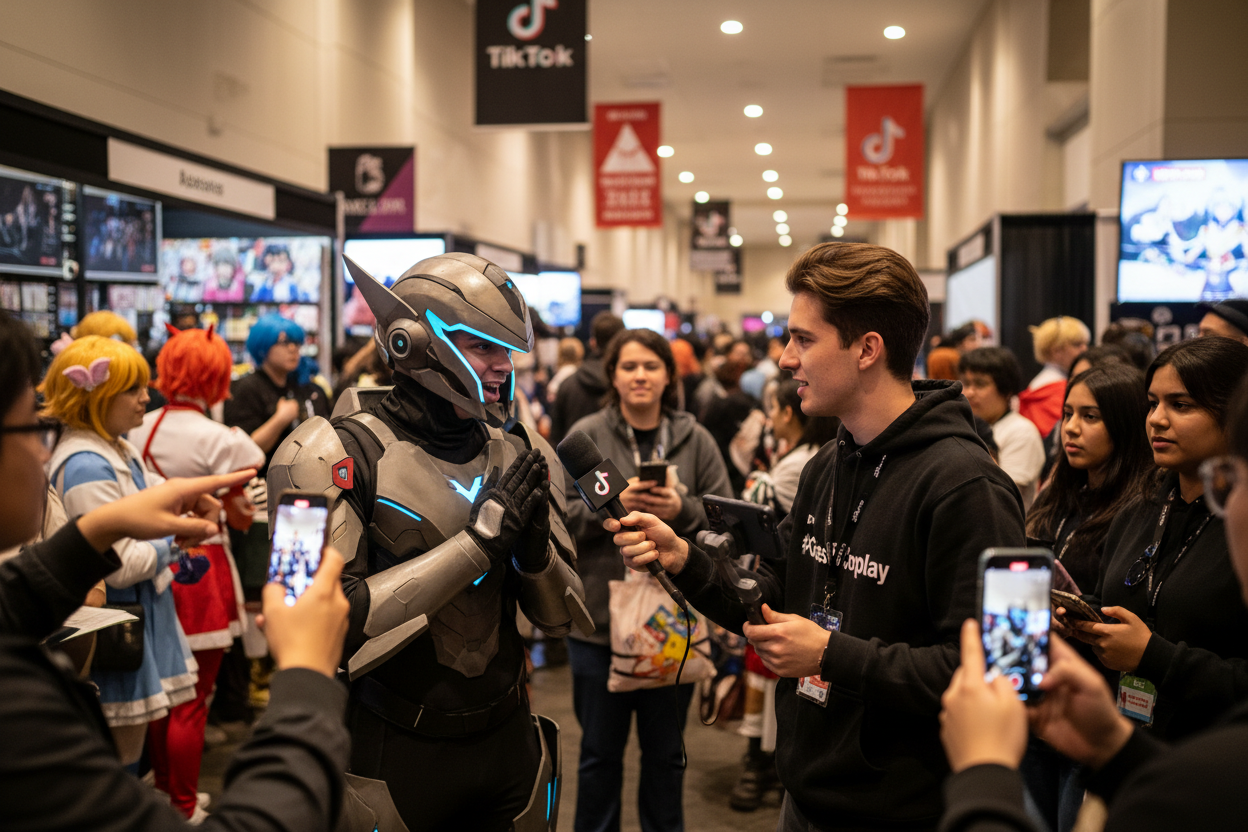
Overview: If you've spent any time in convention hallway content on TikTok, you've probably seen a version of this: a creator with a mic stops a cosplayer walking by, asks "who are you supposed to be?", and either gets an instant, confident answer from the crowd — or a wildly, gloriously wrong guess that turns into the whole point of the video.
Series built entirely around this format — often tagged
#GuessTheCosplay,#MistakenCosplay, or simply filmed at events like Anime Frontier, Anime STL, and Anime North — have become some of the most consistently rewatchable convention content on the platform, precisely because nobody can predict which direction a guess is going to go. This guide breaks down why the format works, how to build genuinely funny (not mean-spirited) content around it, and how it plays out differently depending on which fandom you're pointing the mic at.
Chapter 1: What "Guess the Cosplay" Actually Is
At its core, this is a street-interview format borrowed from a much older TikTok tradition — the same basic structure as "what song are you listening to?" interviews, just pointed at convention cosplay instead. A creator approaches a cosplayer (or a passerby, or another attendee), holds up a mic, and asks who the costume is supposed to represent. Sometimes the person being asked is the cosplayer's friend, sometimes it's a random stranger walking past, and sometimes — for the format's funniest sub-genre — it's someone with zero context being shown a photo and asked to guess cold.
What makes this different from a standard "outfit of the day" or costume-showcase video is the unscripted uncertainty built into the premise. Nobody involved, including the creator holding the camera, knows in advance whether the answer is going to be instantly correct, charmingly close, or spectacularly, confidently wrong. That unpredictability is the entire engine of the format — a video where everyone recognizes the character immediately is mildly satisfying, but a video where someone looks a meticulously accurate Demon Slayer cosplay dead in the eye and calls it "a really committed Party City employee" is the kind of clip that gets duetted, stitched, and shared into completely unrelated corners of the internet.
It's worth being clear about the tone that makes this format work versus the tone that turns it sour. The best-performing series treat wrong guesses as a shared joke everyone's in on — the cosplayer usually laughs along, and the framing stays affectionate rather than mocking. Series that lean into genuinely humiliating someone, or that single out a cosplayer's appearance rather than just the guessing game itself, tend to draw exactly the kind of backlash the broader cosplay community has gotten more vocal about pushing back on in recent years. The format's popularity depends on it staying good-natured.
Chapter 2: What Makes a Costume Guessable — Or Hilariously Not
If you're planning to participate in this trend — either as the cosplayer being interviewed or as the creator building a series — it's worth understanding the actual mechanics of what makes a guess land correctly versus veer off into chaos, because both outcomes can make for great content depending on what you're going for.
-
High-recognition costumes tend to share a few traits: a strong, simple silhouette that reads even from a distance, a signature color story that's specific to the character rather than generic, and at least one unmistakable prop or accessory that acts as a shorthand identifier even for someone who's never seen the source material. A costume that nails all three tends to get correctly guessed even by casual con-goers who don't follow the specific franchise — which is great if your goal is to be recognized, but admittedly less useful if you're hoping for a chaotic wrong-guess clip.
-
High-chaos costumes — the ones that reliably generate the funniest wrong answers — tend to be characters with more unusual or abstract designs, characters from newer or more niche titles that haven't fully entered the mainstream convention consciousness yet, or costumes where a key identifying detail (a specific weapon, a mark, a hairstyle) doesn't translate well to a quick glance from someone unfamiliar with the character. This isn't a flaw in the costume — some of the most technically impressive cosplay builds are also the ones most likely to get mistaken for something else entirely, simply because the source character isn't yet a household name outside its specific fandom. If you're a creator building a series specifically for comedic wrong-guess content, seeking out cosplayers from newer or more visually unconventional franchises tends to produce better hit rates than sticking to only the most mainstream, instantly recognizable characters.
Either way, framing matters. If you're the one asking the questions, keep the energy warm and curious rather than "gotcha" — the funniest wrong guesses land specifically because everyone's laughing together, not because someone's being set up to feel embarrassed on camera.
There's also a middle category worth naming, since it's arguably the richest source of content: partially-guessable costumes, where an interviewee gets close but not quite there. This is where you see guesses like correctly identifying the general genre ("some kind of demon hunter") without landing the specific character name, or nailing the franchise but mixing up which character is which within it. This middle ground tends to produce the most conversational, back-and-forth clips, since it opens the door for the cosplayer to give a hint, watch the interviewee course-correct, and land on the right answer collaboratively — which reads as warmer and more community-minded than a flat right-or-wrong reveal. If you're planning a series, it's worth deliberately including a mix of all three categories (instant-recognition, partial-guess, and total-chaos) rather than optimizing purely for the funniest wrong answers, since a series that's only mockery-adjacent content tends to burn out its goodwill with the cosplay community faster than one that also celebrates correct, enthusiastic recognition.
One more mechanical factor worth understanding: context collapse. A costume that would be instantly recognized inside a themed gathering or a fandom-specific meetup (see our earlier guide on Facebook-organized mass group cosplay meetups) can become far harder to identify the moment it's pulled out of that context and shown to a random passerby with no situational cues. This is part of why "guess the cosplay" content filmed in general convention hallways tends to generate more chaotic guesses than the same costume would get inside a character-specific photo gathering — the surrounding context normally does a lot of unconscious identification work that disappears the moment you isolate a single costume and a single question.
Chapter 3: Case Studies by Fandom — Demon Slayer, Hatsune Miku, KPop Demon Hunters, Jujutsu Kaisen
Different franchises produce genuinely different flavors of "guess the cosplay" content, and it's worth understanding why before you plan a series around any specific fandom.
1. Demon Slayer
Demon Slayer sits firmly in the high-recognition category for most of its main cast — Tanjiro's checkered haori and Nezuko's pink kimono are now recognizable well outside anime circles specifically because the franchise crossed over so hard into mainstream pop culture. Where Demon Slayer content tends to generate genuinely funny wrong guesses is with its more visually unusual supporting characters and demon designs, where an elaborate, monstrous costume can get mistaken for a generic horror-movie creature or a completely unrelated character by someone unfamiliar with the specific arc it's from.
2. Hatsune Miku
Hatsune Miku produces a genuinely unique category of wrong guesses, because her design — twin turquoise pigtails, a futuristic schoolgirl-adjacent outfit, a numbered tattoo detail — is instantly recognizable to a vocaloid or gaming-adjacent audience but can genuinely stump someone with zero exposure to that specific corner of internet culture, generating guesses ranging from "some kind of idol" to complete unrelated franchise names. Miku cosplay also tends to draw an unusually wide range of build qualities, from simple wig-and-outfit versions to highly engineered stage-performance builds, which affects how confidently a guess lands. (Tip: Check out our bedroom-to-studio photography tutorial as Miku's neon color scheme pairs perfectly with RGB lighting!)
3. KPop Demon Hunters
KPop Demon Hunters is the newest major entry on this list, and it's currently one of the single biggest drivers of "guess the cosplay" chaos precisely because of its recency — the film exploded into one of the most cosplayed properties of the past year almost overnight, which means a meaningful chunk of convention-goers simply haven't caught up yet. This produces a specific, very funny category of wrong guess: someone confidently identifying a Saja Boys member as "some K-pop group" (which, to be fair, is directionally correct) without clocking the demon-hunting plot at all, or mistaking Rumi's dragon-braid and crop-top look for an entirely different pop-idol-inspired character from a different franchise altogether. Because the film's five core looks — Rumi, Zoey, Mira, and the Saja Boys — are all built around bold, idol-glam silhouettes, they're highly guessable within the fandom and highly mistakable outside it.
4. Jujutsu Kaisen
Jujutsu Kaisen splits fairly cleanly down the middle depending on which character gets interviewed. Main cast members like Gojo (with his blindfold and distinctive hair) tend to land correctly even with casual audiences, since the design is striking and the character has broad crossover recognition. Deeper-cut characters — Choso, for instance, whose design relies more on subtler detail work than one single unmistakable visual hook — tend to produce more of the classic "confidently wrong" guess that makes for great chaotic content, especially from interviewees who know anime broadly but aren't caught up on this specific arc. Cursed technique-related props and effects (glowing markings, specific weapon shapes) also create an interesting split in guessability: interviewees who've seen the anime tend to identify the technique instantly from the prop alone, while interviewees unfamiliar with the series often guess an entirely different power-fantasy franchise, since "glowing supernatural weapon" reads as a fairly universal anime signifier rather than something JJK-specific.
Key takeaway across all four fandoms: Franchises with a strong, singular visual "logo" moment — Tanjiro's haori pattern, Miku's turquoise twin-tails, Gojo's blindfold — tend to survive being guessed out of context far better than franchises (or specific characters within a franchise) that rely on a combination of subtler details to read correctly. If you're choosing a costume specifically because you want to be recognized on sight by a general convention crowd, leaning toward a character with that kind of singular, iconic visual hook is a far more reliable bet than choosing based on personal favoritism alone.
Chapter 4: Tools and Resources for Filming Your Own Series
If you're planning to build your own "guess the cosplay" content — either as an interviewer or by encouraging your friends to grab a mic and put you on the spot — a few practical basics make a real difference in production quality and how well the series performs.
-
A simple handheld mic or lapel mic setup: Con hallways are loud, and audio clarity matters more than video polish for this format, since the guesses and reactions are the actual content.
-
A phone gimbal or stabilizer: Walking-and-filming interview content benefits enormously from smooth handheld footage rather than shaky, hard-to-watch clips.
-
A quick-release or lanyard mic flag: Labeling your mic or camera clearly as content-in-progress makes people more comfortable stopping for an interview, and signals to convention staff and other attendees what you're doing.
-
A consent-first approach: Always ask before filming, and be ready to cut footage if someone's uncomfortable after the fact; the best-performing series in this space are consistently the ones with a reputation for being kind rather than gotcha-driven. (See our guide on Cosplay Photography Ethics & CosplayIsNotConsent for more on this crucial topic.)
-
A short, consistent intro format: Series that open the same way every time (a consistent greeting, a consistent "guess the cosplay" prompt) build audience recognition faster than one-off, inconsistently formatted clips.
-
A quick post-interview debrief moment: The strongest clips in this genre often include a brief reaction shot after the reveal, where the cosplayer either laughs off a wrong guess or lights up at being recognized; leaving your camera rolling for an extra three or four seconds after the "correct answer" reveal consistently captures this, and it's often the moment that actually gets a video shared.
-
Location awareness: Check your convention's specific media and filming policies before setting up interviews on the floor; most major events are fine with casual phone-based interviews but may restrict tripods, lighting rigs, or anything that could be read as commercial filming without a press pass, so it's worth confirming ahead of time rather than getting stopped mid-series.
It's also worth thinking about your own costume choice differently depending on which side of the camera you expect to be on most often. If you suspect you'll be approached for these interviews frequently at a given event — say, you're wearing a highly detailed, competition-level build — leaning into a character with strong crossover recognition (see the "singular visual hook" principle from Chapter 3) means more of your interactions will be quick, satisfying correct-guess moments rather than long explanations. If you'd rather lean into the chaotic, conversational side of the trend, a build from a newer or more niche property is far more likely to generate the kind of guessing-game back-and-forth that makes for genuinely entertaining footage.
FAQ
Q1: Do I need permission from the cosplayer before filming a "guess the cosplay" clip?
Yes — always ask first, both to film someone and to post the footage afterward. The format only works long-term if cosplayers trust that interviewers are operating in good faith, and reputations travel fast within convention communities.
Q2: What if someone gets a genuinely mean-spirited comment in response to a wrong guess?
Cut it. The healthiest, most consistently popular series in this space keep the tone affectionate, and a single cruel comment caught on camera can undercut months of goodwill built with a convention community.
Q3: Is it rude to ask a cosplayer "who are you" if the costume seems obvious?
Not at all — plenty of the funniest and most heartwarming clips in this genre come from confidently correct answers just as often as wrong ones, and most cosplayers enjoy being recognized and asked about their build regardless of how obscure or mainstream the character is.
Q4: Which characters make for the best content — obscure ones or mainstream ones?
Both, for different reasons. Mainstream, high-recognition characters produce satisfying "everyone knew it instantly" moments, while newer or more niche characters produce the chaotic wrong-guess content that tends to travel further. A good series usually mixes both rather than leaning entirely on one type.
Summary and Related Resources
"Guess the Cosplay" works because it turns convention hallways into an unscripted, low-stakes guessing game where nobody — cosplayer, interviewer, or interviewee — knows which way the answer is going to go, and that genuine unpredictability is what keeps people watching and sharing.
Whether you're building a costume specifically to be instantly recognized or secretly hoping for a chaotic wrong guess, understanding what actually drives recognition — silhouette, color story, signature props — helps you plan either outcome intentionally.
If you're gearing up for your next convention appearance, check out our character-specific costume guides for Demon Slayer Cosplay Costumes, Hatsune Miku Cosplay Costumes, KPop Demon Hunters Cosplay Costumes, and Jujutsu Kaisen Cosplay Costumes linked throughout this piece, and remember: however the guess goes, keep it kind.

Leave a comment
This site is protected by hCaptcha and the hCaptcha Privacy Policy and Terms of Service apply.