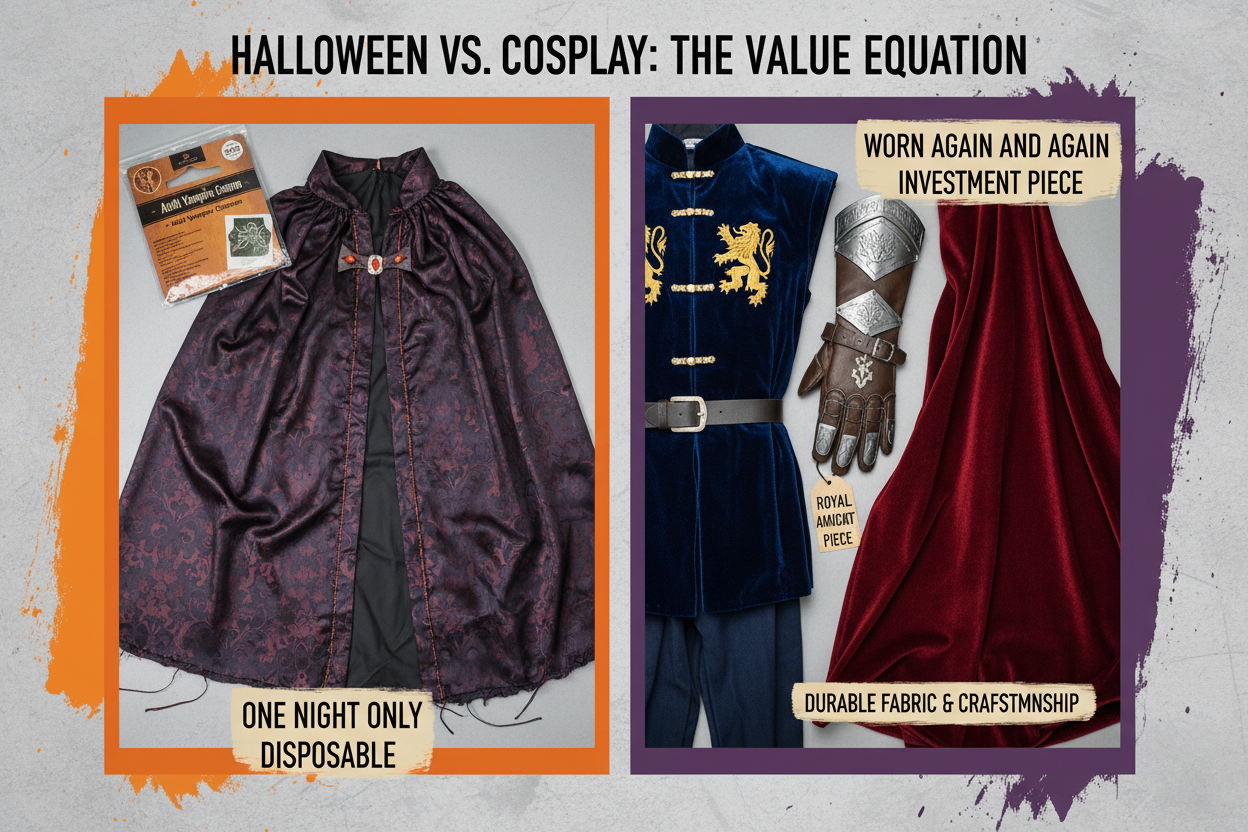
Quick Verdict: If you're trying a character on a whim and genuinely don't know if you'll wear it again, a disposable Halloween costume is still the right call — cheap, fast, zero long-term commitment. But if there's any real chance you'll want this character again, at a convention, at a future Halloween, or as part of a broader cosplay wardrobe, buying (or building) it as an investment cosplay wardrobe piece from the start is almost always the smarter long-term choice — the cost difference upfront is smaller than most people assume, and the payoff compounds every time you wear it again.
This is exactly the shift a growing number of cosplayers are describing in community threads: a Halloween costume bought as a one-off ends up getting refined and worn again at a convention months later, or a piece originally intended for a single night quietly becomes a Halloween costume for cosplay that gets reused for years. Halloween costume reuse isn't a niche behavior anymore — it's becoming the default expectation for anyone who plans to stay in this hobby past a single October.
Core Comparison Table
| Category | Disposable Halloween Costume | Investment Cosplay Wardrobe Piece |
|---|---|---|
| Upfront cost | Low ($) | Moderate–higher ($$–$$$) |
| Cost per wear (if reused 3+ times) | Increases with reuse (not built for it) | Decreases significantly with reuse |
| Material durability | Built for single-night wear | Built for repeated wear and travel |
| Modularity (mixing with other pieces) | Low — often a fixed one-piece design | High — designed to combine with other wardrobe pieces |
| Best for | One-off characters, budget-limited nights | Characters you'll revisit, building a long-term wardrobe |
| Resale/repurpose potential | Low | Moderate–high |
Dimension 1: Cost & Long-Term Value
A disposable costume wins on day-one price, no question — it's designed to be cheap precisely because it's not expected to survive more than a handful of wears. The problem shows up the moment you actually do wear it again: thin seams, low-grade fabric, and glued-rather-than-sewn details start failing exactly when you need them to hold up, which means a "cheap" costume that gets worn three or four times can end up costing more in repairs and premature replacement than a slightly pricier piece would have from the start.
An investment piece flips this math over time. The upfront cost is higher, but because it's built with costume investment in mind — actual seams instead of glue, fabric chosen for durability rather than just appearance, props built to survive travel — the cost per wear drops every single time you put it back on. A piece worn once at Halloween and then twice more at conventions the following year has already cut its effective cost by two-thirds, something a disposable costume structurally can't do since it's rarely still wearable by the second or third outing.
Bottom line: If you're confident this character is a one-and-done, disposable wins on pure cost. If there's a reasonable chance you'll wear it again — which, per the community pattern behind this whole trend, is more often than people initially expect — the investment piece wins on total cost within just a couple of extra wears.
Dimension 2: Versatility & Modularity
This is where the gap becomes most obvious, and it's the core idea behind modular cosplay: building or buying pieces that can be mixed, matched, and restyled across multiple characters rather than treating every costume as a single, disposable unit tied to one specific look.
A disposable costume is almost always a fixed package — a one-piece printed jumpsuit, a pre-assembled set that only really works as that one specific character. There's no real way to pull a piece out and reuse it for something else. An investment piece, by contrast, is generally built (or bought) as separate components — a base garment, a wig, specific accessories — precisely so that a well-chosen wig or jacket from one build can become the foundation of a completely different character down the line. This is the actual mechanism behind a genuine cosplay wardrobe or character closet: not a growing pile of single-use costumes, but a shrinking need to buy from scratch each time, because you're increasingly pulling from pieces you already own.
Bottom line: Disposable costumes solve one character, once. Investment pieces solve one character now and quietly reduce the cost and effort of your next several characters, provided you're buying with modularity in mind rather than the most character-specific, single-use option available.
Dimension 3: Durability, Fit & "Convention-Readiness"
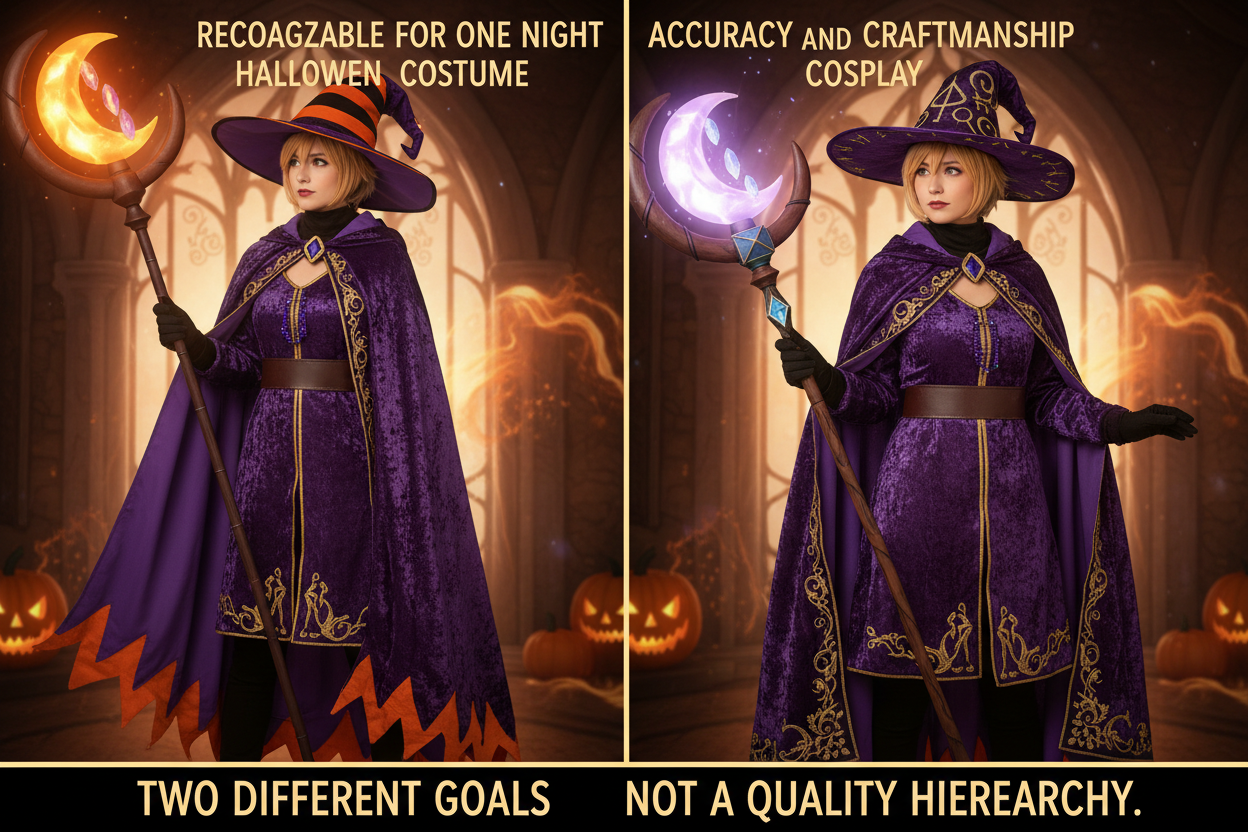
Halloween and convention wear ask genuinely different things of a costume. A single Halloween night rarely involves more than a few hours of light movement. A convention day can mean eight-plus hours of walking, posing, sitting, and repeated handling — and this is exactly where disposable costumes tend to fall apart, sometimes literally, mid-event.
Investment pieces are built (or should be built) with that heavier use case in mind from the start: reinforced stress points, better-fitted construction rather than one-size-stretch fabric, and props with real internal structure rather than surface-level shape alone. This is also where a Halloween-to-convention cosplay pipeline actually works in practice — a piece built to Halloween-costume standards usually needs some reinforcement before it can survive a full con day, while a piece built as an investment from the start often needs little more than a cleaning and a fit check before its next wear.
Bottom line: If a piece has any chance of making the jump from Halloween to convention floor, durability during construction (or purchase) matters far more than it would for something worn once and retired.
When Should You Choose a Disposable Halloween Costume?
Go disposable if:
- You're trying a character purely on impulse and have no real plan to wear it again
- Your budget for this specific costume is genuinely tight and can't stretch further right now
- The character is a joke, meme, or group-costume tie-in unlikely to have lasting appeal for you specifically
- You need something ready in days, not weeks, and don't have time to source higher-quality components
There's no shame in this choice — plenty of great Halloween nights come from a costume that was never meant to be more than that.
When Should You Choose an Investment Cosplay Wardrobe Piece?
Go with an investment piece if:
- You already cosplay, or you're building toward attending a convention and want pieces that can carry over
- The character is one you're genuinely attached to, not just trying out for a night
- You want to start (or grow) an actual cosplay wardrobe rather than a pile of single-use costumes
- You're choosing components — wigs, base garments, accessories — with an eye toward reusing them for other characters later
If you're leaning this direction, prioritize the pieces that carry the most reuse value first. A well-made Halloween Cosplay Wigs & Props purchase is one of the highest-leverage investment decisions you can make, since a good base wig can often be restyled for multiple future characters rather than needing full replacement each time. For everything that isn't wig or prop specific — the smaller pieces that make a modular cosplay wardrobe actually mix and match well — a dedicated Cosplay Accessories & Character Closet Essentials collection is worth building out over time rather than buying character-specific one-offs each October.
Summary & Call to Action
The real question behind Halloween costume reuse isn't "cheap versus expensive" — it's "one night versus every future night this character (or these components) could plausibly get worn again." Disposable costumes still make sense for genuine one-off impulse picks, but for anyone even loosely planning to stick with this hobby, treating your next costume purchase as the first piece of a long-term cosplay wardrobe — rather than a single-use item — pays for itself faster than most people expect, often within just two or three additional wears.
Before your next Halloween purchase, ask one question: is there any real chance I wear this again? If the answer is even a maybe, buy like it's a yes — build in the durability and modularity now, while it's cheap to do, rather than trying to retrofit a disposable costume into something convention-ready after the fact.

Leave a comment
This site is protected by hCaptcha and the hCaptcha Privacy Policy and Terms of Service apply.