💡 Editorial Note: Our team has tracked the intersection of cosplay and mainstream fashion across three convention cycles, monitored major brand collaboration announcements from Uniqlo, Hugo Boss, Louis Vuitton, and Crunchyroll, and spoken with independent costume makers, fashion industry contacts, and cosplayers who've watched their hobby become a design input source in real time. We've worn the costumes in this guide. We've also watched the fashion industry quietly copy their silhouettes. What follows is documented observation with purchase guidance.
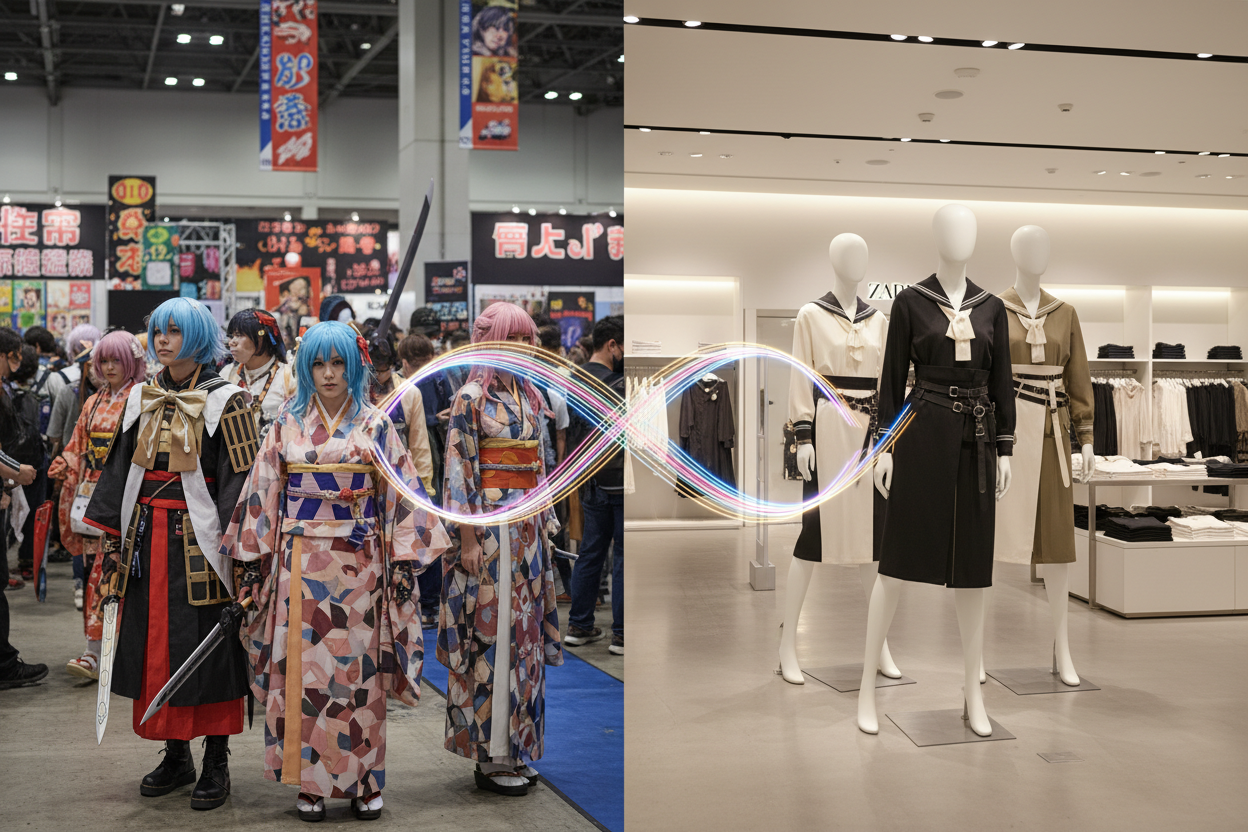
1. When Zara Starts Looking Like the Convention Floor, Something Has Shifted
The Reddit thread that started this conversation wasn't about conventions. It was about a shopping trip.
“Walked into H&M today and found a kimono-style jacket that looks exactly like the Hashira haori I built last year. Same silhouette. Same layering logic. They're selling it for $45 and calling it 'Japanese-inspired outerwear.'”
The post collected 4,100 upvotes. The replies filled in the picture from a dozen angles:
-
“I've been seeing corset-over-shirt layering everywhere and that's literally just Genshin Impact character design from 2022.”
-
“The oversized structured coat thing that's all over streetwear right now? That's been in anime for decades. Fashion is just noticing.”
-
“Louis Vuitton did an Akira capsule. Hugo Boss did a Crunchyroll collab. Luxury brands are paying licensing fees for what cosplayers have been building by hand for years.”
-
“We were the R&D department and we didn't know it.”
The community's observation is accurate and documented. In 2025, Louis Vuitton unveiled a capsule collection inspired by Akira, referencing the film's cyberpunk dystopia through metallic fabrics, moto-inspired tailoring, and graffiti-style prints. Hugo Boss, teaming up with Crunchyroll, dropped a capsule collection that felt less like "merch" and more like a runway statement, featuring distinct menswear and womenswear lines leaning heavily into unisex streetwear. Certain cosplay-inspired apparel is merging into casual fashion, with streetwear brands incorporating anime or fantasy themes — a crossover trend that expands the customer demographic beyond committed cosplayers.
What's happening is structural, not coincidental: cosplay has become a fashion supply chain input. The silhouettes, construction logic, material choices, and color systems that cosplayers have developed and tested on convention floors for two decades are now being absorbed, simplified, and commercially produced by an industry that's finally paying attention.
This creates something interesting for the cosplayer. You are no longer just a fan making a costume. You are, whether you know it or not, part of the design language that is shaping what the fashion industry produces next. Here's how to make that work in your favor — and which costumes sit at the most interesting intersection of convention culture and mainstream fashion influence.
2. ⚡ Quick Picks: Costumes at the Cosplay-Fashion Crossover Point
These builds use construction logic, silhouettes, and materials that are simultaneously excellent cosplay and genuinely influential on mainstream fashion direction in 2026.
| # | Costume Profile | Fashion Influence Category | Convention Strength |
| 1 | Jinx Arcane | Dark streetwear, braided accessories | ⭐⭐⭐⭐⭐ |
| 2 | Toga Himiko | Schoolwear-subversive, soft-dark aesthetic | ⭐⭐⭐⭐⭐ |
| 3 | Makima | Elevated office-core, controlled menace | ⭐⭐⭐⭐½ |
| 4 | Sailor Moon | Y2K magical girl revival, pastel power dressing | ⭐⭐⭐⭐⭐ |
| 5 | Power | Dark uniform streetwear, devil accessory | ⭐⭐⭐⭐ |
| 6 | Jolyne Kujo | Avant-garde layering, sculptural silhouette | ⭐⭐⭐⭐ |
| 7 | Frieren | Quiet luxury outerwear, muted fantasy | ⭐⭐⭐⭐½ |
| 8 | Yor Forger | Power dressing, dramatic occasion wear | ⭐⭐⭐⭐½ |
3. 📋 Full Reviews: Costumes at the Edge of Cosplay and Fashion
1. Jinx Arcane Cosplay Costume for Sale
Product Overview
The jinx arcane cosplay costume for sale — the twin-braided, electric-blue-haired chaos agent from Netflix's Arcane — is one of the clearest examples of how a cosplay design becomes a fashion input source. Jujutsu Kaisen is arguably the most streetwear-relevant anime of the current era — the characters dress well, the aesthetic is dark and stylish, and the color palette maps directly onto streetwear palettes. Jinx achieves the same crossover from a different angle: her silhouette — midriff, layered belts, wild expressive hair, distressed fabric textures — reads simultaneously as character design and streetwear editorial.
The evidence of fashion absorption is direct: after Arcane Season 1, multiple streetwear brands released blue twin-braid-adjacent accessories and layered-belt silhouettes that bore unmistakable visual similarity to Jinx's character design. The brand attribution didn't reference Jinx. The design logic did.
Who Is It For?
-
LoL and Arcane fans who want the series' most visually explosive character.
-
Cosplayers interested in builds that sit at the streetwear-cosplay crossover.
-
Convention-goers who want a build that generates photography attention and community warmth simultaneously.
Pros & Cons
-
✅ Pros: Character design is a demonstrable streetwear influence — wearing it is wearing the source; Electric blue palette is photography-dominant in any convention lighting condition; Arcane adaptation deepened character into cross-demographic recognition; Layered belt and distressed texture detail rewards craftsmanship investment; Strong LoL community presence at gaming conventions.
-
❌ Cons: Twin braids with extensions are a significant wig management challenge; Con-safety for Zap minigun requires foam construction; Midriff-baring design requires venue policy awareness; Base outfit is relatively minimal — full visual impact requires accurate accessories; Budget builds miss the texture detail that makes the fashion-cosplay bridge visible.
💡 Editor's Take:
The Jinx build is the one to understand if you're interested in how cosplay becomes fashion influence. The character's design team at Riot/Fortiche did something that fashion designers also do: they built a complete visual identity from silhouette, color, texture, and accessory logic rather than from literal clothing references.
The craftsmanship point matters here specifically: the Jinx build that reads as a fashion-crossover piece is the one with accurate texture work on the distressed fabric, wire-reinforced braids that hold their dynamic shape, and the correct electric blue (not neon, not navy — the specific Arcane blue). Budget builds that approximate these elements don't achieve the crossover. The quality tier does.
Specs
-
Includes: jacket, shorts, layered belt accessories, wig with extensions, goggles
-
Fashion Influence: dark streetwear, layered belt aesthetic, braided hair fashion
-
Photography Rating: EXCEPTIONAL — electric blue palette, dynamic silhouette
-
Prop: foam Zap minigun — con-safe, character-completing
2. Toga Himiko My Hero Academia Cosplay
Product Overview
The toga himiko my hero academia cosplay — the blood-quirk villain's schoolgirl uniform subverted with knives, accessories, and the particular energy of someone who weaponized aesthetic compliance — is one of anime fashion's most interesting constructions. Crunchyroll partnered with Fira X Wear, a cosplayer-creator-owned fashion brand, to release a streetwear line inspired by My Hero Academia — it's cut-and-sew fashion inspired by the characters' silhouettes, featuring cropped jackets, utility joggers, and rompers targeted at convention-goers blending comfy fits with episode-ready prints.
Toga specifically represents the "schoolwear-subversive" aesthetic that fashion has been circling: the uniform as base layer, destabilized by accessories, fit alterations, and attitude. This exact logic — compliant silhouette, subversive detail — is the construction principle behind a significant portion of Gen Z fashion.
Who Is It For?
-
MHA fans who've followed Toga's arc through the series finale.
-
Cosplayers interested in the soft-dark / dark-cute aesthetic crossover.
-
Convention-goers who want a build with strong fashion-adjacent visual language.
Pros & Cons
-
✅ Pros: Schoolwear-subversive aesthetic is a direct fashion crossover point; Post-series finale character arc gives Toga deep community emotional resonance; Soft-dark color palette (grey, muted yellow, blood detail) is fashion-forward; MHA collaboration with fashion brands makes character design familiarity unusually broad; Strong MHA gathering community at major conventions.
-
❌ Cons: Knife prop must be obviously non-functional — prop knives face scrutiny at some venues; Blonde bun wig styling requires significant preparation to maintain across a convention day; Blood detail aesthetic may face content policy review at family-oriented conventions; Character recognition requires full accessory set — partial builds lose specificity.
💡 Editor's Take:
The Toga build is the fashion supply chain argument made concrete in cosplay. Her costume is literally a school uniform — a fashion baseline — subverted through accessory logic. The knife holder, the hero-killing intent expressed through civilian clothing, the specific way her character design makes compliance threatening: this is the exact aesthetic operation that avant-garde fashion executes season after season.
The most impactful anime characters share distinct visual identities, emotional depth, and cultural resonance — and the approach of treating anime characters as archetypes rather than costumes is what drives the most sophisticated fashion absorption. Toga is an archetype: the dangerous girl in the school uniform. Fashion has been designing around that archetype since at least the 1990s. Anime crystallized it. Cosplay deployed it at convention scale.
Specs
-
Includes: MHA villain school uniform variant, blonde bun wig, prop knife set (non-functional), accessories
-
Fashion Influence: schoolwear-subversive, soft-dark aesthetic
-
Community: MHA fandom post-series has deep emotional attachment to Toga's arc
-
Prop Note: non-functional display knives — verify con-safety at your specific venue
3. Makima Chainsaw Man Cosplay Dress
Product Overview
The makima chainsaw man cosplay dress — the Control Devil's business attire, red hair, and predatory composure — is the cosplay that fashion industry observers have cited most frequently when discussing anime's influence on contemporary design. Makima's aesthetic is "elevated office-core weaponized as menace": the fitted dress or suit, the red hair, the rings, the controlled expression. Every element of her visual design operates within fashion's existing vocabulary — and then adds something fashion has been trying to articulate for years.
Designers are also adopting anime's exaggerated proportions and dramatic contrasts — oversized sleeves, asymmetrical hems, and layered textures that are hallmarks of character design are now seen in collections by emerging labels. Makima represents the inverse: a character whose fashion influence comes from restraint rather than exaggeration. The fitted silhouette, the precise color (Makima's specific auburn-red hair tone has been referenced in fashion editorial), the control it implies.
Who Is It For?
-
Chainsaw Man fans who want the series' most psychologically complex character.
-
Cosplayers interested in fashion-adjacent builds that work beyond convention contexts.
-
Convention-goers who want a build that reads as both character-specific and genuinely wearable.
Pros & Cons
-
✅ Pros: Office-core aesthetic means the costume elements are genuinely wearable outside convention; Controlled menace aesthetic is a direct fashion editorial crossover; Red ring accessories are the build's distinctive detail — low cost, high impact; Fashion-industry-adjacent design logic makes the build photograph as editorial content; Growing Chainsaw Man convention community with strong Part 2 manga presence.
-
❌ Cons: Character recognition requires the auburn wig — the dress alone reads as formal wear; Requires excellent posture and composed demeanor to sell the character on the floor; Character arc spoilers mean fan reception varies depending on series completion; Business attire may be less visually dramatic in photograph-heavy convention contexts; The character demands a very specific hair color — wrong auburn breaks the build.
💡 Editor's Take:
Makima is where the fashion-cosplay supply chain argument becomes most literal. Her costume is, at base level, business formal wear in a specific color palette with specific accessories. The fashion industry produces business formal wear in those exact color palettes and adds accessories in those exact formats.
The rings are the detail worth investing in: Makima's specific ring styling — the way they stack, the metal tone, the placement — is the accessory logic that tells Chainsaw Man fans they're looking at the real thing rather than business attire. Three to four rings on the correct fingers, in a warm gold tone. Inexpensive to source, essential to the build.
Specs
-
Includes: fitted dress or business suit variant, auburn wig, gold ring accessories, belt
-
Fashion Influence: elevated office-core, controlled menace aesthetic, fashion editorial crossover
-
Wearability: full-day convention comfort — standard garment construction
-
Key Accessories: specific gold rings (3–4 pieces) and auburn-tone wig are character-essential
4. Sailor Moon Cosplay Costume Set
Product Overview
The sailor moon cosplay costume set — the original magical girl's sailor fuku, odango buns, and crescent moon accessories — is currently experiencing the most significant fashion-crossover moment in its three-decade convention history. Sailor Moon is experiencing a full cultural renaissance in 2026, riding the Y2K anime revival and nostalgia wave reshaping aesthetics across fashion and cosplay.
The practical evidence: pastel sailor-collar designs have appeared in H&M, Zara, and ASOS collections across 2024–2026. The Y2K revival has pushed the pleated skirt and structured sailor collar back into mainstream fashion. High-end labels have referenced the magical girl silhouette in runway collections. The cosplay community built this. The fashion industry is now excavating it commercially.
Who Is It For?
-
Sailor Moon fans who want to wear one of anime's most historically significant cosplays.
-
Cosplayers who want a build sitting directly at the Y2K fashion revival crossover.
-
Convention-goers who want maximum cross-demographic recognition and fashion-forward visual language.
Pros & Cons
-
✅ Pros: Y2K revival makes Sailor Moon design language more fashion-current than at any point since the 1990s; Universal recognition across every age group at convention; Pleated skirt + structured sailor collar is a direct mainstream fashion reference point; Lightweight construction — full convention day comfort; Multiple Sailor Scouts available for group builds.
-
❌ Cons: The sailor fuku is widely replicated at all quality levels — differentiation requires quality detail; Red/white/navy palette must be correct — off-tones immediately read as wrong; Heeled boots or mary janes add footwear fatigue consideration; Crescent moon accessories are easily lost in transit — pack carefully.
💡 Editor's Take:
Uniqlo's multiple collaborations with Sailor Moon stand out for their restraint — introducing minimalist tees, trench coats, and cardigans that referenced the series through subtle cues: moon motifs embroidered near hems, color-blocking matching each Sailor Scout's uniform, and soft pastel palettes reflective of 90s shojo aesthetics.
A standout piece was a double-breasted trench coat in deep navy with gold buttons shaped like crescent moons. For non-fans, it read as a well-cut outerwear item. That duality is key: functionality first, fandom second. This duality is exactly what makes the Sailor Moon build so interesting in 2026.
Specs
-
Includes: sailor fuku (character-specific color), white gloves, tiara accessory, odango wig, bow accessories
-
Fashion Influence: Y2K revival, magical girl aesthetic, pleated skirt + sailor collar mainstream recovery
-
Convention Recognition: cross-generational — broadest demographic recognition of any magical girl character
-
Group Potential: full Sailor Scout ensemble (Moon, Mercury, Mars, Jupiter, Venus) is one of convention's most beloved group formats
5. Power Chainsaw Man Cosplay Buy
Product Overview
The power chainsaw man cosplay buy — the Blood Fiend's Public Safety uniform, white hair, and devil horns — occupies a specific space in the fashion-cosplay conversation: she represents the "dark uniform" aesthetic that has been generating significant streetwear interest since the early 2020s. Dark uniform pieces — structured jackets in institutional silhouettes, with accessories that destabilize the uniformity — are a recurring streetwear category. Power is their anime avatar.
Anime characters frequently wear clothes that are dramatically oversized — flowing coats, baggy pants, enormous scarves. This aesthetic has been absorbed into streetwear's preference for oversized fits. Power's costume works through the opposite logic: the institutional fit, the accessories that break it (horns, tail, blood-effect makeup), the chaotic energy that makes compliance seem violent.
Who Is It For?
-
Chainsaw Man fans who want the series' most energetically chaotic character.
-
Cosplayers interested in the dark-uniform streetwear crossover aesthetic.
-
Convention-goers who enjoy character performance alongside costume accuracy.
Pros & Cons
-
✅ Pros: Dark uniform aesthetic is a direct streetwear crossover point; White hair + devil horns creates immediate visual recognition in Chainsaw Man community; Character's chaotic energy invites and rewards convention floor performance; Growing CSM convention community with strong Part 2 manga presence; Pairs with Makima for Chainsaw Man duo photography.
-
❌ Cons: Foam horns require correct finish to read as character-accurate at close range; Blood-effect makeup requires fresh application for afternoon convention photography; Foam chainsaw prop (if included) requires carrying or holstering — hand-carry adds fatigue; Character performance (screaming about blood and money) may not suit all convention contexts; White wig requires careful maintenance — Power's hair style is specific.
💡 Editor's Take:
Power is the character who makes the dark-uniform fashion argument obvious: remove the horns and tail, and you're wearing institutional workwear in a specific silhouette. Add the horns and tail, and you're wearing one of Chainsaw Man's most beloved characters.
The foam horn finishing is the quality variable: acrylic-sealed foam horns read as costume-accurate at any distance and photograph cleanly. Unfinished foam horns read as construction material. The sealing step takes 30 minutes and transforms the build's visual register.
Specs
-
Includes: Public Safety uniform, white wig (Power styling), foam devil horns, tail
-
Fashion Influence: dark uniform streetwear, institutional silhouette subversion
-
Performance Dimension: character energy is convention floor asset — commit to it
-
Horn Finish: acrylic seal required for photograph-quality results
6. Jolyne Kujo JoJo Cosplay Costume
Product Overview
The jolyne kujo jojo cosplay costume — the Stone Ocean protagonist's sculptural green outfit with string-ability visual effects and the Joestar birthmark — is the cosplay that has appeared most frequently in fashion editorial reference in the past two years, cited by designers who explicitly name JoJo's Bizarre Adventure as an influence.
Designers focus on silhouette and structure — whether the character is known for flowing robes, tight armor, or layered streetwear, and translate that into real-world equivalents like kimono coats, tactical vests, or asymmetric hemlines. Jolyne Kujo is specifically recommended as a seasonal fashion inspiration for cosplayers interested in avant-garde layering. Jolyne's design uses sculptural silhouette work — the cutout torso, the asymmetrical layering, the string motif built into the fabric structure — that maps directly onto what avant-garde fashion labels call "deconstructed construction."
Who Is It For?
-
JoJo fans who want the series' strongest female protagonist in her iconic Part 6 design.
-
Cosplayers interested in avant-garde silhouette work as both craft challenge and fashion statement.
-
Convention-goers who want a build that generates craft-recognition from the cosplay community and visual-interest from photography contexts.
Pros & Cons
-
✅ Pros: Sculptural silhouette directly references avant-garde fashion construction logic; JoJo community is among the most knowledgeable and passionate in cosplay culture; Asymmetric design is genuinely challenging — craft achievement is visible; Cutout construction creates convention floor presence without prop dependency; Fashion editorial reference makes the build legible to non-fans as design statement.
-
❌ Cons: String effect visual detail requires careful execution to read as character-accurate; JoJo's Bizarre Adventure Part 6 has less mainstream recognition than earlier parts; Green hair wig in Jolyne's specific shade requires careful sourcing; Asymmetric builds are harder to modify or repair mid-convention if something shifts.
💡 Editor's Take:
The Jolyne build is the test case for whether cosplay-as-fashion-influence is understood as a direction or a coincidence. When fashion designers explicitly cite JoJo character design as an influence — the advice to channel Jolyne Kujo from JoJo's Bizarre Adventure for a fall wardrobe, treating her as a seasonal design inspiration — the connection between convention floor craft and fashion industry input is no longer inference. It's direct.
Specs
-
Includes: green sculptural outfit with cutout construction, green wig, string-effect visual elements, accessories
-
Fashion Influence: avant-garde silhouette, deconstructed construction, asymmetric design
-
Craft Difficulty: HIGH — requires accurate string-effect execution for full community recognition
-
Community: deeply knowledgeable JoJo fandom — accuracy is noticed and rewarded
7. Frieren Beyond Journey's End Mage Robe Cosplay
Product Overview
The frieren beyond journey's end mage robe cosplay is the fashion-influence argument from the opposite direction: while most of the builds in this article demonstrate how energetic, colorful, or structurally complex anime design becomes fashion input, Frieren demonstrates how restraint becomes fashion influence.
The mage robe's visual logic — oversized outerwear in grey-black tones with structured hat and staff, worn over simple base layers — is the same logic currently driving the "quiet luxury outerwear" category in mainstream fashion. The silhouette is elongated, structured, and undecorated. The color palette is muted and sophisticated. The accessories (hat, staff) are character-specific but read as fashion objects to non-fans.
Cosplay has gone from a niche fan hobby to one of the biggest creative movements in the world. What started as fans making homemade costumes has grown into something much larger — a culture that now shapes fashion runways, film costume design, and even high-end streetwear. Frieren's visual language — the oversized grey coat worn by an ancient being who has outlived everyone she loved — is being absorbed into fashion through the "quiet luxury" trend that prizes restraint, structure, and materials quality over decoration.
Who Is It For?
-
Frieren fans who want the series' protagonist in her most iconic costume.
-
Cosplayers interested in the quiet-luxury fashion crossover build.
-
Convention-goers who want deep community engagement with high craft-recognition potential.
Pros & Cons
-
✅ Pros: Quiet luxury aesthetic directly parallels fashion's current "understated quality" trend; Simple silhouette means execution quality is fully visible — corners can't be hidden; Deep community emotional engagement — Frieren fans want to discuss the series, not just photograph; Structured oversized coat is a craft investment piece that can be repurposed as fashion outerwear; Muted palette photographs beautifully in natural light — outdoor convention photography premium.
-
❌ Cons: Character recognition requires white wig, pointed ears, and staff — without them, reads as generic fantasy; White wig maintenance across a full convention day requires careful anchoring; Muted palette can feel less visually dramatic in low-light indoor exhibit halls.
💡 Editor's Take:
Frieren's fashion crossover isn't about trend-chasing — it's about design logic convergence. The character was designed by artists who made the same decisions that fashion designers making "quiet luxury" pieces make: restrain the decoration, invest in the silhouette, let the materials do the work. Both arrive at the same visual result because they're solving the same design problem.
The mage robe as a cosplay investment piece is worth thinking about specifically: a correctly constructed Frieren coat in appropriate fabric — structured wool-adjacent, in grey-black — is a garment that works in convention contexts and in daily life as a structured oversized coat. This dual-utility is rare in cosplay and reflects the character's design's genuine fashion-adjacency.
Specs
-
Includes: oversized grey-black mage robe, pointed hat, white wig with elf ears, staff prop
-
Fashion Influence: quiet luxury outerwear, muted palette structured coat aesthetic
-
Craft Requirement: HIGH precision in simple construction — clean seams, correct grey tone, structured collar
-
Staff: wooden or resin — universally con-safe, character-essential
8. Yor Forger Assassin Dress for Sale
Product Overview
The yor forger assassin dress for sale — SPY×FAMILY's Thorn Princess in her signature red bodycon dress with rose-crown headpiece — closes this list as the fashion-supply-chain case study for "dramatic occasion wear." The red dress category in fashion is perennially significant; the structured bodycon silhouette is a perennial fashion investment piece. Yor's dress is the cosplay-culture version of both — and it has generated direct fashion references in editorial and lookbook content since SPY×FAMILY premiered.
Mainstream brands like Uniqlo, H&M, and Supreme have all released anime collaboration lines. Even luxury houses like Balenciaga and Louis Vuitton have hinted at anime nods in their collections, using exaggerated silhouettes, colorful prints, and thematic accessories inspired by hit series. The Yor Forger dress predates most of these collaborations as a convention floor presence — and its red-dress-with-rose-accessories design logic has appeared in fashion contexts that didn't reference the character by name but clearly absorbed the visual.
Who Is It For?
-
SPY×FAMILY fans who want the series' most dramatically photogenic character design.
-
Cosplayers interested in how a red dress cosplay transcends convention contexts.
-
Convention-goers who want a build with the broadest possible photography reception.
Pros & Cons
-
✅ Pros: Red dress as fashion archetype makes the build legible to non-fans as "dramatic occasion wear"; Rose-crown headpiece is the character's most distinctive and fashion-referential accessory; SPY×FAMILY community warmth is among the highest at current conventions; Character's dual identity (assassin/mother) invites expressive convention performance; Pairs with Loid and Anya for the convention's most beloved family photography format.
-
❌ Cons: Bodycon fit requires precise sizing — imprecise fit undermines the silhouette; Rose-crown requires careful transport — rigid protective box essential; Red stiletto heel adds significant footwear fatigue over full convention day; Shorter skirt variant requires venue content policy verification; Dark hair wig and specific ring accessory are character-essential completions.
💡 Editor's Take:
The Yor Forger dress is the most direct fashion-cosplay supply chain example in this list because the design operates in an existing fashion category (the red occasion dress) and adds character-specific elements (the rose-crown, the ring, the dark hair) rather than creating an entirely new visual language. Fashion absorbs it easily because the absorption distance is short.
The ring is the detail that distinguishes a Yor build from "woman in a red dress": the specific ring on the right hand, referenced constantly in the series, is the accessory that tells SPY×FAMILY fans this is intentional character cosplay rather than fashionable dress. Invest in a quality ring prop — simple silver band with the character's specific design — and it earns more character recognition than any amount of dress accuracy.
Specs
-
Includes: red bodycon dress, rose-crown headpiece, ring accessory, dark hair wig, optional stiletto prop
-
Fashion Influence: red occasion dress as fashion archetype, dramatic silhouette power dressing
-
Key Detail: character-specific ring — essential for community recognition beyond "woman in red dress"
-
Group Value: Forger family trio is convention photography gold
4. 🛒 Buying Guide: Navigating Cosplay as Fashion Influence in 2026
1. The Supply Chain Flow — How It Actually Works
The cosplay-to-fashion supply chain isn't a direct line. It works through visual vocabulary accumulation. Here's the documented flow:
[Anime Character Design]
          │  (Optimized for animation clarity & recognition)
          ▼
[Cosplay Community Execution]
          │  (Years of voluntary R&D on convention floors)
          ▼
[Social Media Amplification]
          │  (Circulation via TikTok, Instagram, and Photography)
          ▼
[Fashion Industry Absorption]
          │  (Designers & trend forecasters absorb the visual vocabulary)
          ▼
[Mainstream Fast-Fashion Production]
             (Simplified commercial items sold globally without credit)
Fashion brands, seeing anime's influence, begin incorporating these elements — oversized silhouettes from anime character design appear in streetwear; kimono-style layering from Demon Slayer and Bleach enters women's fashion; the pastel-meets-dark aesthetic from magical girl series returns in Gen Z fashion. Fast fashion then produces simplified versions of the absorbed aesthetic. Zara makes a "Japanese-inspired outerwear" jacket. H&M releases "Y2K-inspired" sailor collar pieces. The original source — the anime design — is rarely credited.
2. The Characters Whose Fashion Influence Is Most Documented
Based on fashion industry references and brand collaboration patterns through 2025–2026:
-
Documented direct brand collaborations:
-
Sailor Moon × Uniqlo (multiple collections, restraint approach)
-
My Hero Academia × Crunchyroll × Fira X Wear (cut-and-sew silhouette-inspired)
-
Demon Slayer × Uniqlo (haori-translated outerwear)
-
Akira × Louis Vuitton (moto-tailoring, metallic fabrics)
-
Anime × Hugo Boss × Crunchyroll (unisex streetwear runway format)
-
One Piece × Nike Air Max Plus (sneaker culture penetration)
-
-
Undocumented but visually traceable influences:
-
JoJo's Bizarre Adventure $\rightarrow$ avant-garde sculptural fashion
-
Chainsaw Man (Makima specifically) $\rightarrow$ controlled menace office-core aesthetic
-
Arcane Jinx $\rightarrow$ dark streetwear layering and braid accessories
-
Frieren $\rightarrow$ quiet luxury outerwear, muted structured coat design
-
3. What This Means for Your Cosplay Purchase
Understanding cosplay as fashion influence changes how you evaluate costume quality:
-
The source-material premium: A costume that accurately represents a design with documented fashion influence is a more durable investment than one that approximates the design. The Sailor Moon fuku that correctly executes the sailor collar construction and color palette will remain culturally relevant as Y2K fashion continues. The approximated version won't.
-
The crossover value: Builds with fashion crossover value generate photography opportunities beyond convention contexts. The Yor Forger dress that photographs as fashion editorial has resale value and content value beyond the convention floor. The same dress in incorrect proportions or wrong fabric doesn't.
-
The material-quality convergence: The most successful anime × fashion collaborations succeed because they respect both worlds — they avoid cheap merchandising tactics and instead elevate anime visuals through premium materials, innovative tailoring, and conceptual depth. Consumers see these pieces as collectible art, not just apparel. Apply the same standard to your cosplay purchases: the costume that uses premium materials and accurate construction is the one that sits at the cosplay-fashion crossover point.
4. The "Closet Cosplay" Bridge
One of the most visible manifestations of cosplay's fashion supply chain influence is the closet cosplay movement — building character-recognizable looks from existing fashion pieces rather than purpose-built costume sets.
The closet cosplay version of Miku often performs better on social media than full-costume versions because it reads as stylish and intentional, not just accurate — the casual format has exploded on TikTok with creators building recognizable Miku looks from streetwear and character-inspired fashion sets.
The bridge works in both directions: the closet cosplay movement uses fashion to approximate cosplay characters, while fashion's absorption of cosplay design logic means some fashion pieces can approximate cosplay characters without the cosplayer intending it. For purchasers: a costume that has a natural "closet cosplay" version is a character whose design has already been absorbed by mainstream fashion aesthetics.
5. The Wearability-Fashion Crossover
The builds in this guide share a specific quality that distinguishes fashion-influenced cosplay from pure costume production: they have elements that function as wearable fashion beyond the convention context.
-
Makima: the dress or suit is business formal wear in a specific palette — functional, wearable, fashion-adjacent.
-
Frieren: a correctly constructed version is an oversized structured coat that works as fashion outerwear.
-
Yor Forger: the red bodycon with rose accessories functions as dramatic occasion wear.
-
Toga Himiko: the school uniform base layer is genuinely wearable casualwear.
6. The Authenticity Premium in a Fashion-Absorbed Market
As fashion absorbs cosplay design language, the original cosplay community faces an interesting positioning question: what distinguishes authentic cosplay from fashion reference?
The answer the community has always known: source material investment. A Jolyne Kujo build worn by someone who has read Stone Ocean is categorically different from a "sculptural green asymmetric dress" sold at a fashion forward boutique. The cosplay carries the character's story. The fashion piece carries the aesthetic.
That distinction has market value. The authentic cosplay community's response to fashion absorption isn't to compete with Zara's $45 kimono jacket — it's to build at the level of craft and accuracy that distinguishes source-material investment from aesthetic reference.
5. ❓ Frequently Asked Questions (FAQ)
Q: Is cosplay actually influencing fashion, or is fashion just using anime IP for licensing revenue?
A: Both, and they're distinct. IP licensing (Uniqlo × Demon Slayer graphic tees) is commercial use of existing IP for brand alignment. Design influence (oversized haori-silhouette jackets appearing in non-licensed fashion lines, asymmetric cuts referencing anime character design without attribution) is the deeper supply chain effect. Attack on Titan's dark, military-inspired aesthetic made it a natural fit for streetwear — the military green palette, the wing insignia, and the distressed textures all aligned with existing streetwear trends. That alignment didn't require a license agreement — it was design vocabulary absorption.
Q: Which cosplay character has the most documented fashion industry influence right now?
A: Across our research, the most directly documented current influences are: Sailor Moon (multiple Uniqlo collections), Demon Slayer characters (kimono-style outerwear across multiple brands), JoJo's Bizarre Adventure characters (cited in avant-garde fashion editorial), and the Akira × Louis Vuitton capsule signals Akira's cyberpunk aesthetic. The Jolyne Kujo JoJo cosplay costume and Sailor Moon cosplay costume set have the most traceable direct fashion-editorial references.
Q: Should I buy cosplay based on its fashion-influence potential, or based on character love?
A: Character love, always. Fashion influence is an interesting contextual layer, but it doesn't predict which costume will make you feel best on a convention floor. A Toga Himiko My Hero Academia cosplay worn by someone who's been following her arc since the beginning generates community engagement that a fashion-conscious consumer buying the same silhouette for its streetwear crossover potential doesn't. The emotional investment in the character is the thing that makes convention culture work.
Q: Are the Uniqlo anime collaborations worth buying as cosplay base pieces?
A: For some characters, yes. The Uniqlo × Sailor Moon and Uniqlo × Demon Slayer collections include pieces — the structured cardigans, the haori-silhouette jackets — that function as genuine cosplay base pieces for casual or closet-cosplay contexts. They're not accurate enough for competition or photography builds, but they work as convention casual wear or as the base layer under more accurate accessory investment.
Q: Is the Makima cosplay actually wearable outside of conventions?
A: The business formal variant, yes. The makima chainsaw man cosplay dress in its office-core implementation (fitted dress, specific auburn wig, gold rings) produces a look that reads as formal occasion wear with character-specific accessories that can be removed. Without the auburn wig and rings, it's a fitted dark dress with a belt — completely wearable outside convention contexts. This is the most genuinely dual-use build in current cosplay.
Q: How do I build a cosplay that photographs as fashion editorial rather than convention costume?
A: Three things: material quality (the fabric must behave correctly in photography, which means correct weight, sheen, and drape — not costume-grade approximation), construction precision (seams must be clean, silhouette must be intentional), and styling (hair, makeup, and accessory choices that complete the look rather than approximating it). The yor forger assassin dress for sale and frieren mage robe cosplay both achieve editorial-quality photography when correctly built for exactly these reasons.
Q: Is the Y2K revival making Sailor Moon cosplay more or less relevant at conventions?
A: Significantly more relevant. The Y2K fashion revival has brought Sailor Moon's visual language into mainstream fashion awareness for the first time since the character's 1990s peak. Convention-floor recognition of Sailor Moon cosplays has increased from existing fans recognizing an established character to a broader wave that includes younger attendees who know the aesthetic from fashion rather than from the original series. Both recognition types are warm; the Y2K crossover has simply expanded the audience.
Q: What's the best cosplay to buy if I want something that works both at conventions and in fashion-adjacent contexts?
A: The makima chainsaw man cosplay dress (office-core wearability), frieren mage robe cosplay (structured outerwear potential), or yor forger assassin dress for sale (red occasion dress with removable character accessories). All three have core garment elements that function in fashion contexts with character-specific accessories that can be deployed for convention recognition and stored for non-convention wear.
🎯 Conclusion: The Convention Floor Was Always a Design Laboratory. Fashion Just Found Out.
The cosplay community's reaction to discovering they've been an unwitting fashion supply chain input is nuanced. There's pride — “we were doing this first.” There's frustration — “they're selling our silhouettes without crediting us.” There's amusement — “Zara really did make a haori jacket and call it Japanese-inspired outerwear.” And there's something more complex: the recognition that what the community built out of fan love and craft dedication has a design value that the fashion industry is only beginning to understand how to acknowledge.
The global cosplay costume market is set for substantial expansion with a projected CAGR of 9.7% from 2025 to 2035, fueled by strong global fan engagement across various entertainment mediums. That growth is driven partly by the same cultural legitimacy that makes fashion brands want to collaborate with anime IP, but its foundation is the community that has been building, testing, and refining visual language on convention floors for decades.
The jinx arcane cosplay costume for sale whose layered-belt silhouette appeared in streetwear collections before the brand referenced the character. The sailor moon cosplay costume set whose sailor-collar construction Uniqlo translated into genuinely wearable fashion collaborations that sold across demographics. The jolyne kujo jojo cosplay costume whose avant-garde silhouette gets cited in fashion editorial as a seasonal design inspiration. The makima chainsaw man cosplay dress whose controlled menace office-core aesthetic shows up in fashion lookbooks without attribution.
The toga himiko my hero academia cosplay whose schoolwear-subversive construction logic — compliant silhouette, destabilized by accessories — is the exact operation that avant-garde fashion has been executing for seasons. The frieren mage robe cosplay whose quiet-luxury structured outerwear logic converges with high-fashion's current restraint movement. The power chainsaw man cosplay buy whose institutional uniform aesthetic participates in a streetwear conversation it helped create.
The convention floor was always a design laboratory. The community was always producing design output that was more sophisticated than the fashion industry gave it credit for.
Fashion has found out. The community deserves the credit.
Buy the costume you love. Build it well. Know that you're not just wearing a character — you're wearing a design language that has influenced what the rest of the world wears next.

Leave a comment
This site is protected by hCaptcha and the hCaptcha Privacy Policy and Terms of Service apply.